Symbotic Earns Fast Company's Most Innovative Recognition: What AI-Orchestrated Warehouse Systems Signal for Automated Distribution

On March 24, 2026, Symbotic (Nasdaq: SYM) earned the #9 spot in the Robotics & Engineering category on Fast Company's annual list of the World's Most Innovative Companies. This marks Symbotic's second appearance on the prestigious list—and it signals something far more significant than a single company's accolade. It reflects a fundamental architectural shift in how distribution centers operate: from automating individual tasks to orchestrating entire warehouse ecosystems with artificial intelligence.
The Rise of Full-System Orchestration
For decades, warehouse automation meant deploying point solutions—a conveyor here, a pick-to-light system there, an automated storage and retrieval unit in one zone. Each technology improved its narrow function, but the warehouse remained a patchwork of disconnected systems requiring human coordinators to bridge the gaps.
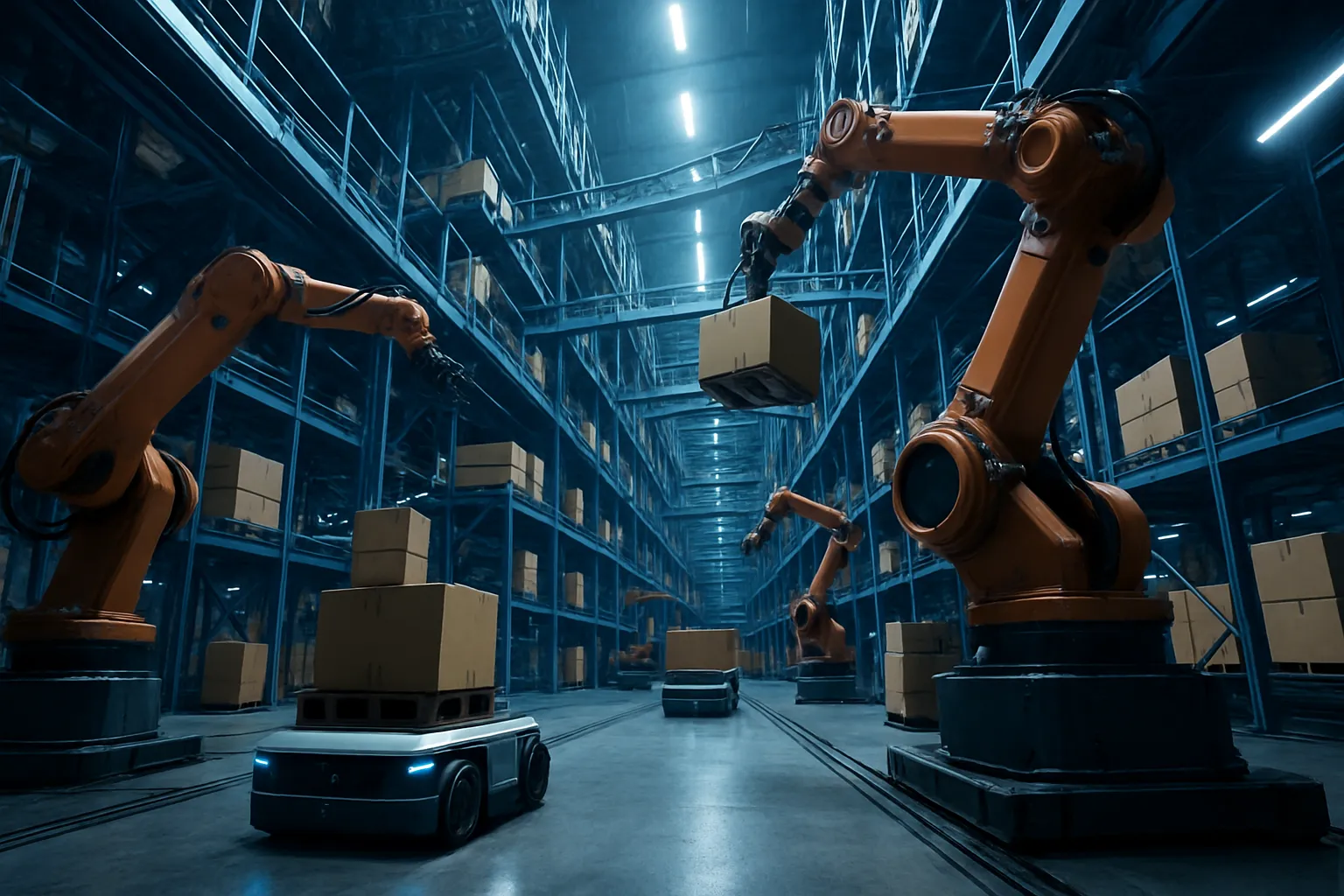
Symbotic's approach inverts this model. Its end-to-end, AI-powered robotic and software platform treats the entire distribution center as a single orchestrated system. Autonomous robots handle inbound receiving, storage, case picking, and outbound palletization under unified AI coordination. The software doesn't just control robots—it continuously optimizes product placement, travel paths, and sequencing across the full facility in real time.
This distinction matters because the differentiator in 2026 warehouse automation is orchestration, not the robot itself. Logistics Viewpoints noted in their 2026 outlook that companies learned AMRs are not plug-and-play—they require disciplined operational design and ongoing tuning. The value has migrated from hardware to the intelligence layer that coordinates it.
A $34 Billion Market Demanding Intelligence
The scale of investment underscores why orchestration platforms attract attention. According to Mordor Intelligence, the global warehouse automation market reached $34.17 billion in 2026 and is projected to hit $65.74 billion by 2031, growing at a 13.98% CAGR. North America leads adoption, driven by e-commerce compression, labor shortages pushing a 3.1% impact on CAGR, and the rapid ROI from plug-and-play AMR and AGV fleets adding another 2.5%.
But raw market growth masks a critical evolution. The AGV swarm-management software market alone—valued at $500 million in 2026—is projected to reach $3.4 billion by 2036. This ten-fold growth in orchestration software dramatically outpaces hardware growth, confirming that the intelligence layer is where value concentrates.
Symbotic's Customer Scale Tells the Story
Symbotic's financial performance reflects the demand for full-system approaches. In Q1 fiscal 2026, the company reported systems revenue of $590 million, driven overwhelmingly by its anchor customer Walmart. The partnership expanded significantly when Symbotic acquired Walmart's Advanced Systems and Robotics business in January 2025 and signed a commercial agreement to develop, build, and deploy automation across more than 400 Accelerated Pickup and Delivery (APD) centers.
Beyond Walmart, Symbotic operates its GreenBox joint venture with SoftBank to deploy systems for Albertsons and other retailers. The company's fiscal 2024 revenue grew nearly 52% year-over-year, with significant remaining performance obligations tied to multi-site projects expected to be recognized over the next one to five years.
These aren't pilot programs. They represent enterprise-wide commitments to AI-orchestrated distribution at a scale that redefines what "automated warehouse" means.
Orchestration vs. Point Solutions: The Architecture Gap
Understanding why full-system orchestration outperforms point solutions requires examining three architectural differences:
1. Unified Decision-Making. Point solutions optimize locally—a sorter maximizes its throughput, an AMR optimizes its travel path. But local optimization often creates system-level bottlenecks. An AI orchestration layer optimizes globally, balancing inbound receiving speed against storage density against outbound sequencing requirements simultaneously.
2. Dynamic Adaptation. Traditional automation is configured for steady-state operations. When SKU mix shifts seasonally, or order profiles change during promotions, reconfiguration takes weeks. Orchestrated systems adapt continuously, re-optimizing product placement and robot assignments based on real-time demand signals.
3. Scalable Complexity Management. As facilities add more robots, conveyors, and automation zones, coordination complexity grows exponentially. Human-managed integration breaks down at scale. AI orchestration handles hundreds of simultaneous robot movements, storage decisions, and picking sequences without linear increases in management overhead.
The Competitive Landscape Sharpens
Symbotic doesn't operate in isolation. AutoStore reported improving second-half results in 2025 after early-year caution, with its cubic storage grid approach gaining traction in smaller-footprint facilities. Ocado Intelligent Automation continues deploying its grid-based robotic fulfillment system, with robots navigating and fetching items from bins stacked up to 21 units high—orchestrated by its own Warehouse Execution Software.
Each competitor brings a different philosophy. AutoStore excels at storage density in constrained spaces. Ocado dominates grocery fulfillment with temperature-controlled automation. Symbotic's strength lies in case-level handling at distribution center scale—the high-volume, mixed-SKU environments where major retailers operate.
The convergence point is clear: every major player now competes on software orchestration quality, not hardware novelty. The robots are table stakes. The AI that coordinates them determines throughput, accuracy, and adaptability.
What This Means for Shippers and Supply Chain Leaders
For logistics professionals evaluating automation investments, Symbotic's recognition highlights several strategic considerations:
- Evaluate orchestration depth, not robot count. Ask automation vendors how their software coordinates across warehouse zones, not just how fast individual robots move.
- Demand integration transparency. Full-system platforms should expose APIs for WMS, TMS, and ERP connectivity. Isolated automation creates new data silos.
- Plan for multi-year deployment timelines. Enterprise-scale orchestration systems aren't installed in quarters—they're deployed over years. Budget and organizational readiness must match.
- Consider the Robotics-as-a-Service model. Mordor Intelligence identifies RaaS as contributing 1.9% to CAGR growth, specifically helping mid-tier operators overcome capital expenditure barriers.
How CXTMS Connects to Automated Distribution
As warehouse orchestration systems transform distribution center operations, the integration between warehouse execution and transportation management becomes critical. CXTMS provides the API-first connectivity that automated facilities need—linking outbound shipment data from orchestrated warehouses directly to carrier selection, rate optimization, and shipment execution.
When an AI-orchestrated facility like Symbotic's completes a palletized outbound order, CXTMS can instantly match it to optimal carrier capacity, ensuring the efficiency gains inside the warehouse extend through the final mile of delivery.
Ready to connect your automated distribution operations with intelligent transportation management? Request a CXTMS demo today and see how our platform bridges the gap between warehouse automation and freight optimization.