ATRI's 2026 Top Truck Bottleneck Report: How Chicago's I-294 Interchange Dethroned Fort Lee and What It Means for Freight Planning

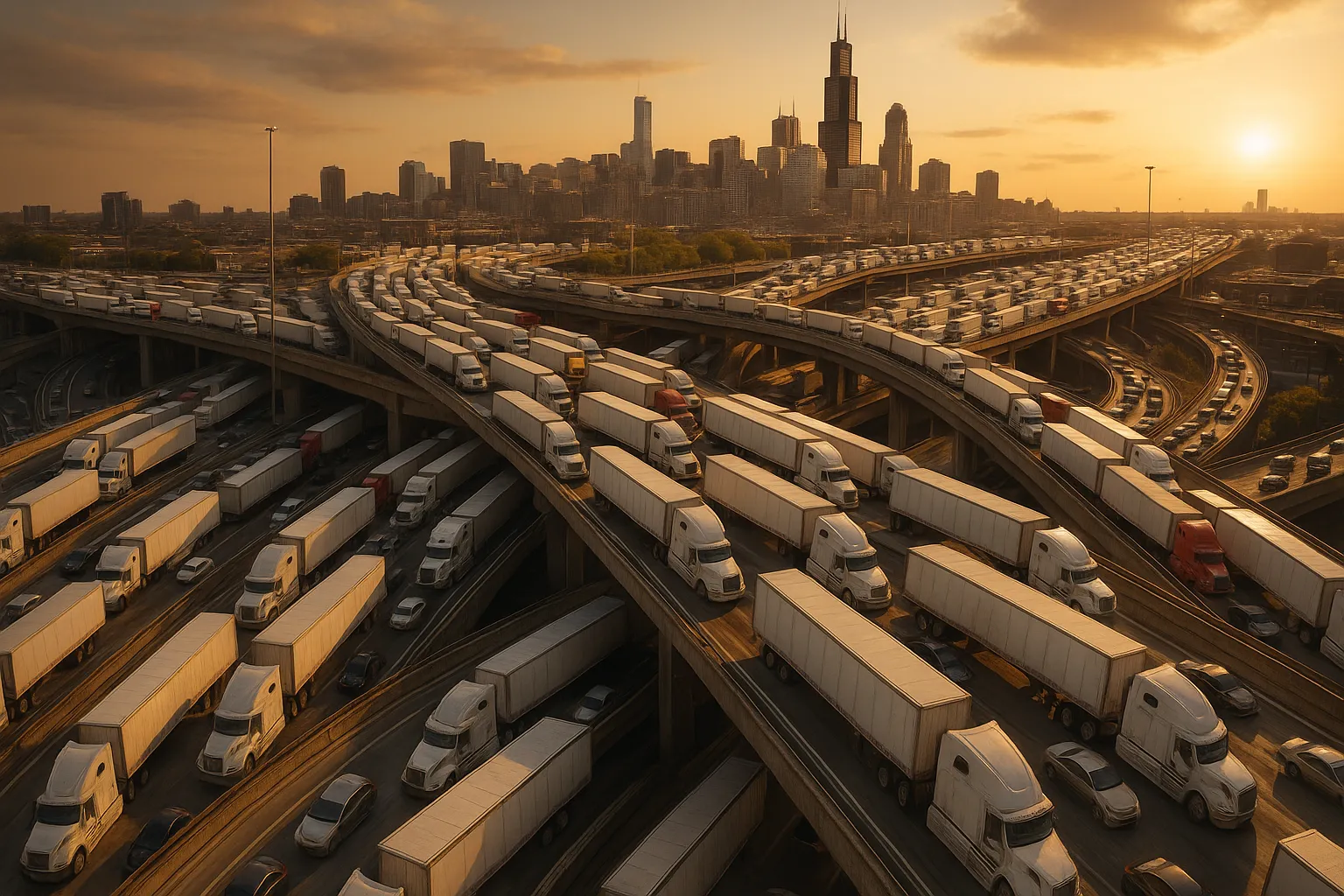
For the first time in the history of the American Transportation Research Institute's annual bottleneck study, a Chicago interchange has claimed the number one spot. The I-294 at I-290/I-88 interchange on the west side of Chicago is now officially America's worst freight bottleneck — ending Fort Lee, New Jersey's long reign at the top.
ATRI's 15th annual report, released in February 2026, analyzes truck GPS data across more than 325 locations on the national highway system. The findings paint a sobering picture: traffic conditions continue to deteriorate nationwide, and the costs are staggering.
Chicago's I-294: The New King of Congestion
The I-294/I-290/I-88 interchange handles more than 300,000 vehicles per day, and it's currently in year six of a massive $800 million reconstruction project managed by the Illinois Tollway. That reconstruction, while essential for long-term relief, is a major contributor to current delays. Completion isn't expected until the end of 2027.
During rush hours, truck speeds at this interchange average just 39.5 mph — a figure that doesn't sound catastrophic until you consider the cascading delays it triggers across the broader Chicago freight corridor, one of North America's most critical logistics hubs.
The Full 2026 Top 10
ATRI's complete top 10 reveals clear regional congestion patterns:
| Rank | Location | City/State | Avg. Speed (mph) |
|---|---|---|---|
| 1 | I-294 at I-290/I-88 | Chicago, IL | 39.5 |
| 2 | I-95 at SR 4 | Fort Lee, NJ | 28.2 |
| 3 | I-285 at I-85 (North) | Atlanta, GA | 35.0 |
| 4 | I-45 at I-69/US 59 | Houston, TX | 29.2 |
| 5 | I-75 at I-285 (North) | Atlanta, GA | 39.1 |
| 6 | I-20 at I-285 (West) | Atlanta, GA | 40.4 |
| 7 | I-24/I-40 at I-440 (East) | Nashville, TN | 36.8 |
| 8 | I-10 at I-69/US 59 | Houston, TX | 34.3 |
| 9 | I-71 at I-75 | Cincinnati, OH | 42.5 |
| 10 | I-75 | McDonough, GA | 46.2 |
Atlanta dominates the list with four of the top 10 spots — a troubling concentration for any shipper routing freight through the Southeast. Houston claims two spots, reinforcing that Gulf Coast freight corridors remain under heavy strain.
The $109 Billion Problem
According to ATRI and ATA President Chris Spear, traffic congestion adds an estimated $109 billion annually to the cost of goods paid by American consumers. ATRI's separate Cost of Congestion study pegged the direct cost to the trucking industry at $108.8 billion — equivalent to 436,000 truck drivers sitting idle for an entire year.
For shippers, these costs manifest as:
- Higher per-mile rates as carriers factor congestion delays into pricing
- Missed delivery windows that trigger detention fees and customer penalties
- Increased fuel burn from stop-and-go traffic through bottleneck zones
- Driver dissatisfaction that worsens an already tight labor market
The numbers are getting worse, not better. Average rush hour truck speeds across all monitored locations fell to 33.2 mph in 2025 — a 2.8% decline from the prior year. Among the top 10 bottlenecks, speeds averaged just 29.6 mph.
There Is Hope: Infrastructure Investment Works
The report isn't all bad news. ATRI's data demonstrates that targeted infrastructure investment delivers real results.
The George Washington Bridge corridor between New York and New Jersey — which held the top bottleneck title for years — has seen meaningful improvement thanks to a $2 billion rehabilitation project. Similarly, Chicago's own Jane Byrne Interchange, once the nation's worst bottleneck, no longer ranks in the top 25 after sustained capacity expansion efforts.
"This success provides a roadmap for policymakers to invest in projects that will improve efficiency throughout our transportation system," Spear noted.
What Shippers Can Do Right Now
While infrastructure improvements take years to complete, shippers don't have to accept congestion as a cost of doing business. Here's how forward-thinking logistics teams are responding:
1. Route intelligence over static planning. Stop relying on the same lanes year after year. Use real-time and historical congestion data to identify alternative corridors that avoid known bottleneck zones.
2. Time-of-day optimization. ATRI's data is based on rush-hour performance. Shifting pickup and delivery windows by even two hours can dramatically reduce exposure to peak congestion at these interchanges.
3. Carrier selection with congestion awareness. Carriers that know how to navigate bottleneck regions — with experienced drivers and flexible routing — deliver more consistent transit times. Evaluate carrier performance by lane, not just overall on-time percentage.
4. Multi-stop consolidation. For LTL and multi-stop truckload shipments through congested corridors like Atlanta or Houston, smart load consolidation can reduce the total number of trips through bottleneck zones.
How CXTMS Helps You Navigate the Noise
CXTMS was built for exactly this kind of challenge. Our TMS platform integrates real-time traffic intelligence with historical performance data to help shippers:
- Optimize routing around known bottlenecks using dynamic lane scoring
- Benchmark carrier performance at congested interchange locations
- Model transit time variability so you can set realistic delivery commitments
- Automate rate adjustments that account for congestion-driven cost increases
When 436,000 drivers' worth of productivity is being lost to gridlock every year, the shippers who win are the ones who plan around it — not through it.
Ready to route smarter? Request a CXTMS demo and see how intelligent freight planning helps you avoid the nation's worst bottlenecks — before they eat into your margins.