AI-Powered Freight Audit: How Machine Learning Is Catching Billing Errors Humans Miss


The freight billing error epidemic is costing shippers billions. According to industry data, up to 80% of carrier invoices contain some form of discrepancy, with 15-20% involving outright overcharges. For companies processing thousands of invoices monthly, that's a staggering amount of revenue leaking through the cracks — and manual audit teams simply can't keep up.
The Scale of Freight Billing Errors
Freight billing is one of the most error-prone processes in logistics. Between incorrect accessorial charges, misapplied fuel surcharges, duplicate invoices, and contract rate deviations, the typical shipper overpays by 3-8% on total freight spend before anyone notices.
For a mid-size shipper spending $10 million annually on freight, that's $300,000 to $800,000 in recoverable overcharges — every year. Multiply that across the industry, and the freight sector loses an estimated $700 million annually to invoicing errors alone.
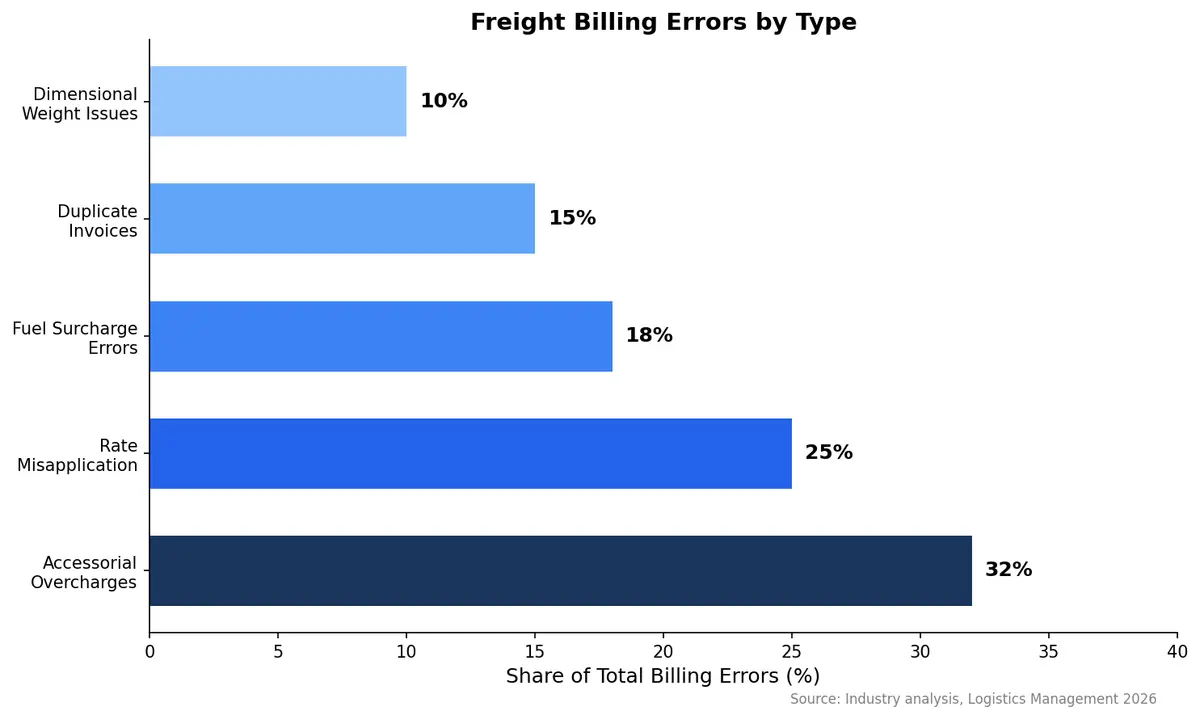
The problem isn't that shippers don't care. It's that traditional manual audit processes catch only the obvious errors. A human auditor reviewing hundreds of invoices daily will spot a glaring duplicate charge, but subtle rate misapplications, incorrect weight breaks, and bundled accessorial fees slip through undetected.
How AI Catches What Humans Miss
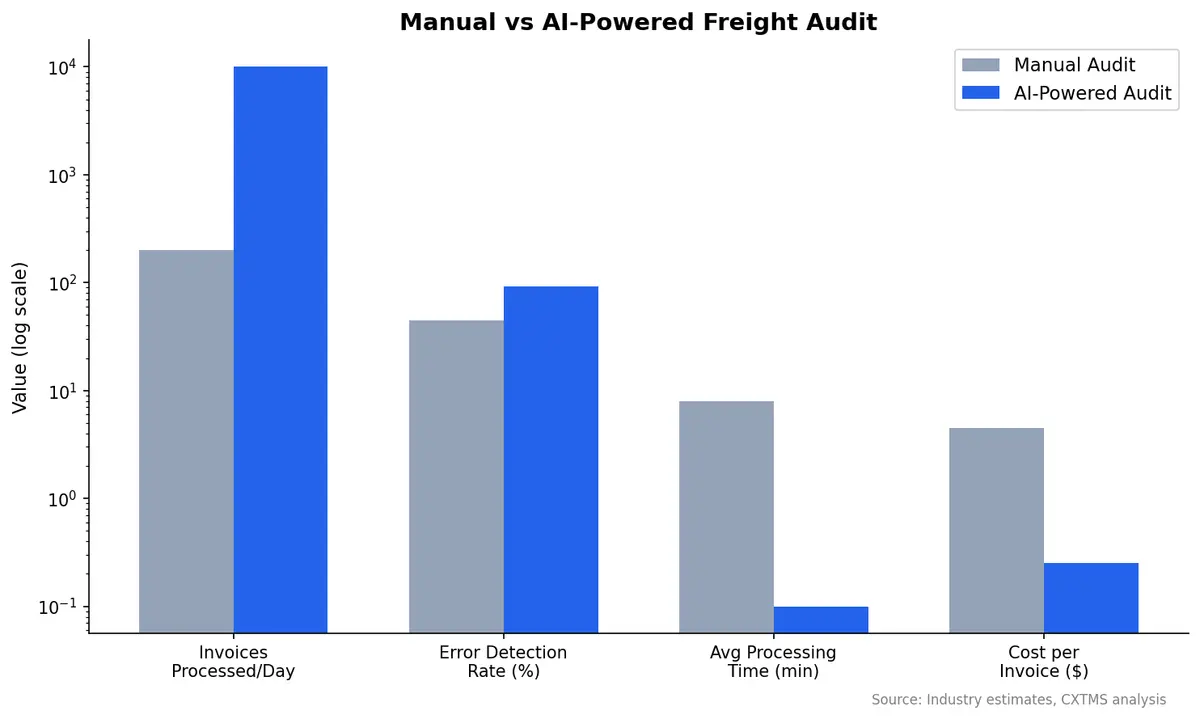
Machine learning brings three capabilities to freight audit that manual processes fundamentally lack: pattern recognition at scale, anomaly detection across historical data, and continuous learning from every invoice processed.
Pattern recognition allows AI systems to compare each invoice line item against contracted rates, historical pricing, and industry benchmarks simultaneously. Where a human auditor checks one variable at a time, ML models evaluate dozens of data points per line item in milliseconds.
Anomaly detection identifies statistical outliers that wouldn't trigger manual review thresholds. A fuel surcharge that's 0.5% above the contracted rate on a single invoice is easy to miss. But when ML detects that same carrier has applied that same micro-overcharge across 200 invoices, the pattern — and the savings — become clear.
Continuous learning means the system improves with every audit cycle. As Logistics Management reports, leading freight payment providers are training AI to be "a great freight auditor" that surfaces errors faster than manual processes ever could.
Five Error Types ML Excels at Catching
1. Duplicate Invoices
Carriers occasionally submit the same shipment twice with slightly different reference numbers. ML models cross-reference shipment details — origin, destination, weight, date, PO numbers — to flag probable duplicates that simple invoice-number matching would miss.
2. Rate Misapplication
Contract rates often include complex tier structures, volume discounts, and lane-specific pricing. ML validates every charge against the full rate agreement, catching misapplied weight breaks and incorrect service-level billing that human auditors frequently overlook.
3. Unauthorized Accessorials
Detention charges, liftgate fees, residential delivery surcharges — accessorials are where billing errors hide. AI models learn which accessorials are legitimate for each lane and flag unusual charges for review.
4. Fuel Surcharge Discrepancies
Fuel surcharges should align with published indices on specific dates. ML automates the cross-reference between invoice dates, applicable fuel indices, and contracted surcharge tables — a tedious manual task that's ripe for automation.
5. Dimensional Weight Gaming
Carriers may apply dimensional weight calculations inconsistently. ML models compare declared dimensions against historical shipment profiles and flag statistical anomalies that suggest measurement errors or deliberate inflation.
The ROI of AI-Powered Freight Audit
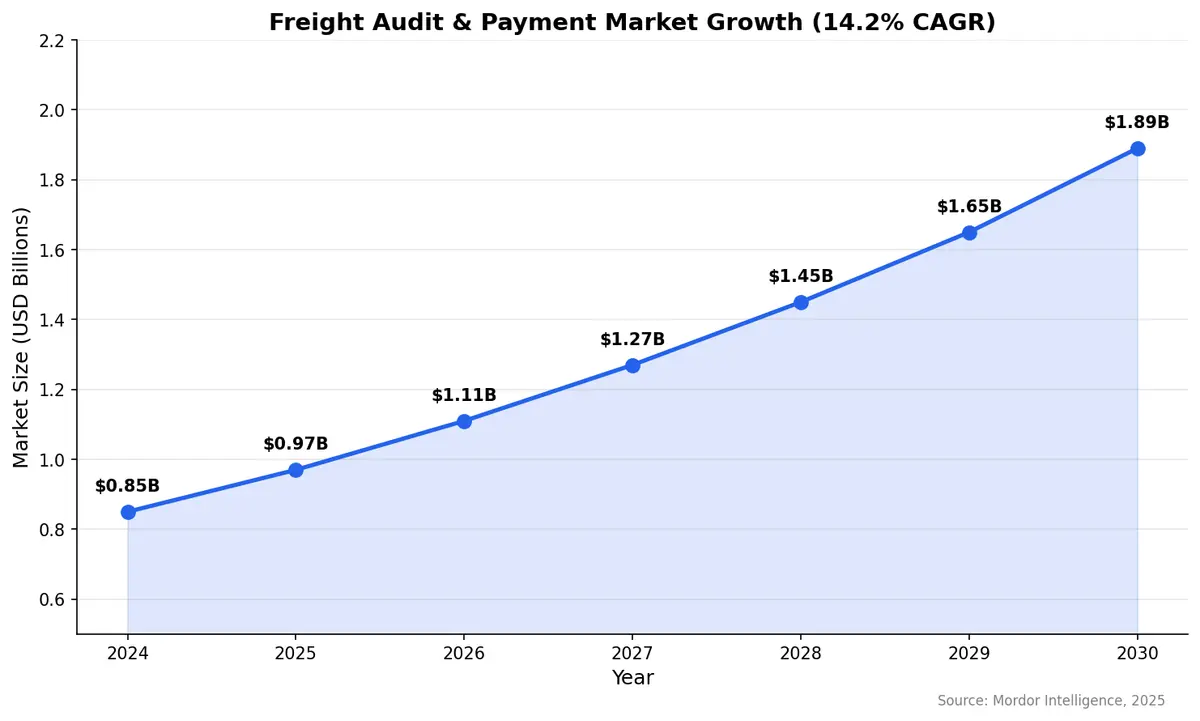
The freight audit and payment market is growing rapidly — valued at approximately $970 million in 2025 and projected to reach $1.89 billion by 2030 at a 14.2% CAGR, according to Mordor Intelligence. That growth reflects the clear ROI shippers are seeing from automated audit solutions.
Companies implementing AI-powered freight audit typically see:
- Recovery rates of 3-8% of total freight spend in the first year
- 90%+ reduction in manual audit time
- Faster dispute resolution with carrier-ready documentation
- Continuous improvement as models learn from each billing cycle
The math is straightforward. If your organization spends $5 million or more on freight annually, AI-powered audit pays for itself within months — often recovering multiples of the implementation cost in the first year alone.
Implementation: The Human-AI Partnership
Despite the technology's capabilities, the most effective freight audit programs combine AI with human expertise. As industry veteran Mike Regan of TranzAct notes, "30% of AI is driven by prompts and another 30% relies on the human element. Technology and AI are great, but so is experience and expertise."
The optimal implementation roadmap looks like this:
- Data integration — Connect carrier invoices, rate agreements, and shipment records into a unified platform
- Baseline audit — Run AI models against historical data to identify existing error patterns and quantify recovery potential
- Automated screening — Deploy ML models for real-time invoice validation before payment approval
- Exception management — Route flagged invoices to human auditors for complex disputes
- Continuous optimization — Feed audit outcomes back into models to improve detection accuracy
This isn't about replacing auditors — it's about amplifying their effectiveness. AI handles the volume; humans handle the judgment calls.
What to Look For in an AI Audit Solution
Not all AI-powered audit tools are created equal. When evaluating solutions, prioritize:
- Rate agreement ingestion — Can the system parse and apply your full contract terms automatically?
- Multi-modal coverage — Does it audit across parcel, LTL, FTL, ocean, and air freight?
- Carrier integration — How does it handle dispute workflows and credit recovery?
- Transparency — Can you see why the AI flagged a specific charge, or is it a black box?
- Scalability — Will it handle your invoice volume without degrading accuracy?
How CXTMS Approaches Freight Audit Intelligence
CXTMS integrates automated invoice reconciliation directly into its transportation management platform. By connecting rate agreements, shipment execution data, and carrier invoices in a single system, CXTMS enables real-time billing validation that catches discrepancies before payment — not months after.
The platform's approach ensures that every invoice is checked against contracted rates, historical patterns, and industry benchmarks, giving logistics teams the confidence that they're paying only what they owe.
Losing money to freight billing errors you can't see? Contact CXTMS for a demo of our integrated freight audit capabilities.