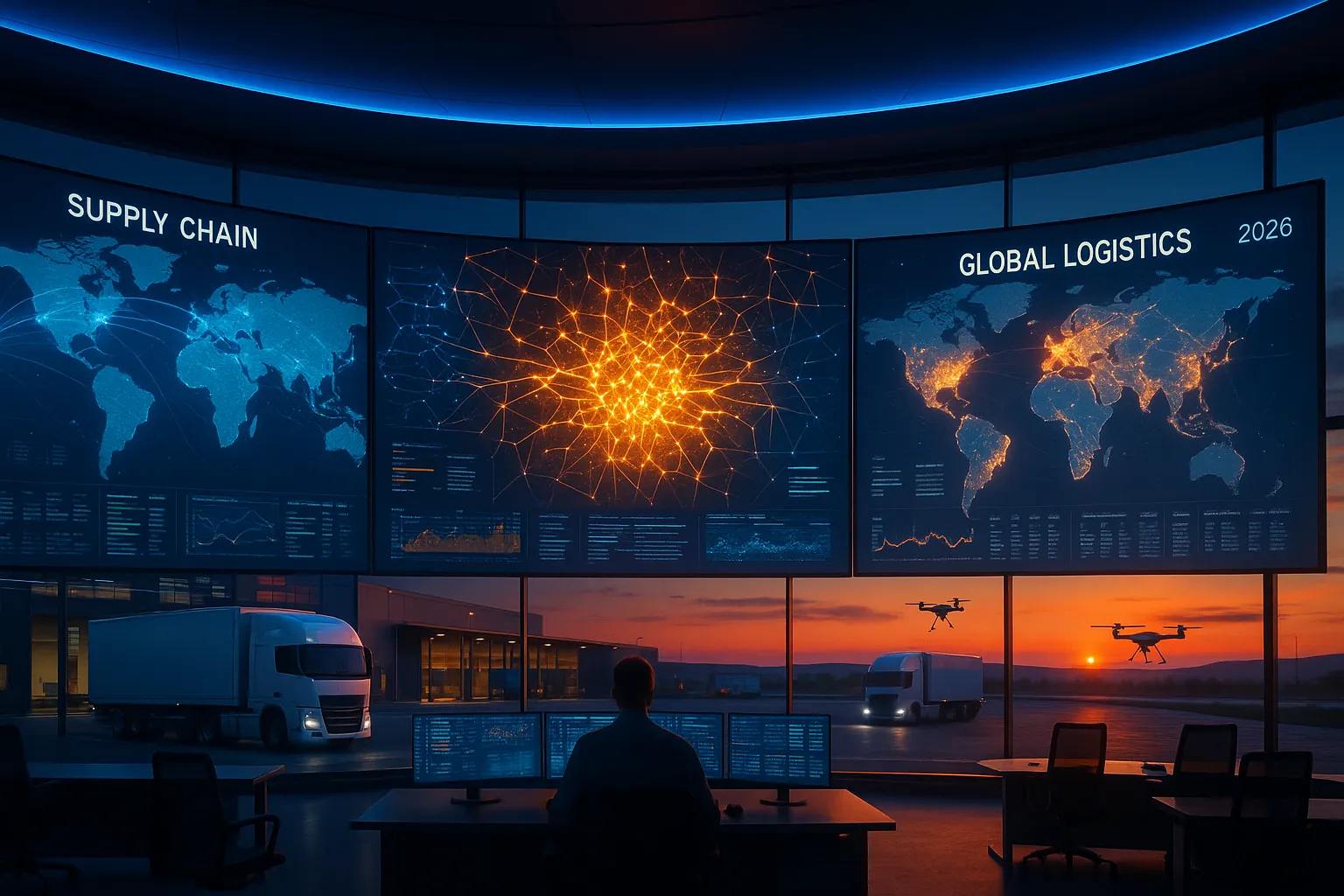
AI Freight Scaling Tools Are Disrupting Logistics Stocks — What Shippers Need to Know


On February 12, 2026, a micro-cap company called Algorhythm Holdings sent shockwaves through the logistics industry. Its SemiCab platform — claiming to scale freight volumes 300–400% without adding headcount — triggered a massive selloff across trucking and logistics stocks. C.H. Robinson dropped 14.5%. RXO plunged 20.5%. The Russell 3000 Trucking Index slid 6.6% in a single session.
For shippers watching from the sidelines, the question isn't whether AI will change freight. It already is. The question is what to do about it right now.
What Actually Happened
Algorhythm Holdings, a former maker of in-car karaoke systems that pivoted to AI freight logistics, announced that its SemiCab platform was delivering dramatic results for live customers. The company claimed its technology reduces empty freight miles by more than 70% across active customer networks — a staggering figure in an industry where trucks drive empty nearly one out of every three miles, representing more than $1 trillion in wasted freight spending annually according to Mordor Intelligence.
The selloff wasn't just about one company. It was the latest chapter in a broader "AI fear trade" that had already hammered software stocks and real estate companies earlier in February. Investors are increasingly asking: which traditional industries can't keep pace with AI advancement?
The Open-Source Wildcard: Molt Bot and AI Freight Agents
Beyond SemiCab's proprietary platform, analysts flagged something potentially more disruptive — open-source AI freight agents. Baird analyst Daniel Moore highlighted an "emerging debate around open-source automation agents such as Molt Bot that offer increased potential to automate routine back-office tasks and help equalize the technology playing field for smaller operators."
This is the part that should grab every shipper's attention. Open-source tools don't just threaten large brokerages — they democratize capabilities that were previously locked behind enterprise-grade software. A mid-size shipper or small brokerage could theoretically deploy AI agents to handle load matching, rate negotiation, and carrier communication at a fraction of what legacy platforms cost.
Former Gartner analyst Bart De Muynck, now an independent consultant, confirmed the trend at the operational level: freight brokerages with "rows and rows of people on the phone" are now seriously evaluating which processes AI can replace. The question isn't theoretical anymore — it's budgetary.
Reality Check: What AI Can and Can't Automate
Before anyone starts restructuring their logistics department, some perspective is warranted. Baird's Daniel Moore reiterated his outperform ratings on C.H. Robinson and Expeditors after the selloff, noting that "automation is not a new theme."
He's right. Here's what AI handles well today:
- Load matching and optimization — Algorithms can process thousands of variables to find optimal carrier-load pairings faster than any human team.
- Back-office documentation — Bills of lading, invoices, customs paperwork — repetitive document processing is a natural AI fit.
- Rate benchmarking — AI can analyze historical rate data and market conditions to recommend pricing in real time.
- Empty mile reduction — Network optimization across multiple shippers and carriers (what SemiCab claims to do).
And what still requires human judgment:
- Exception management — When shipments go sideways, human relationships and creative problem-solving still matter.
- Strategic carrier relationships — Long-term partnerships built on trust and negotiation can't be reduced to an algorithm.
- Complex regulatory compliance — International freight involves nuanced compliance decisions that change constantly across jurisdictions.
- Customer-specific requirements — Every shipper has unique needs that require contextual understanding beyond pattern matching.
Why Smart Shippers Are Leaning In, Not Running Away
The stock market reaction was driven by fear of disruption. But for actual shippers — companies that move goods every day — the AI freight revolution is an opportunity, not a threat.
Consider the math: if AI tools can genuinely reduce empty miles by even 30% (let alone 70%), the cost savings cascade through the entire supply chain. Fewer empty miles mean lower carrier costs, reduced fuel consumption, fewer trucks on the road, and faster capacity availability.
The shippers who benefit most won't be the ones waiting to see what happens. They'll be the ones integrating AI-powered tools into their existing workflows now — using technology to enhance their teams rather than replace them.
This is particularly relevant as the logistics industry heads into what many analysts see as a critical technology adoption year. The companies that emerge stronger from this transition will be those that treated AI as a force multiplier for their human expertise.
How to Respond: A Shipper's Playbook
1. Audit your automation readiness. Map your freight operations and identify which processes are truly repetitive and rules-based versus which require judgment. Start automating the former immediately.
2. Don't over-index on one vendor's claims. A $6 million market-cap company claiming 400% volume scaling should be evaluated with healthy skepticism. Look for platforms with verifiable track records and transparent metrics.
3. Invest in integration, not replacement. The best TMS platforms today connect AI capabilities with human oversight. You want a system that automates routine decisions while escalating exceptions to experienced logistics professionals.
4. Watch the open-source space. Tools like Molt Bot may not be enterprise-ready today, but the pace of open-source AI development is accelerating. Having a technology team (or TMS partner) that can evaluate and integrate these tools gives you a strategic edge.
5. Focus on data quality. Every AI tool is only as good as the data it consumes. Clean, structured logistics data — shipment histories, carrier performance, rate trends — is the foundation that makes AI automation possible.
The Bottom Line
The February 2026 logistics stock selloff was a market overreaction to a real trend. AI won't eliminate freight brokerage or make human logistics expertise obsolete overnight. But it will fundamentally change which tasks require human attention and which can be handled by machines.
Shippers who embrace this shift — using intelligent platforms that combine AI automation with human judgment — will move more freight, at lower cost, with fewer headaches. Those who ignore it risk paying a premium for inefficiency.
Ready to integrate AI-powered freight management without losing human oversight? Contact CXTMS for a demo of our intelligent logistics platform.