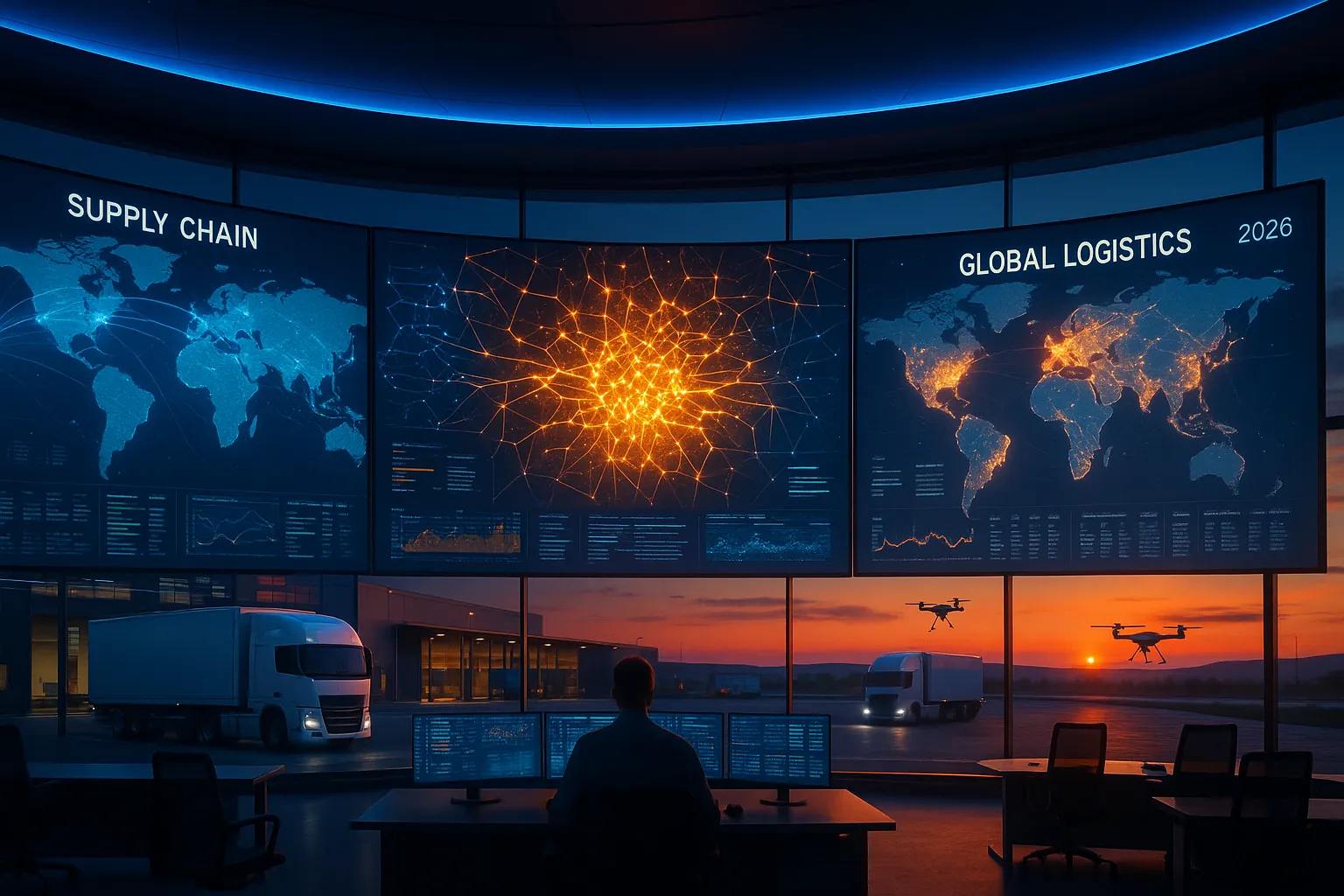
Self-Healing Supply Chains: How AI Agents Are Autonomously Rerouting Shipments and Renegotiating Rates in 2026


The logistics industry has always been reactive. A port closure hits, emails fly, phone calls stack up, and teams scramble to reroute shipments manually. By the time the dust settles, costs have ballooned and delivery windows have slipped. In 2026, that paradigm is finally breaking — not because humans got faster, but because AI agents are making decisions before humans even know there's a problem.
What "Self-Healing" Actually Means
A self-healing supply chain isn't science fiction. It's a network where AI agents continuously monitor conditions — weather patterns, port congestion, carrier capacity, geopolitical risk — and autonomously act when disruptions emerge. No waiting for approvals. No escalation chains. The system detects, decides, and executes.
According to Gartner, by 2030, 50% of cross-functional supply chain management solutions will use intelligent agents to autonomously execute decisions across the ecosystem. The groundwork is being laid right now, in 2026, as early adopters move from pilot programs to production deployments.
The shift is fundamental. Industry analysts describe it as the evolution from "Control Towers" — systems that provide visibility — to "Action Towers" that provide autonomy. You can see the disruption coming, but now the system also fixes it.
Real-World Capabilities Already in Production
AI agents in logistics are no longer theoretical. As reported by Supply Chain Brain, agents are already performing shipping tasks like delivering price quotes, processing orders, setting appointments, and securing tracking updates — executing increasingly complex actions across the full shipment lifecycle.
The numbers are striking: AI agents can process 20 orders simultaneously in the same 90 seconds it takes a human to handle one. They're securing more favorable rates and carrier slots because they operate in seconds instead of hours, and they never sleep. A shipper's needs get the same attention at 1 AM as at 1 PM.
Here's what autonomous rerouting looks like in practice:
- Port closure detected → AI agent identifies alternative ports, recalculates transit times, books new carrier capacity, and updates all stakeholders — within minutes
- Carrier rate spike → Agent compares real-time spot rates across carriers, renegotiates contract terms, and shifts volume to the most cost-effective option
- Demand surge → Agent triggers dynamic inventory rebalancing across distribution centers based on predictive demand models
An IBM study found that 57% of supply chain executives expect agentic AI to make proactive recommendations based on learned patterns by the end of 2026, while 62% expect AI agents will make automation and workflow reinvention more effective across their operations.
The Data Foundation That Makes It Work
Self-healing supply chains don't run on hype — they run on data. The biggest obstacle for organizations experimenting with agentic AI isn't the technology itself but having the breadth and depth of freight data to properly train logistics-specific models.
Every shipment is different. Lane dynamics change seasonally. Carrier performance varies by region, commodity, and time of day. An AI agent needs domain expertise built from millions of data points to reason accurately about logistics decisions. Generic AI models won't cut it — you need purpose-built freight intelligence.
This is where many organizations stumble. SAP's 2026 supply chain resilience blueprint emphasizes that companies are deepening investments in agentic AI specifically to support end-to-end value streams — integrated business planning, sales order management, and predictive maintenance — rather than bolting AI onto disconnected systems.
Why Most Companies Aren't There Yet
Despite the promise, Gartner also projects that more than 40% of agentic AI projects will be canceled by the end of 2027 due to escalating costs, unclear business value, or inadequate risk controls. The gap between pilot and production remains wide.
The common failure points:
- Siloed data — AI agents can't reroute what they can't see. Without unified visibility across carriers, modes, and partners, autonomous decisions are impossible
- Trust deficit — Operations teams hesitate to let algorithms make high-stakes routing and rate decisions without human oversight
- Integration complexity — Legacy TMS platforms weren't designed for real-time agent-to-agent communication
Organizations achieving double-digit efficiency gains with agentic AI share a common trait: they invested in data governance and process standardization first, then layered intelligent automation on top of a clean foundation.
Building Your Self-Healing Supply Chain
The path from reactive to autonomous isn't a single leap. It's a progression:
Phase 1: Unified Visibility — Connect all carriers, modes, and partners into a single platform. You can't heal what you can't see.
Phase 2: Predictive Intelligence — Layer AI-driven analytics to forecast disruptions before they occur. Weather, port congestion, carrier performance — build the early warning system.
Phase 3: Automated Response — Define rules and thresholds for autonomous action. Start with low-risk decisions (appointment rescheduling, document updates) and expand as trust builds.
Phase 4: Full Autonomy — AI agents manage the exception, not the rule. Humans focus on strategy and relationship management while agents handle execution.
How CXTMS Enables the Agentic Future
Self-healing supply chains require a platform that was built for integration, not bolted together from acquisitions. CXTMS provides the unified visibility layer that agentic workflows demand — real-time carrier connectivity, multi-modal rate management, and automated decision-making across the entire shipment lifecycle.
When your data lives in one place and your workflows are already automated, adding autonomous AI agents becomes an enhancement rather than a transformation. The foundation matters more than the AI.
Ready to build a supply chain that heals itself? Contact CXTMS for a demo and see how unified logistics visibility enables the next generation of autonomous freight management.