AI-Powered Freight Market Cycle Prediction: How Machine Learning Models Are Calling Capacity Turns Before Traditional Indicators

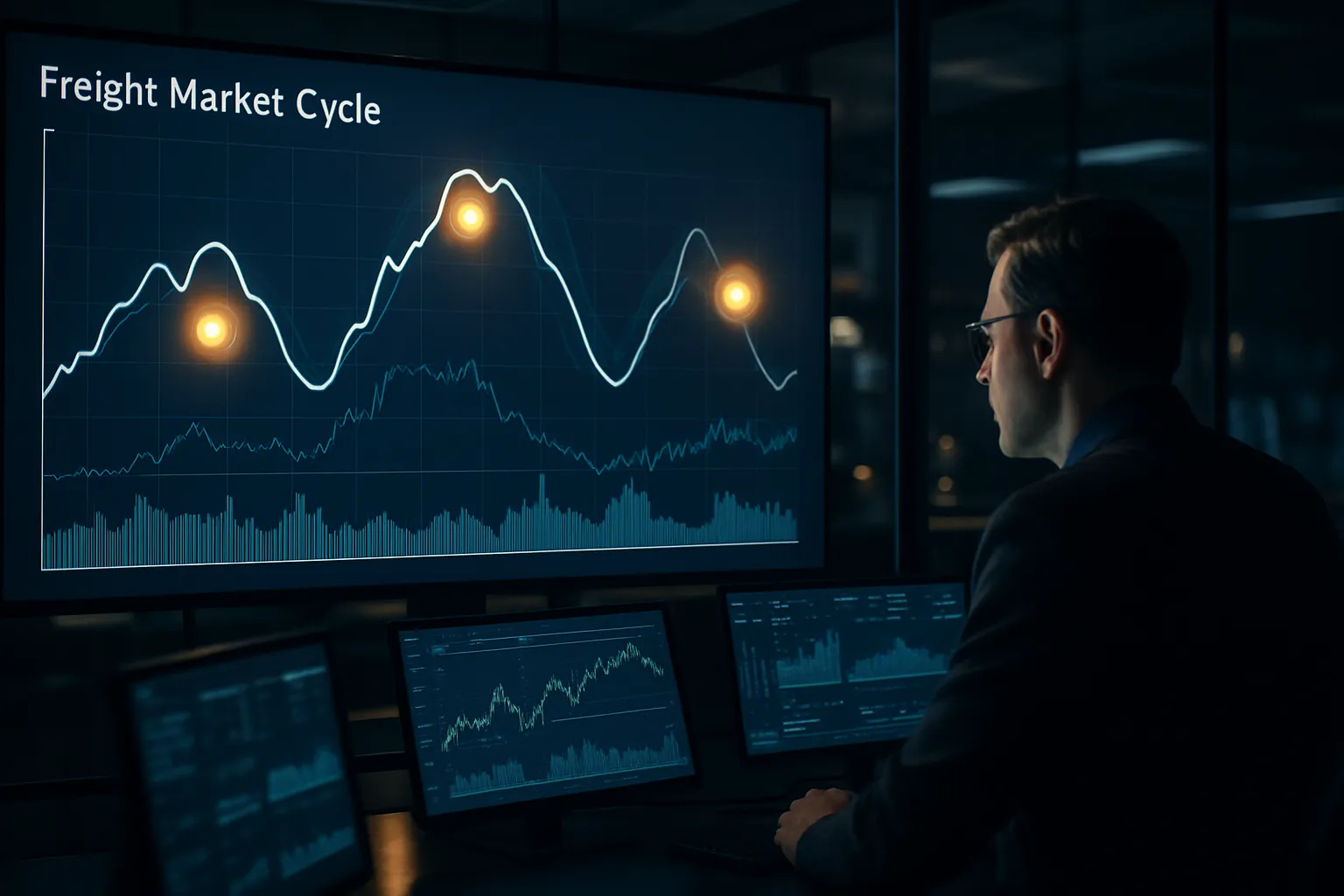
The freight market has always moved in cycles. Boom follows bust, carriers flood in during good times, and they quietly exit when margins evaporate. The problem has never been understanding that cycles exist — it's knowing when the turn is coming. In 2026, AI-powered prediction models are fundamentally changing how the industry reads that signal, calling capacity inflection points weeks or even months before traditional indicators catch up.
According to McKinsey, AI-based forecasting reduces errors by 20–50% compared to traditional methods across supply chain applications. In freight market cycle prediction specifically, machine learning models are now consuming hundreds of non-traditional data signals to identify turning points that legacy indicators like the Logistics Managers' Index (LMI), DAT spot rate averages, and Class 8 truck orders consistently miss — by 60 to 90 days.
Why Traditional Freight Cycle Indicators Always Lag
The freight industry has relied on a familiar set of metrics to gauge market direction: spot rate indexes, tender rejection rates, carrier authority filings, and Class 8 truck orders. These are useful, but they share a fundamental flaw — they measure what has already happened, not what is about to.
Consider the current market environment. FreightWaves reported in March 2026 that spot rates on the SONAR National Truckload Index climbed from around $2.60 per mile in mid-January to nearly $2.82 by February — a meaningful 20-cent jump. Tender rejection rates are creeping toward 14%, levels not seen consistently since the post-COVID unwind in 2022. Over 6,400 carrier authorities were revoked in December 2025 alone.
These numbers tell us the market has tightened. But by the time traditional indicators confirmed the shift, the shippers and carriers who moved early had already locked in favorable contract terms and capacity commitments. The window for strategic action was weeks — sometimes months — before the headline data caught up.
That's the gap AI is designed to close.
The Leading Indicator Stack: What AI Models See That Humans Miss
Machine learning models trained on freight market data don't just look at loads and trucks. They consume a vastly broader set of signals that serve as leading indicators of freight demand and capacity shifts:
- Consumer spending patterns: Credit card transaction data, retail foot traffic, and e-commerce order volumes signal demand changes 4–6 weeks before freight volumes respond.
- Building permits and housing starts: Construction freight is a significant truckload category. Permit data predicts volume shifts months before the first load moves.
- Port booking and container dwell data: Import volumes telegraph domestic freight demand 3–5 weeks ahead of inland distribution.
- Carrier financial filings and insurance lapses: Insurance premium nonpayment and FMCSA authority revocations predict capacity exits before they hit aggregate indexes.
- Fuel card transaction volumes: A real-time proxy for active truck utilization across the fleet.
- Employment and wage data: Driver wage trends and CDL application volumes signal future capacity availability.
The AI in supply chain market is projected to surge from $7.3 billion in 2024 to $63.8 billion by 2030 at a 42.7% compound annual growth rate, according to Strategic Market Research — and freight cycle prediction is one of the fastest-growing application areas within that expansion.
Machine Learning Architectures Powering Cycle Prediction
Not all AI approaches are created equal when it comes to predicting freight market turns. The most effective models combine multiple architectural approaches:
Long Short-Term Memory (LSTM) Networks excel at capturing the sequential dependencies in freight market data. These recurrent neural networks can identify patterns across multiple freight cycles — recognizing, for example, that a specific combination of carrier exit velocity, fuel price trajectory, and consumer confidence decline preceded every major market turn since 2018.
Transformer Models, originally developed for natural language processing, have been adapted for time-series freight forecasting. Their attention mechanisms can weigh the relative importance of hundreds of input features simultaneously, identifying which leading indicators matter most at any given point in the cycle.
Ensemble Methods combine multiple model types to reduce prediction variance. A freight cycle prediction platform might run LSTM, gradient-boosted tree, and transformer models in parallel, using a meta-learner to weight their outputs based on recent accuracy.
The key breakthrough is backtesting. Modern AI cycle prediction platforms validate their models against the extraordinary freight roller coaster of 2019–2026 — the pre-pandemic softness, the COVID demand explosion, the 2021–2022 capacity crisis, the brutal 2023–2025 freight recession, and the current market tightening. Models that accurately predicted each inflection point in backtesting earn credibility for forward-looking predictions.
The 2025–2026 Market Turn: A Case Study in AI Prediction
The current freight market transition offers a compelling real-world validation of AI-powered cycle prediction. As FreightWaves analysis noted, capacity has been eroding through a "slow erosion" of carrier exits rather than dramatic headline bankruptcies — fleets quietly closing, equipment being sidelined rather than replaced, and conservative hiring freezing fleet expansion.
AI models that tracked insurance lapse rates, FMCSA authority revocations, used truck pricing trends, and fuel card transaction declines began flagging the capacity inflection point in mid-2025 — months before spot rate indexes confirmed the shift. The FMCSA's March 2026 Final Rule on non-domiciled CDLs, projected to remove 200,000 to 437,000 drivers over the next two to three years, was an accelerant that AI models had already factored in based on regulatory filing analysis.
Shippers who relied on traditional indicators — waiting for tender rejection rates to cross the 7–8% threshold or spot rates to sustain multi-week increases — entered 2026 contract season at a disadvantage. Those with access to AI cycle predictions had already adjusted their procurement strategies, extended contract terms, and secured committed capacity.
Practical Applications: How Shippers and Carriers Use Cycle Intelligence
AI-powered freight cycle prediction isn't just an academic exercise. It drives concrete strategic decisions:
Contract Timing Optimization. Shippers who know a carrier's market is approaching can lock in multi-year contract rates before the turn. Those who know a shipper's market is forming can negotiate shorter terms with market-rate adjustments. The difference in per-mile cost between acting 60 days early versus 60 days late on a cycle turn can exceed $0.15–0.25 per mile — millions of dollars annually for large shippers.
Mode Selection Strategy. Cycle predictions inform intermodal-to-truckload conversion decisions. As Inbound Logistics reported in its 2026 AI outlook, AI is "turning reactive operations into predictive, proactive service for shippers and carriers" — and mode optimization based on cycle positioning is a prime example.
Capacity Pre-Positioning. Carriers use cycle predictions to decide when to invest in new equipment, when to hire, and when to hold cash. Entering a tightening market with the right fleet size — not too lean, not overextended — is the difference between capturing the upswing and missing it.
Spot Market Hedging. Freight brokerages use AI cycle intelligence to manage their spot exposure, adjusting markup strategies and carrier relationship investments based on where the market sits in the cycle.
The Competitive Arms Race
The freight industry is now experiencing a predictive analytics arms race. Large brokerages, asset-based carriers, and shipper procurement teams are all deploying competing models — each trying to gain an informational edge on the others.
This creates an interesting dynamic: as more participants use AI to predict cycles, the market's reaction to predicted turns may itself accelerate, potentially compressing cycle transitions. Early movers capture the most value, but the window for advantage narrows as AI adoption spreads.
The organizations gaining the most ground are those integrating cycle intelligence directly into their TMS platforms and automated procurement workflows — removing the latency between prediction and action.
How CXTMS Integrates Market Cycle Intelligence Into Strategic Freight Planning
At CXTMS, we believe freight market intelligence should be embedded in every shipping decision — not siloed in a separate analytics dashboard. Our platform integrates AI-driven market cycle signals directly into rate management, carrier selection, and procurement workflows.
When market conditions shift, CXTMS automatically adjusts routing recommendations, flags contracts approaching unfavorable rate territory, and surfaces capacity risk alerts before they become service failures. By connecting predictive analytics with execution, shippers using CXTMS don't just know the market is turning — they're already positioned for it.
The freight market will always cycle. The question is no longer whether you'll be caught off guard — it's whether you'll have the intelligence to move first.
Ready to put AI-powered market intelligence to work in your freight operations? Request a CXTMS demo today and see how predictive analytics can transform your procurement strategy.