How AI Freight Audit Technology Catches Billing Errors That Cost Shippers Millions

Somewhere in your freight invoices right now, there are errors costing you money. Not hypothetical money — real, quantifiable overcharges that compound month after month. Industry data shows that 3% to 7% of total freight spend is lost to billing errors annually, from misapplied accessorial charges to duplicate invoices that slip past manual review.
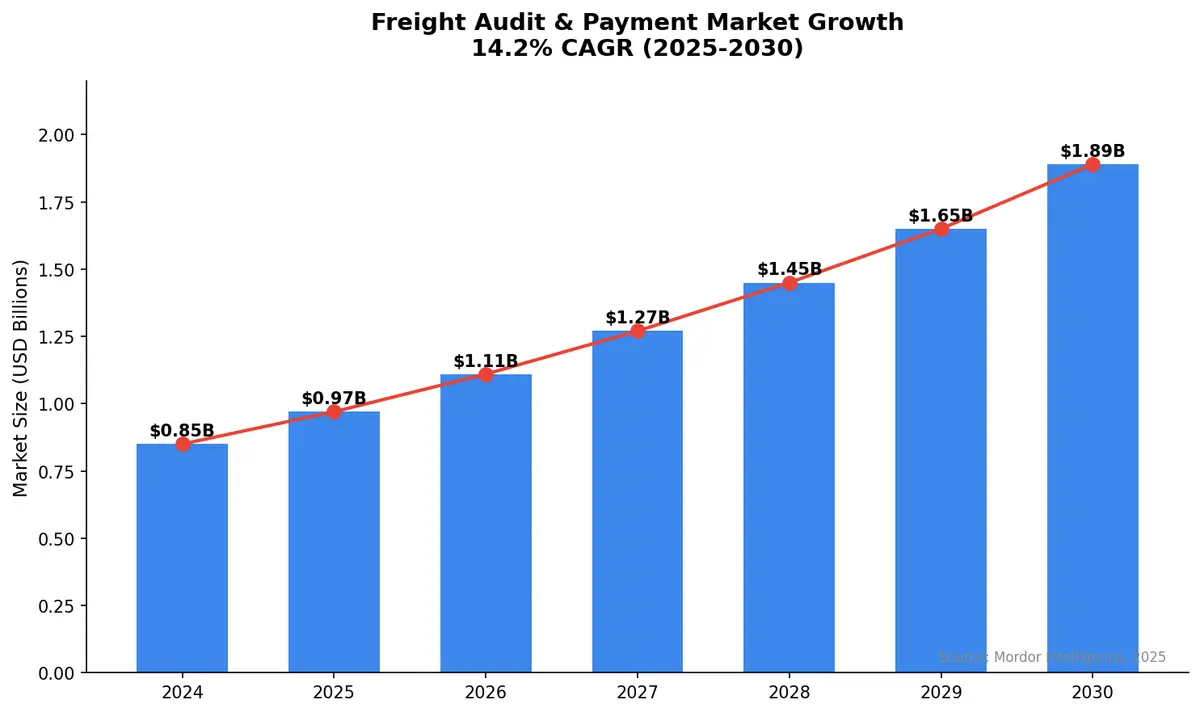
The freight audit and payment market has exploded to nearly $1 billion in 2025, growing at a 14.2% CAGR toward $1.89 billion by 2030, according to Mordor Intelligence. That growth isn't driven by hype — it's driven by shippers who discovered just how much money was walking out the door unnoticed.
The Scale of Freight Billing Errors
Manual freight audit has always been a losing game. A mid-size shipper processing 10,000 invoices per month simply cannot catch every misclassified surcharge, every weight discrepancy, every rate that doesn't match the contracted tariff. The math doesn't work.
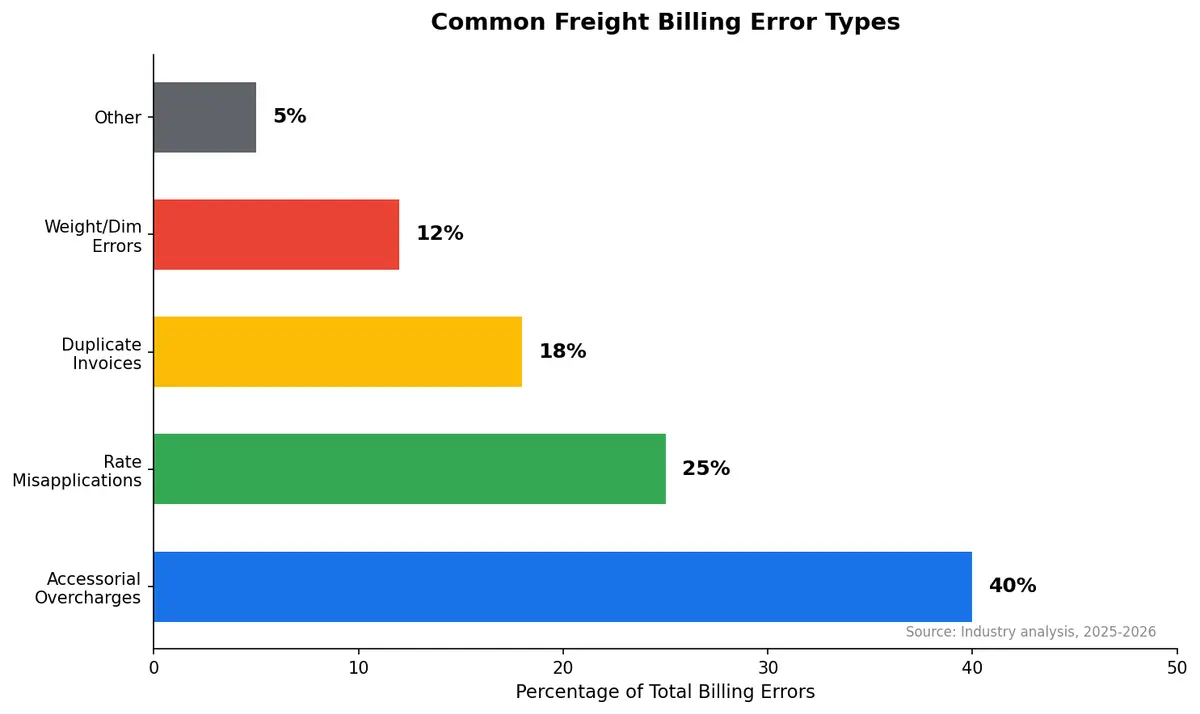
Here's what the error landscape actually looks like:
- Accessorial overcharges account for roughly 40% of all billing errors — fuel surcharges applied incorrectly, residential delivery fees on commercial addresses, liftgate charges for docks with equipment
- Rate misapplications make up another 25%, where carriers apply general rates instead of contracted discounts
- Duplicate invoices represent 15-20% of recoverable spend, often submitted weeks apart with slightly different reference numbers
- Weight and dimensional errors round out the rest, particularly in LTL where reweighs frequently contradict shipper-provided data
For a company spending $50 million annually on freight, even a conservative 3% error rate means $1.5 million in overcharges — every single year.
How AI Changes the Audit Equation
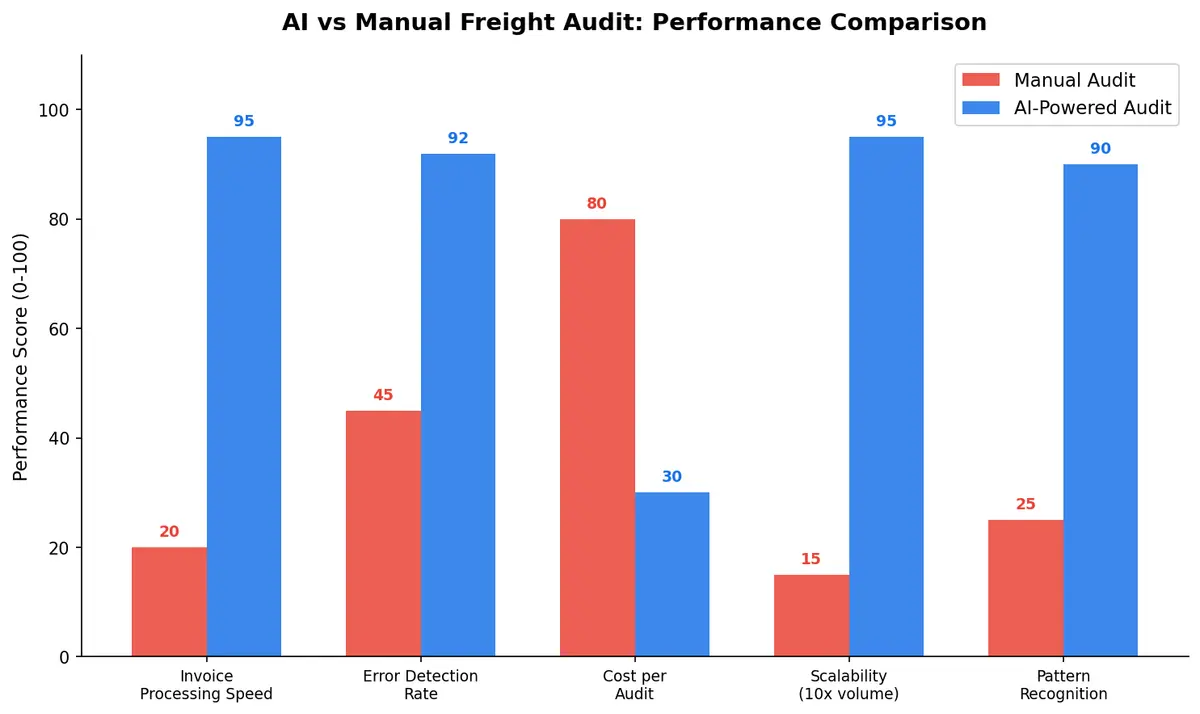
Traditional freight audit relies on rules-based systems: if the invoice rate doesn't match the contract rate, flag it. That catches the obvious errors. AI-powered audit catches everything else.
As Logistics Management reported in their 2026 freight payment analysis, the industry is entering a phase where "AI is being paired with human expertise to improve audit accuracy, reduce fraud, and optimize transportation spend." But the key insight from industry leaders is that AI alone isn't enough — it's the combination of machine learning pattern detection with domain expertise that delivers results.
Pattern Detection at Scale
Machine learning models trained on millions of freight transactions can identify anomalies that no human auditor would catch. These systems learn what "normal" looks like for specific lanes, carriers, and service types, then flag deviations automatically.
A carrier suddenly charging 15% more on a lane where rates have been stable for six months? The AI catches it. An accessorial charge that appears on 30% of shipments to a specific region but only 2% everywhere else? Flagged. Subtle billing pattern changes after a contract renewal? Detected before they compound.
Rate Validation Beyond Simple Matching
Legacy audit systems compare invoice rates to contract rates — a one-dimensional check. AI-powered systems perform multi-dimensional validation:
- Historical rate trending — Is this rate consistent with the lane's pricing history?
- Peer comparison — How does this charge compare to similar shipments across the network?
- Seasonal adjustment — Does the rate increase align with known seasonal patterns, or is it anomalous?
- Carrier behavior modeling — Does this carrier have a pattern of specific billing errors?
The ROI Reality
The return on AI freight audit technology is unusually clear-cut compared to most enterprise software investments. The savings are direct, measurable, and immediate.
| Annual Freight Spend | Conservative Recovery (3%) | Moderate Recovery (5%) | Aggressive Recovery (7%) |
|---|---|---|---|
| $10 million | $300,000 | $500,000 | $700,000 |
| $50 million | $1,500,000 | $2,500,000 | $3,500,000 |
| $100 million | $3,000,000 | $5,000,000 | $7,000,000 |
| $500 million | $15,000,000 | $25,000,000 | $35,000,000 |
Most AI freight audit implementations achieve full payback within the first quarter. The technology doesn't just pay for itself — it generates multiples of its cost in recovered overcharges.
Why Manual Audit Can't Keep Up
Allan Miner, CEO of CT Logistics, put it plainly when speaking with Logistics Management: "We're embracing AI, but AI is only what you train it to do. We're training it to be a great freight auditor." The key word is training — AI systems improve with every invoice they process, building increasingly sophisticated models of carrier billing behavior.
Manual audit teams, by contrast, face compounding challenges:
- Volume scaling — Invoice volumes grow, but audit staff doesn't scale proportionally
- Complexity creep — Carrier rate structures become more complex each contract cycle, with more accessorials and surcharge categories
- Knowledge loss — When an experienced auditor leaves, their institutional knowledge of carrier-specific billing quirks goes with them
- Fatigue errors — Human accuracy degrades after reviewing hundreds of invoices, precisely when the most subtle errors appear
AI doesn't get tired. It doesn't forget carrier-specific patterns. And it processes invoice number 10,000 with the same precision as invoice number 1.
The Human-AI Partnership
TranzAct's founding president Mike Regan offers an important counterpoint to pure automation: "What they're selling is that you don't need the bodies with AI. But 30% of AI is driven by prompts and another 30% relies on the human element."
The most effective freight audit programs combine AI detection with human judgment. The AI identifies anomalies and patterns; experienced auditors validate findings, negotiate recoveries, and feed corrections back into the system. This creates a virtuous cycle where the AI gets smarter with each human-validated decision.
Implementing AI Freight Audit in Your TMS
The most impactful approach integrates freight audit directly into your transportation management system rather than treating it as a separate, downstream process. When audit intelligence lives inside the TMS, you catch errors before payment — not after.
Key integration points include:
- Pre-payment validation — Every invoice is audited before it enters the payment queue
- Contract compliance monitoring — Real-time alerts when carrier billing deviates from negotiated rates
- Carrier scorecarding — Billing accuracy becomes a measurable carrier performance metric
- Spend analytics — Audit data feeds directly into transportation spend dashboards for strategic decision-making
This shift from reactive audit (finding errors after payment) to proactive audit (preventing errors before payment) is where the real savings multiply.
What to Look For in AI Freight Audit Technology
Not all "AI-powered" audit solutions are created equal. When evaluating options, focus on:
- Training data depth — How many transactions has the model been trained on? More data means better pattern recognition
- Carrier coverage — Does it handle all modes (TL, LTL, parcel, ocean, air) with mode-specific logic?
- Integration capability — Can it plug into your existing TMS and ERP without a six-month implementation?
- Recovery process — Does it just flag errors, or does it manage the dispute and recovery workflow?
- Continuous learning — Does the model improve automatically as it processes more of your specific invoice data?
The Bottom Line
Freight billing errors aren't a bug in the system — they're a feature of manual, complex, multi-party logistics networks. The question isn't whether your invoices contain errors. They do. The question is whether you're catching them.
AI freight audit technology has moved from experimental to essential. With a market nearly doubling in the next five years and proven ROI measured in months rather than years, the cost of not implementing automated audit is the overcharges you'll continue paying.
CXTMS integrates AI-powered freight audit directly into its transportation management platform, catching billing errors before payment and recovering overcharges automatically. Request a demo to see how much you could save.