Pallet Pooling Goes Smart: How IoT-Tracked Reusable Pallets Are Cutting Logistics Waste and Costs

The global pallet market is valued at over $70 billion in 2026, yet the industry's dirty secret persists: billions of single-use wooden pallets are manufactured, used once or twice, and discarded every year. With the pallet pooling and rentals market now handling 6.77 billion units annually and growing at nearly 5% CAGR, a fundamental shift is underway — from disposable assets to IoT-tracked, reusable infrastructure.
The Single-Use Pallet Problem
Wooden pallets still dominate global logistics. They're cheap upfront, universally available, and require no return logistics. But that simplicity masks enormous hidden costs.
A typical wooden pallet survives 3-5 trips before it's damaged beyond repair. Factor in moisture absorption, inconsistent dimensions from wear, and the downstream effects — product damage, warehouse equipment jams, automated system failures — and the true cost per trip is far higher than the purchase price suggests.
The environmental toll is equally staggering. In the United States alone, pallets account for roughly 40% of all hardwood lumber production. Millions of tons of pallet waste end up in landfills annually, even as lumber prices remain volatile and sustainability regulations tighten across global markets.
How IoT Is Making Pallets Intelligent
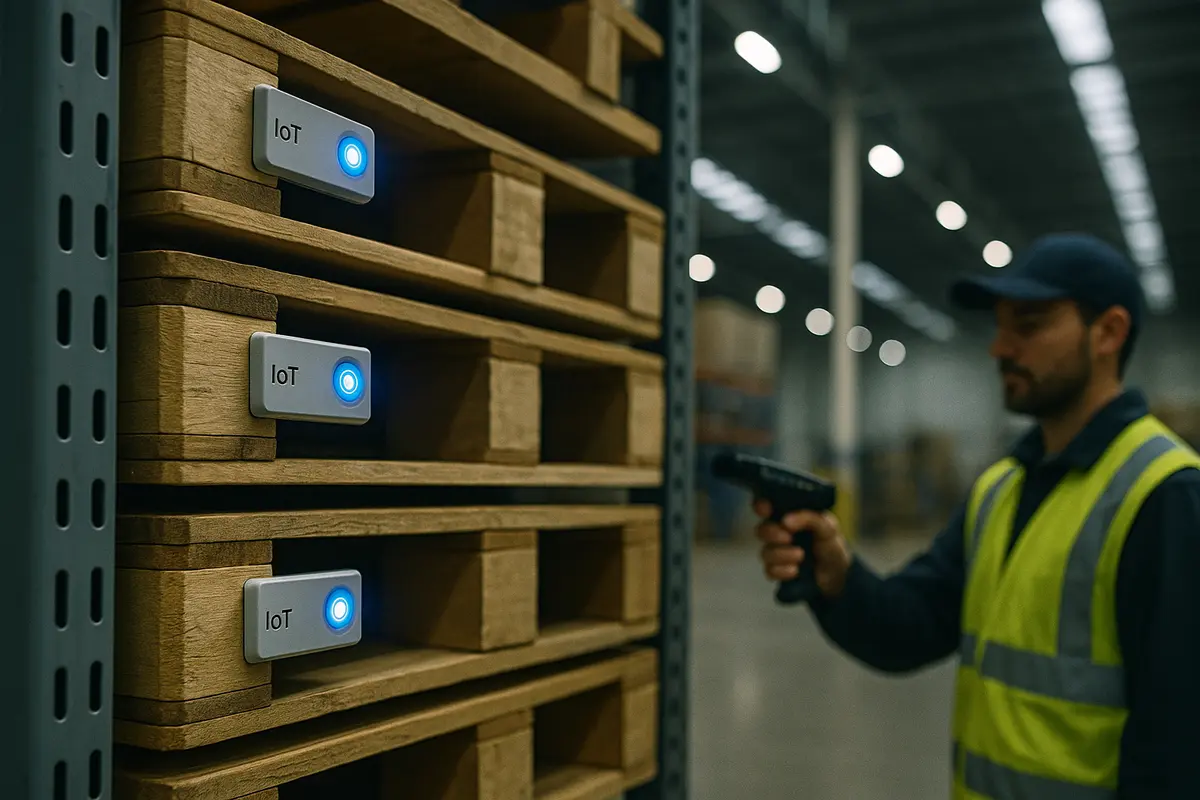
Smart pallets equipped with RFID tags, GPS trackers, and IoT sensors are changing the economics of pallet management entirely. These aren't incremental improvements — they represent a fundamental rethinking of how the supply chain's most basic unit of load transport operates.
Real-time location tracking eliminates the black hole that pallets traditionally disappear into. Companies using RFID-enabled pallet tracking report turnover efficiency improvements of more than 30%, significantly reducing the number of pallets needed to support the same volume of freight movement.
Condition monitoring through embedded sensors tracks temperature, humidity, shock events, and tilt angles. For food and pharmaceutical supply chains, this data serves double duty — ensuring product integrity while generating the compliance documentation that regulators increasingly demand.
Utilization analytics reveal which lanes, warehouses, and partners are pallet sinks — absorbing assets without returning them. This visibility alone can recover 10-15% of a company's pallet fleet that was previously written off as lost.
The Economics of Closed-Loop Pooling
Pallet pooling programs operated by companies like CHEP, PECO, and emerging digital platforms offer a compelling alternative to the buy-use-discard cycle. The model is straightforward: instead of purchasing pallets outright, shippers pay per trip within a managed pool of high-quality, standardized assets.
The financial case is strong. Companies transitioning from single-use to managed pooling programs typically see 15-25% reductions in total packaging logistics costs. Those savings come from multiple sources:
- Elimination of purchase and disposal costs — no more buying pallets or paying for waste hauling
- Reduced product damage — consistent, high-quality pallets mean fewer crushed boxes and rejected loads
- Lower labor costs — standardized dimensions work seamlessly with automated warehouse systems
- Predictable budgeting — per-trip pricing replaces volatile lumber market exposure
When IoT tracking is layered onto pooling programs, the economics improve further. Real-time visibility into pallet location and condition enables dynamic redistribution — moving empty pallets from surplus locations to deficit ones instead of manufacturing new units.
Sustainability That Pays for Itself
The sustainability case for smart pallet pooling isn't about ESG checkboxes or greenwashing press releases. It's about building systems that are inherently less wasteful.
Durable composite and plastic pallets in managed pools can survive 50-100+ trips compared to wood's 3-5. Each reusable pallet that stays in circulation prevents dozens of single-use units from being manufactured and discarded. Multiply that across a global pool of billions of units and the material savings are enormous.
The EU's evolving packaging regulations and corporate sustainability reporting requirements are accelerating adoption. Companies that can demonstrate closed-loop pallet management with verified utilization data — exactly what IoT sensors provide — gain a measurable advantage in sustainability reporting and regulatory compliance.
Automation Compatibility: The Hidden Driver
Modern warehouses increasingly depend on automated storage and retrieval systems, robotic palletizers, and autonomous mobile robots. These systems require precise, consistent pallet dimensions to function reliably.
Single-use wooden pallets, with their variable dimensions and structural inconsistencies, are the leading cause of automated system jams and downtime. Smart pooled pallets — manufactured to exact specifications and continuously monitored for structural integrity — are essentially automation-ready by design.
As warehouse automation continues its rapid expansion, the compatibility advantage of standardized, quality-controlled pooled pallets becomes a strategic necessity rather than a nice-to-have.
How CXTMS Enables Smart Pallet Management
CXTMS integrates pallet tracking and pooling management directly into your logistics workflows. By connecting IoT sensor data with shipment planning and warehouse management, CXTMS gives you complete visibility into pallet utilization, location, and condition across your entire network.
Whether you're managing your own pallet fleet or participating in a third-party pooling program, CXTMS consolidates the data you need to optimize asset recovery, reduce waste, and make informed decisions about your packaging logistics strategy.
Ready to bring intelligence to your pallet operations? Contact CXTMS for a demo and see how smart asset tracking integrates with your logistics workflows.