The Multimodal Transport Market Reaches New Heights: How Route Diversification Is Becoming the Default Strategy for Global Shippers

The era of single-mode dependency is over. For years, global shippers built their logistics networks around a single dominant transport mode — ocean for international, truckload for domestic, air for urgent. That approach worked when trade lanes were stable, geopolitical risks were manageable, and disruptions were the exception rather than the rule.
In March 2026, none of those conditions hold. The Strait of Hormuz is seeing traffic down 80%. Middle East escalation has pushed supertanker rates to all-time highs. Nearshoring is reshaping centuries-old trade corridors between the US and Mexico. And companies that locked themselves into rigid, single-mode supply chains are paying the price in delayed shipments, cost overruns, and lost revenue.
The result? A massive global pivot toward multimodal transport — and the market data confirms the scale of the shift.
A $159 Billion Market by 2032: The Numbers Behind the Pivot
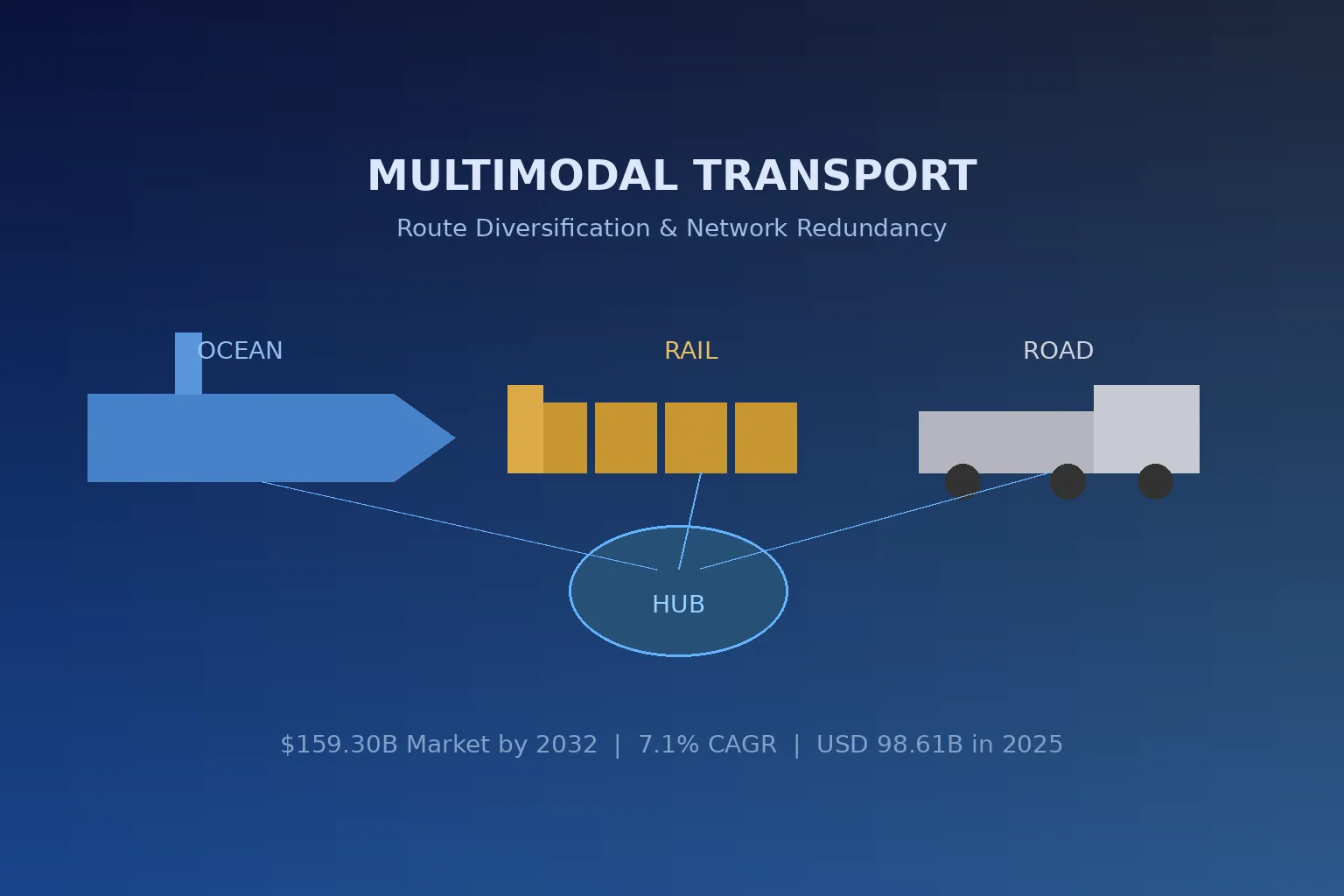
According to a MarketsandMarkets report published in March 2026, the global multimodal transport market is projected to grow from USD 98.61 billion in 2025 to USD 159.30 billion by 2032, representing a compound annual growth rate (CAGR) of 7.1%.
That 61% growth over seven years isn't happening by accident. The report identifies several converging forces driving the expansion:
- Fragmented supply chains demanding streamlined freight movement across road, rail, and waterway networks
- Digital platforms enabling end-to-end visibility, automated documentation, and dynamic route optimization
- Infrastructure investment in new intermodal terminals, port-rail links, inland waterway revival, and multimodal logistics parks
- Policy mandates promoting carbon reduction through incentives for rail and coastal shipping over long-haul trucking
But the most powerful driver? Geopolitical disruption forcing companies to build redundancy into every transport network they operate.
Why Single-Mode Dependency Is Now a Strategic Liability
Consider what happened to shippers relying exclusively on Red Sea ocean routes in early 2026. When Middle East tensions escalated again in February, supertanker insurance premiums spiked overnight, rerouting costs added 10–15 days to transit times, and shippers without alternative modal options faced the choice between paying 40% rate premiums or missing delivery windows entirely.
As SupplyChainBrain notes, multimodal transport delivers on all fronts, enabling companies to "switch modes, manage costs, lower emissions, and keep goods moving" when disruptions hit. The key insight is that route diversification isn't just about having backup plans — it's about building logistics networks where mode switching is operationally seamless rather than an emergency scramble.
Hybrid-mode configurations are seeing the sharpest demand growth. These setups allow cargo to transition between transport combinations — road-rail-waterway or road-air-waterway — based on available capacity and service priorities. Industries with variable shipment patterns, including pharmaceuticals, electronics, and high-value manufacturing, are leading adoption because delivery timing and risk diversification are non-negotiable in those sectors.
How the Giants Are Building Diversified Service Portfolios
The market's major players are positioning aggressively. DSV, Deutsche Post, Kuehne+Nagel, NIPPON EXPRESS, and A.P. Moller-Maersk are all expanding their multimodal portfolios to capture the growing demand for integrated transport solutions.
DSV became the world's largest freight forwarder after completing its acquisition of DB Schenker, giving it unmatched road, air, and ocean capacity across every major trade lane. The combined entity now operates the most extensive multimodal network in the industry.
Kuehne+Nagel reported solid 2025 earnings while maintaining its global number-one position in both sea and air freight volumes, with significant market share gains in air logistics. The company is investing heavily in AI-driven mode optimization expected to deliver material efficiency improvements from 2027 onward.
Maersk continues its transformation from a pure ocean carrier into an integrated logistics provider. In Brazil, Maersk is expanding port services with DP World, launching six new services with eight weekly calls in 2025 — increasing to seven services and ten weekly calls in 2026. This port-to-door strategy exemplifies how ocean carriers are building multimodal capabilities to capture more of the logistics value chain.
Nearshoring Is Rewriting the Multimodal Playbook
Perhaps no trend is reshaping multimodal demand more dramatically than nearshoring. Mexico attracted $40.9 billion in foreign direct investment during the first three quarters of 2025 — a year-on-year growth of 14.5% — as manufacturers diversify production away from China and toward North American supply chains.
Mexico's freight and logistics market is estimated at USD 131 billion in 2026 and projected to reach USD 170 billion by 2031, driven directly by nearshoring and multimodal network development. Infrastructure projects like the Isthmus of Tehuantepec Interoceanic Corridor, which creates multimodal connectivity between the Pacific and Gulf coasts, are designed to handle exactly this type of cross-border freight growth.
For US importers, nearshoring doesn't simplify logistics — it transforms it. Products that once traveled by ocean from Shanghai now move by truck, rail, and short-sea routes from Monterrey, Guadalajara, and Querétaro. Each origin requires different modal combinations, customs processes, and transit time calculations. Shippers who invested in multimodal capabilities early are capturing the nearshoring advantage. Those still running single-mode networks are watching costs climb.
A similar pattern is emerging in intra-ASEAN trade, where Vietnam, Thailand, and Indonesia are absorbing manufacturing capacity that once concentrated in coastal China. The regional trade networks being built require road-rail-maritime combinations that didn't exist five years ago.
Technology Requirements: Unified Visibility Across Every Mode
The operational challenge of multimodal transport isn't moving cargo across modes — it's maintaining visibility, cost control, and compliance as shipments transition between carriers, modes, and jurisdictions. A single international shipment might touch an ocean carrier, a port drayage operator, a rail intermodal provider, and a last-mile trucking company — each with different tracking systems, rate structures, and documentation requirements.
FreightWaves highlights that freight winners in 2026 will be those who blend contract freight with on-demand capacity, including smaller fleets and owner-operators, to recover faster when disruptions hit. That blending requires technology platforms capable of managing rates, tracking, and documentation across every transport mode simultaneously.
The technology stack for effective multimodal operations in 2026 requires:
- Unified rate management across air, ocean, road, and rail with real-time market intelligence
- Dynamic routing engines that can evaluate mode alternatives based on cost, time, carbon impact, and risk factors
- Cross-modal tracking providing shipment-level visibility regardless of which carrier or mode is handling the freight
- Automated compliance managing customs documentation, carbon reporting, and regulatory requirements across jurisdictions
How CXTMS Enables Multimodal Rate Comparison and Routing Optimization
CXTMS was built for exactly this multimodal reality. Rather than forcing shippers to manage separate systems for each transport mode, CXTMS provides a unified platform for rate comparison, routing optimization, and shipment tracking across air, ocean, and road freight.
The platform's multimodal capabilities include:
- Cross-modal rate benchmarking that lets shippers compare air, ocean, and surface options side by side, factoring in total landed cost rather than just line-haul rates
- Route diversification analysis that evaluates alternative routing options based on geopolitical risk, transit time variability, and carbon footprint
- Real-time carrier performance scoring across all transport modes, helping shippers identify which carriers deliver consistent service in volatile conditions
- Integrated compliance workflows that manage documentation requirements across modal transitions and border crossings
In a world where single-mode dependency is a liability and route diversification is the new default, having a platform that operates natively across transport modes isn't a nice-to-have — it's a competitive requirement.
Build Your Multimodal Strategy Before the Next Disruption Hits
The multimodal transport market's growth to $159 billion isn't a forecast shippers can afford to watch from the sidelines. Every month of delay in building diversified transport networks is another month of exposure to the geopolitical volatility, capacity constraints, and cost spikes that define global logistics in 2026.
Ready to build route diversification into your supply chain strategy? Request a CXTMS demo to see how unified multimodal visibility and rate intelligence can transform your logistics network from a single-mode liability into a resilient, cost-optimized competitive advantage.