Multi-Agent AI Orchestration: How Hershey and CPG Giants Are Deploying AI Agent Teams Across Supply Chains

The era of the single AI copilot is already over. In 2026, the most advanced supply chains aren't running one AI agent — they're orchestrating entire teams of autonomous agents that self-assemble, collaborate, and govern each other in real time. Hershey, Mars, Kraft Heinz, and Unilever are leading this shift, deploying multi-agent decision intelligence platforms that are fundamentally changing how CPG supply chains operate.
From Single Agents to Self-Assembling Agent Teams
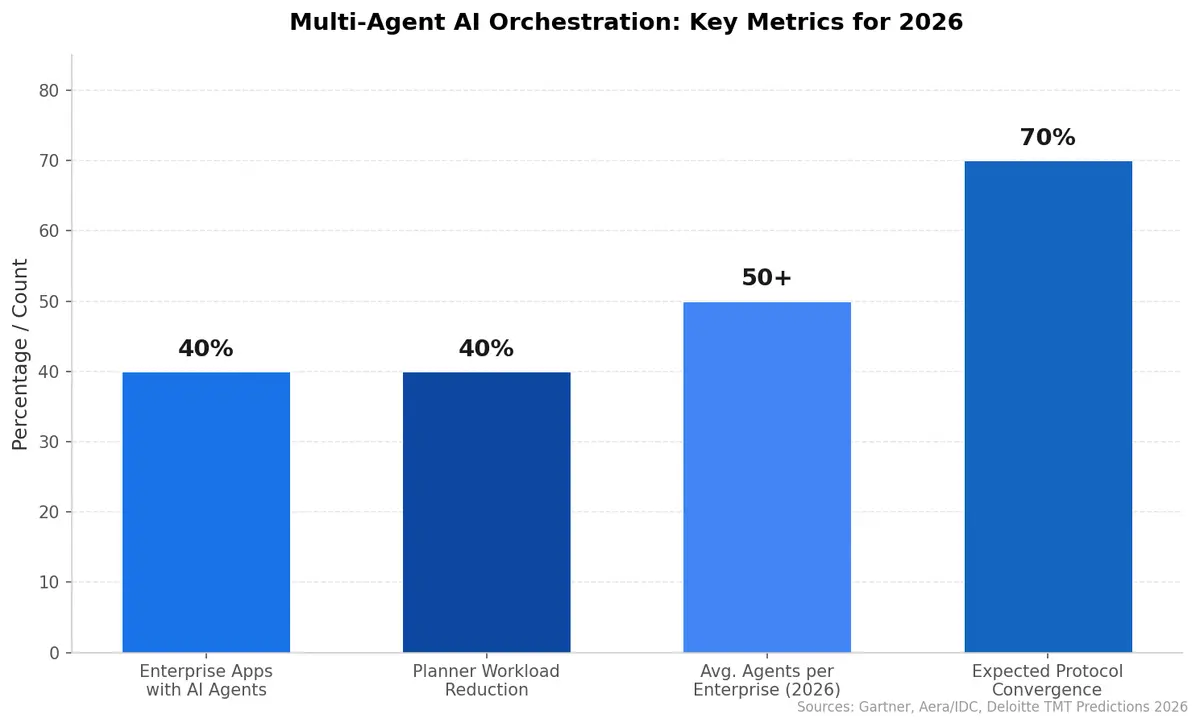
If 2025 was the year enterprises piloted individual AI agents for narrow tasks — demand forecasting here, route optimization there — 2026 is the year those isolated agents collide. Gartner predicts that 40% of enterprise applications will feature task-specific AI agents by the end of 2026, up from less than 5% in 2025. For a typical large enterprise, that translates to 50 or more specialized agents running simultaneously across procurement, logistics, inventory, and customer service.
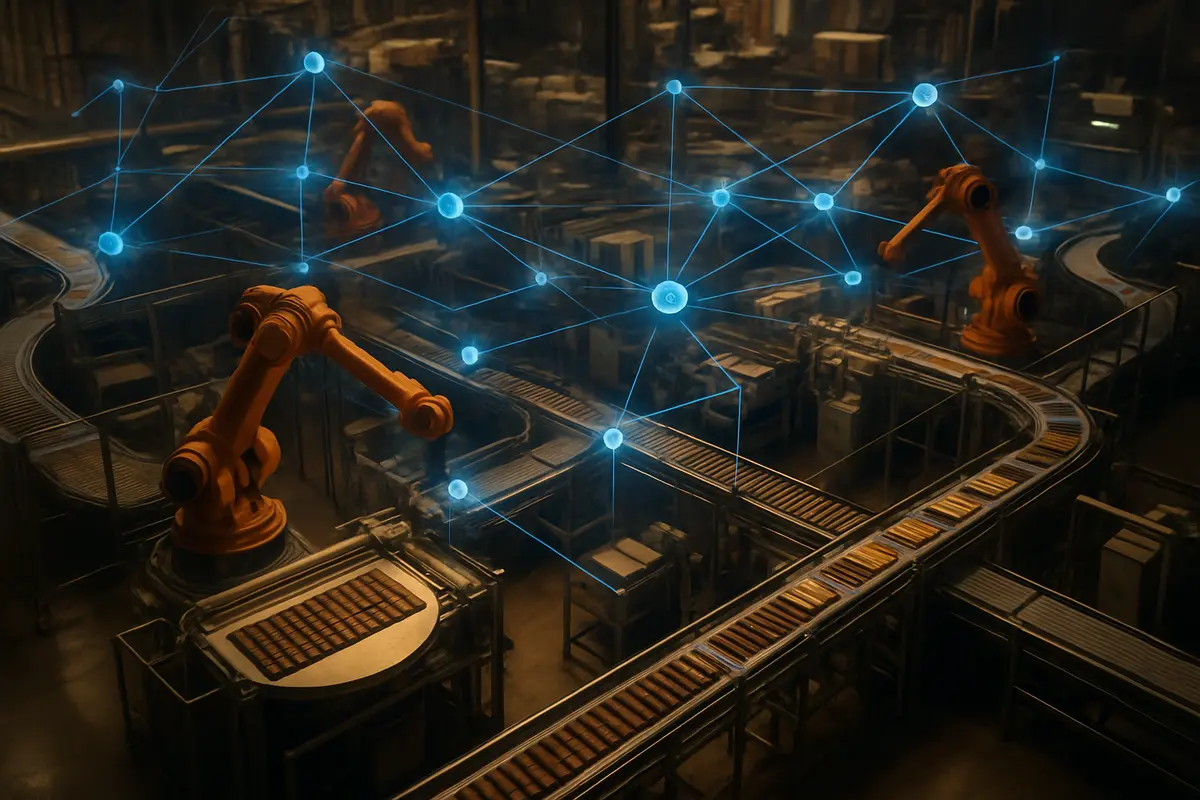
The architectural shift is significant. Instead of deploying agents as standalone tools, leading organizations are building multi-agent orchestration layers — platforms where agents communicate, negotiate priorities, share context, and coordinate actions without requiring human intervention at every handoff.
Hershey's Decision Cloud: Autonomous Agent Teams in Action
The Hershey Company offers one of the most compelling real-world examples of multi-agent AI at scale. Working with Aera Technology's Decision Cloud platform, Hershey has deployed autonomous agent teams that self-assemble based on the decision at hand.
Douglas Guilherme, Hershey's global VP of supply chain, described the approach at the 2025 North American Supply Chain Executive Summit: rather than reacting to supply chain disruptions after they occur, Aera's agents take a forward-looking approach. When a potential problem is identified — say, a cocoa supply shortage or a logistics bottleneck — specialized agents for demand sensing, inventory optimization, and logistics planning autonomously assemble into a task-specific team to evaluate scenarios and recommend actions.
The results are tangible. According to an IDC study commissioned by Aera Technology, enterprises using decision intelligence platforms are reducing planner workloads by up to 40% while enabling faster, more accurate responses to supply chain volatility. For a confectionery giant navigating cocoa price swings and tariff uncertainty, that speed matters.
Hershey isn't alone. Mars, Kraft Heinz, and Unilever have all adopted Aera's platform to orchestrate AI-driven decision-making across their supply chains — a signal that multi-agent orchestration is becoming table stakes for CPG leaders.
The Agent Sprawl Problem: Token Hemorrhaging and Governance Vacuums
But deploying dozens of agents without coordination creates a dangerous new problem: agent sprawl. As CIO contributor and AI strategist Isaac Sacolick warned in February 2026, uncoordinated agents are becoming the new "Shadow IT" — and the consequences are more immediate than unmanaged SaaS subscriptions.
Consider a real-world cautionary tale: a global logistics firm deployed two autonomous agents — one for inventory procurement, one for dynamic warehouse pricing. A data lag caused the procurement agent to detect a false "low stock" signal and over-order high-value components. Simultaneously, the pricing agent saw the incoming surplus and slashed prices to move volume. Without an orchestration layer to reconcile these conflicting objectives, the firm spent $2 million on premium freight to ship items it was essentially selling at a loss.
This wasn't a failure of AI logic. It was a failure of AI orchestration.
The problem scales with adoption. Redundant API calls across uncoordinated agents create "token hemorrhaging" — quietly eroding ROI through overlapping compute tasks. And when agents operate in silos, they become "locally optimal but globally catastrophic," each maximizing its own objective while undermining the organization's broader goals.
Three Pillars of AI Agent Orchestration
The emerging consensus — reflected in frameworks from both Deloitte's 2026 TMT Predictions and the Cloud Security Alliance's MAESTRO framework — points to three non-negotiable pillars for governing multi-agent systems:
1. Conflict Resolution and Priority Logic. When a cost-optimization agent wants to shut down servers while a customer-experience agent needs to scale up for a product launch, something has to arbitrate. An effective orchestration layer implements priority logic aligned with current business objectives — not just local agent goals.
2. Universal Context (The Memory Layer). Agents that lack shared memory perform redundant work and make contradictory decisions. Centralizing context through a shared memory layer eliminates duplicate data retrieval, reduces total token spend, and ensures every agent operates from the same ground truth.
3. Cross-Agent Security and Immutable Audits. Agentic prompt injection — where a low-clearance agent inadvertently tricks a high-privilege agent into leaking data — is a real and growing threat. Every handoff between agents must be authenticated and logged. Deloitte notes that emerging "guardian agents" can both execute tasks and govern other agents, sensing and managing risky behaviors autonomously.
The Protocol Wars: A2A, MCP, and AGNTCY
Multi-agent orchestration also requires agents to speak the same language. Several inter-agent communication protocols have emerged in rapid succession: Google's Agent-to-Agent (A2A), Anthropic's Model Context Protocol (MCP), and the Cisco-led AGNTCY framework. Deloitte predicts these will converge into two or three dominant standards by 2027, but for now, enterprises must navigate a fragmented landscape.
The risk of "walled gardens" — where companies get locked into a single protocol and agent ecosystem — is real. Forward-thinking organizations are choosing protocol-agnostic orchestration platforms that can bridge multiple standards, ensuring flexibility as the landscape matures.
Practical Steps for Multi-Agent Supply Chain Deployment
For logistics and supply chain leaders looking to move beyond single-agent pilots, the path forward involves:
- Inventory your agents. Map every active agent, its underlying model, data permissions, and decision scope. You can't orchestrate what you can't see.
- Establish an orchestration layer. Whether through a commercial platform or custom-built middleware, centralize agent coordination with shared context and conflict resolution logic.
- Define governance boundaries. Set clear escalation paths for high-stakes decisions. Autonomous doesn't mean unsupervised — humans should remain in the loop for strategic choices.
- Monitor token economics. Track compute costs across your agent fleet. Redundant processing is the silent killer of AI ROI.
How CXTMS Enables Multi-Agent Integration
CXTMS is built for the multi-agent era. With an API-first, composable architecture, CXTMS serves as a coordination hub where AI agents for carrier selection, freight audit, route optimization, and shipment visibility can operate collaboratively rather than in silos.
Through open APIs and webhook-driven event architectures, CXTMS integrates with decision intelligence platforms like Aera's Decision Cloud, ensuring that agent-driven insights translate directly into optimized transportation execution. The result: fewer blind spots, faster decisions, and a supply chain that adapts in real time.
Ready to orchestrate your supply chain AI agents on a unified platform? Contact CXTMS for a demo.