The Logistics SaaS Pricing Revolution: How Usage-Based Models Are Replacing Per-User Licenses and Changing TMS Economics


The way logistics companies buy software is changing faster than the software itself. Per-seat licensing — the model that dominated enterprise SaaS for two decades — is collapsing under the weight of its own contradictions. In its place, usage-based pricing is emerging as the default for transportation management systems, with Gartner predicting that 70% of businesses will prefer consumption-based models over per-seat pricing by 2026.
For shippers managing volatile freight volumes, this shift isn't academic. It's the difference between paying for 50 user licenses during a slow quarter and paying only for the 12,000 shipments you actually moved.
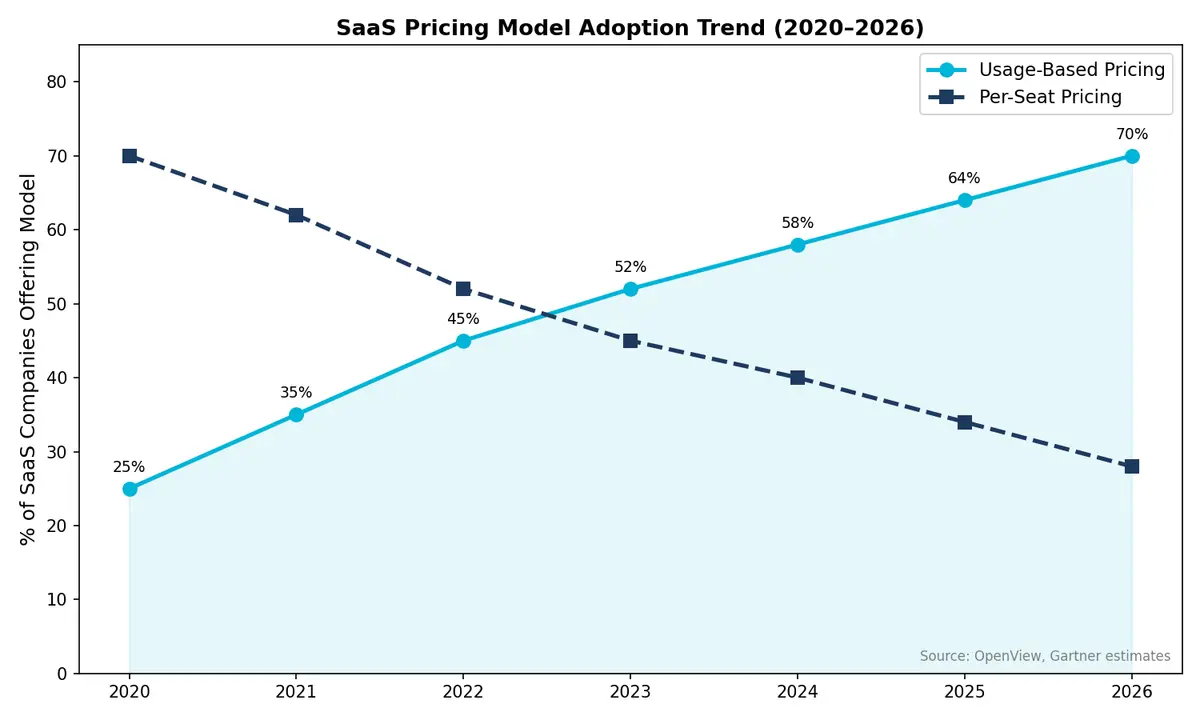
Why Per-Seat Pricing Is Breaking Down
The per-user licensing model was designed for a world where software value scaled with headcount. More employees meant more usage, and per-seat fees were a reasonable proxy for consumption. That logic has disintegrated for three reasons.
First, AI automation is shrinking logistics teams while increasing output. A shipper that once needed 15 people to manage 20,000 monthly shipments can now handle the same volume with eight. Under per-seat pricing, the software vendor loses revenue as their customer becomes more efficient — a perverse incentive that punishes productivity.
Second, seasonal freight volumes create painful mismatches. Retail shippers processing 50,000 shipments in Q4 and 15,000 in Q1 pay the same annual license fee regardless. The TMS market, valued at $15 billion in 2025 and growing at 10.6% CAGR through 2035, is too competitive to sustain pricing models that frustrate mid-market buyers.
Third, cross-functional access demands are exploding. Modern supply chains require warehouse staff, customer service reps, finance teams, and carrier partners to access TMS data. Per-seat pricing turns every new user into a budget negotiation, creating artificial barriers to the visibility that supply chains desperately need.
The Per-Shipment Model: Aligning Cost With Value
Per-shipment pricing charges a flat fee for each transaction processed through the platform — typically $1 to $20 per shipment depending on complexity, mode, and service tier. According to industry research, approximately 54% of logistics SaaS providers now offer per-shipment pricing options, making it the most prevalent model in the current market.
The appeal is straightforward: costs scale linearly with business volume. A mid-market shipper processing 5,000 shipments monthly pays proportionally less than an enterprise moving 100,000. When volumes dip during slow periods, so does the software bill.
What per-shipment pricing typically includes:
- Unlimited user access — no more seat-counting or license negotiations
- Full feature availability — routing, optimization, analytics, and reporting
- Standard carrier integrations — EDI, API, and portal connections
- Basic support and updates — included in the per-transaction fee
This model particularly benefits companies in growth mode. A 3PL that doubles its shipment volume from 10,000 to 20,000 monthly sees predictable cost increases rather than stair-step jumps when they exceed a license tier.
Consumption-Based Tiers: Beyond Simple Per-Shipment Fees
The most sophisticated logistics platforms are moving beyond flat per-shipment fees to multi-dimensional consumption pricing. OpenView's benchmark data shows that 86% of SaaS companies valued above $100 million now employ at least three pricing dimensions, with companies using multi-dimensional models achieving 34% higher customer lifetime value ratios.
In logistics, these dimensions typically include:
- API call volume — charges for carrier rate shopping, tracking updates, and ERP integrations
- Data storage and retention — fees for maintaining historical shipment records beyond standard periods
- Advanced analytics — premium pricing for predictive models, lane optimization, and benchmarking
- Integration complexity — tiered fees based on the number of connected systems (ERP, WMS, OMS)
This approach lets shippers start with a lean configuration and add capabilities as they grow. A company might begin with basic shipment execution at $3 per transaction, then add real-time visibility for $1.50 more, and predictive analytics for another $2 — building a custom cost structure that matches their operational maturity.
The Hidden Cost Trap: What Pricing Models Don't Show
Regardless of whether a TMS vendor charges per seat or per shipment, the sticker price rarely tells the full story. Implementation, training, customization, and data migration can add 50–150% to first-year costs. SaaS vendors hiking prices by 9–25% annually compound the problem for locked-in customers.
A practical 3-year TCO framework should account for:
| Cost Category | Per-Seat Model | Usage-Based Model |
|---|---|---|
| Software licensing | Fixed annual fee | Variable with volume |
| Implementation | $50K–$500K | $25K–$200K (cloud-native) |
| Training | Per-user cost | Unlimited users included |
| Integrations | Often add-on fees | Often included in tier |
| Annual increases | 8–15% typical | Volume-driven, negotiable |
| Scaling cost | New license purchase | Automatic with growth |
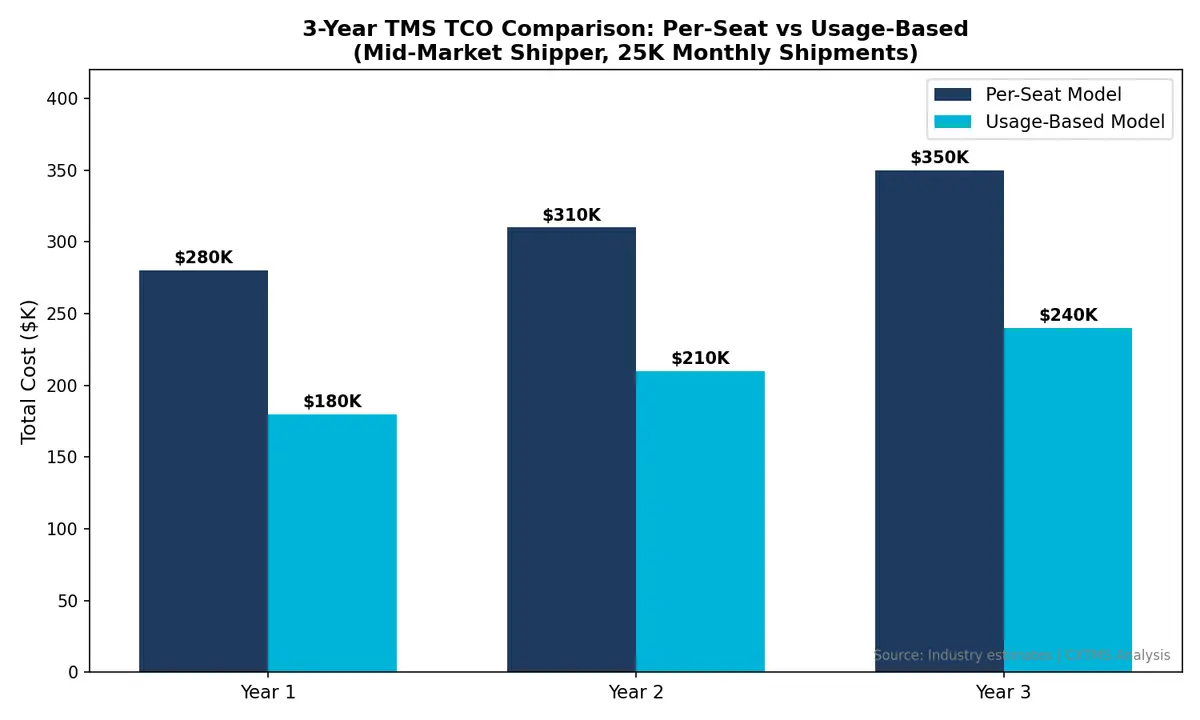
Mid-market shippers processing 10,000–50,000 monthly shipments consistently find that usage-based models deliver 20–35% lower three-year TCO compared to equivalent per-seat platforms, primarily because they eliminate shelfware — licenses purchased but rarely used.
Why Usage-Based Pricing Favors Growing Shippers
The economics of usage-based TMS pricing create a natural advantage for companies in their growth phase. Unlike per-seat models that require upfront commitment to a license tier, consumption pricing lets shippers:
Start small and prove ROI. A shipper can onboard with 2,000 monthly shipments, demonstrate value in 90 days, and scale to 10,000 without renegotiating contracts or purchasing additional licenses.
Weather seasonal swings. Companies with 3:1 peak-to-trough volume ratios save significantly when their software bill contracts alongside their shipping activity during slow months.
Expand access without budget fights. When every warehouse worker, customer service rep, and carrier partner can access the platform without triggering a new seat license, data flows more freely and decisions happen faster.
The global SaaS market is forecast to reach $465 billion in 2026, and logistics software is following the broader trend toward consumption economics. Vendors that cling to per-seat models risk losing mid-market customers who've learned to demand pricing that reflects actual usage, not projected headcount.
Making the Right Choice for Your Operation
The best pricing model depends on your operational profile. Per-seat pricing may still make sense for large enterprises with stable headcount and predictable volumes. But for the majority of shippers navigating volatile markets, usage-based pricing offers financial flexibility that traditional models simply cannot match.
When evaluating TMS vendors, demand transparency on all cost dimensions — not just the per-shipment or per-seat rate, but implementation timelines, integration fees, annual escalation caps, and exit costs. The cheapest per-transaction rate means nothing if implementation takes 12 months and locks you into a five-year contract.
Looking for a TMS with transparent, scalable pricing that grows with your business? Contact CXTMS for a personalized demo and cost analysis.