AI Will Drive Freight Brokerage Consolidation: What C.H. Robinson's CEO Says About the Industry's Future


When C.H. Robinson's stock plunged 14.5% on February 12, 2026 — its biggest single-day drop in roughly two years — investors sent a clear message: AI-enabled freight platforms are coming for traditional brokers. But CEO Dave Bozeman sees a very different story unfolding.
The Selloff That Shook Freight Brokerage
The February 12 rout wasn't limited to C.H. Robinson. Transportation and logistics stocks across the board tumbled as headlines about AI-enabled freight platforms spooked investors. The catalyst? AI-technology company Algorhythm Holdings claimed its SemiCab platform was helping customers scale freight volumes by 300% to 400% without adding operational headcount.
For an industry built on human relationships and phone calls, those numbers triggered panic. If a startup can move four times the freight with the same team, what happens to the 17,000+ licensed freight brokers operating in the United States?
Bozeman's Counterargument: Consolidation, Not Disruption
In a Reuters interview on February 23, Bozeman called the selloff a "short-term reaction" and laid out a thesis that AI won't destroy incumbents — it will concentrate the industry around the companies that can wield it best.
His argument rests on three pillars:
1. Data moats are real. C.H. Robinson processes roughly $22 billion in freight annually across 100,000+ customers and 85,000+ contract carriers. That proprietary data set — spanning rates, lanes, seasonal patterns, and carrier performance — is extremely difficult and costly to replicate, even with significant venture capital.
2. Scale compounds AI advantage. More data means better models. Better models mean more efficient matching, pricing, and exception handling. The result is a flywheel where the largest brokers get disproportionately better at AI-driven operations. "We're going to go into agentic artificial intelligence that's going to make us faster and even better," Bozeman told Reuters.
3. AI investment requires capital depth. Building agentic AI systems — where software autonomously handles booking, tracking, exception management, and carrier negotiations — demands sustained investment that most mid-size brokers simply can't afford.
The Market Numbers Tell the Story
The global freight brokerage market, valued at approximately $57.8 billion in 2025, is projected to reach $94.2 billion by 2033, growing at a 6.3% CAGR. But that growth won't be distributed evenly.
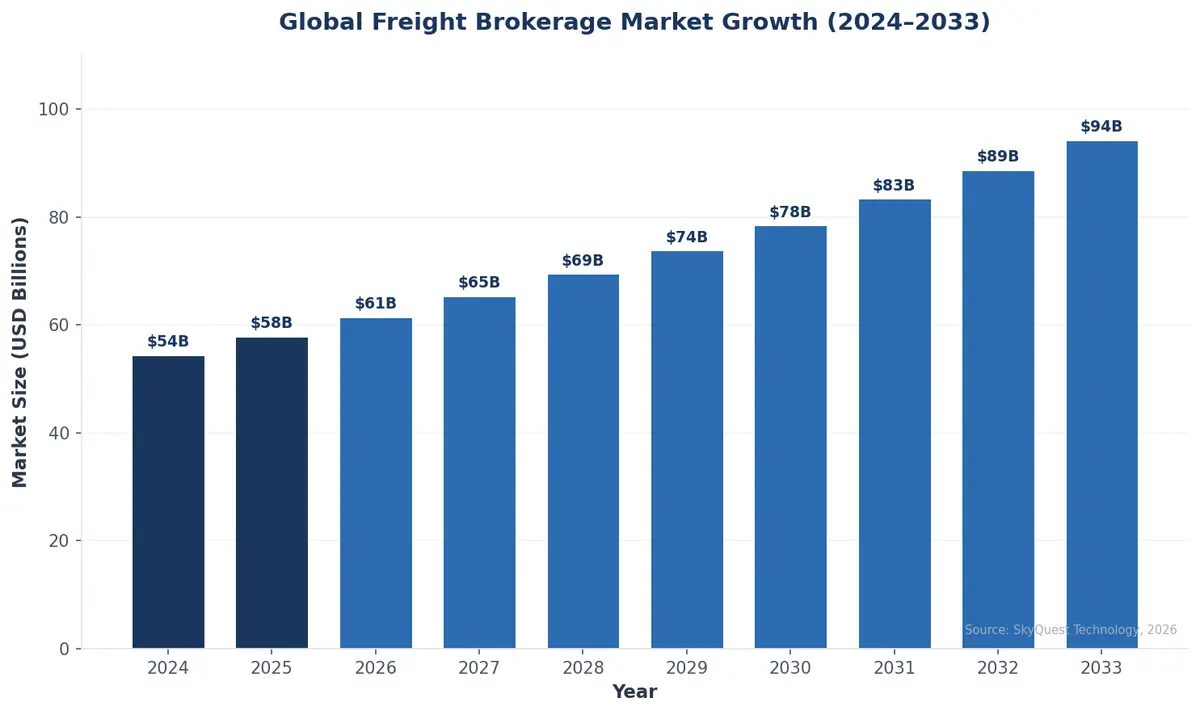
Digital freight platforms are capturing an increasing share. According to Mordor Intelligence, digital platforms are actively disrupting traditional brokerage models in the U.S. market, with brokers offering technology-enabled services like drop-trailer pools and cross-dock transloads gaining lane density advantages over competitors relying on manual processes.
C.H. Robinson's own Q4 2025 results proved the point: the company beat Wall Street profit estimates, driven in part by AI efficiencies that streamlined operations and reduced manual processes across routine functions.
The Agentic AI Arms Race
What makes this cycle different from previous waves of freight tech hype is the shift from predictive AI to agentic AI — systems that don't just analyze data but autonomously execute decisions.
For freight brokers, that means AI agents that can:
- Auto-match shipments to carriers based on real-time capacity, historical performance, and cost optimization
- Negotiate rates dynamically using market data and relationship history
- Handle exceptions autonomously — rerouting shipments, managing detention claims, and updating customers without human intervention
- Generate documentation including BOLs, customs paperwork, and compliance filings
The logistics sector is already seeing this play out. GXO Logistics expects 20 basis points of margin expansion in 2026 through robotics and AI investments — proof that automation directly translates to bottom-line improvement in logistics operations.
What Mid-Size Brokers Should Do Now
Bozeman's consolidation thesis creates a stark choice for the thousands of mid-size freight brokers operating today: adopt or be acquired.
The brokers most at risk are those handling fewer than 10,000 shipments annually with primarily manual workflows. They lack the data volume to train competitive AI models and the capital to build proprietary technology. For these companies, the playbook is clear:
Invest in TMS technology immediately. Modern transportation management systems with built-in AI capabilities can level the playing field. A mid-size broker using an AI-enabled TMS can access carrier matching algorithms, automated pricing, and exception management that would otherwise require a dedicated engineering team.
Specialize or consolidate. Generalist brokers competing on price alone will be squeezed. The survivors will be those who develop deep expertise in specific verticals — hazmat, refrigerated, oversized, cross-border — where relationship knowledge and regulatory expertise still matter.
Build your data infrastructure. Every load you move generates data. Brokers who systematically capture, clean, and leverage their operational data today will have a competitive advantage tomorrow — or at minimum, a more valuable asset if acquisition becomes the exit strategy.
The Technology Imperative
The freight brokerage industry is entering a period of accelerated natural selection. AI isn't the meteor that wipes out incumbents — it's the climate change that favors the most adaptable.
C.H. Robinson's bet on agentic AI, combined with its massive data advantage, positions it as one of the consolidators. But the technology itself is accessible. What matters is how quickly brokers can integrate AI-driven tools into their operations and whether they can do it before larger players absorb their market share.
The brokers who thrive in 2026 and beyond won't be the ones with the most trucks or the biggest Rolodex. They'll be the ones whose technology platforms can learn, adapt, and execute faster than the competition.
Ready to equip your brokerage with AI-powered logistics tools? Contact CXTMS to see how our TMS platform helps brokers compete in the age of agentic AI.