Automotive Supply Chains Under Siege: How Tariffs, EVs, and Geopolitics Are Forcing a Complete Redesign


The automotive industry isn't dealing with a supply chain disruption. It's living through a complete supply chain redesign. Tariffs, the EV transition, and escalating geopolitical tensions have converged to make the logistics architectures that served automakers for three decades fundamentally obsolete.
The Triple Threat Reshaping Automotive Logistics
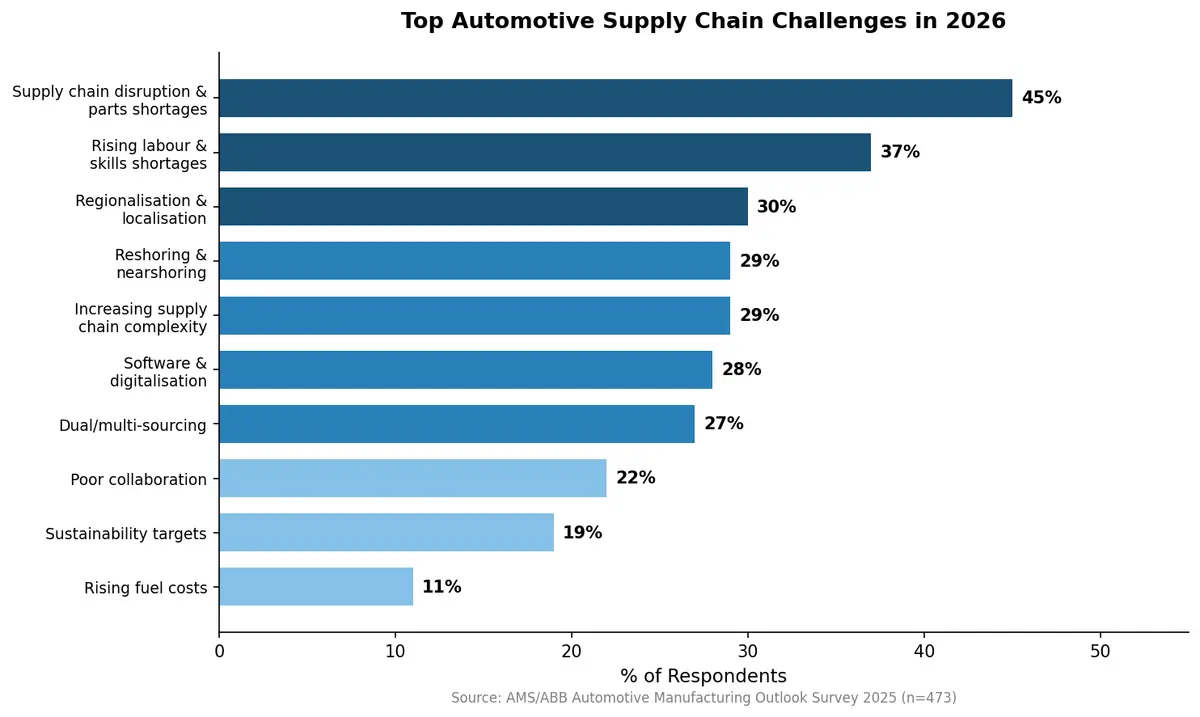
According to the AMS/ABB Automotive Manufacturing Outlook Survey 2025, 45% of automotive industry respondents identified supply chain disruption, parts shortages, and inventory management as their single biggest challenge. That figure has remained stubbornly elevated every year since 2022 — proof that disruption is no longer cyclical but structural.
What's driving this permanence? Three forces hitting simultaneously:
- Tariffs and trade restrictions are actively reshaping where components are sourced, manufactured, and shipped. The U.S. International Trade Commission launched a formal review of USMCA automotive rules of origin in February 2026, putting billions in cross-border automotive trade under scrutiny.
- The EV transition is creating entirely new supply chain requirements — battery-grade lithium, cobalt, and nickel routing that didn't exist a decade ago.
- Geopolitical fragmentation is forcing manufacturers to choose sides, with China's dominance in battery materials creating uncomfortable dependencies for Western automakers.
From Just-in-Time to Just-in-Case
The automotive industry practically invented just-in-time manufacturing. Now it's dismantling it.
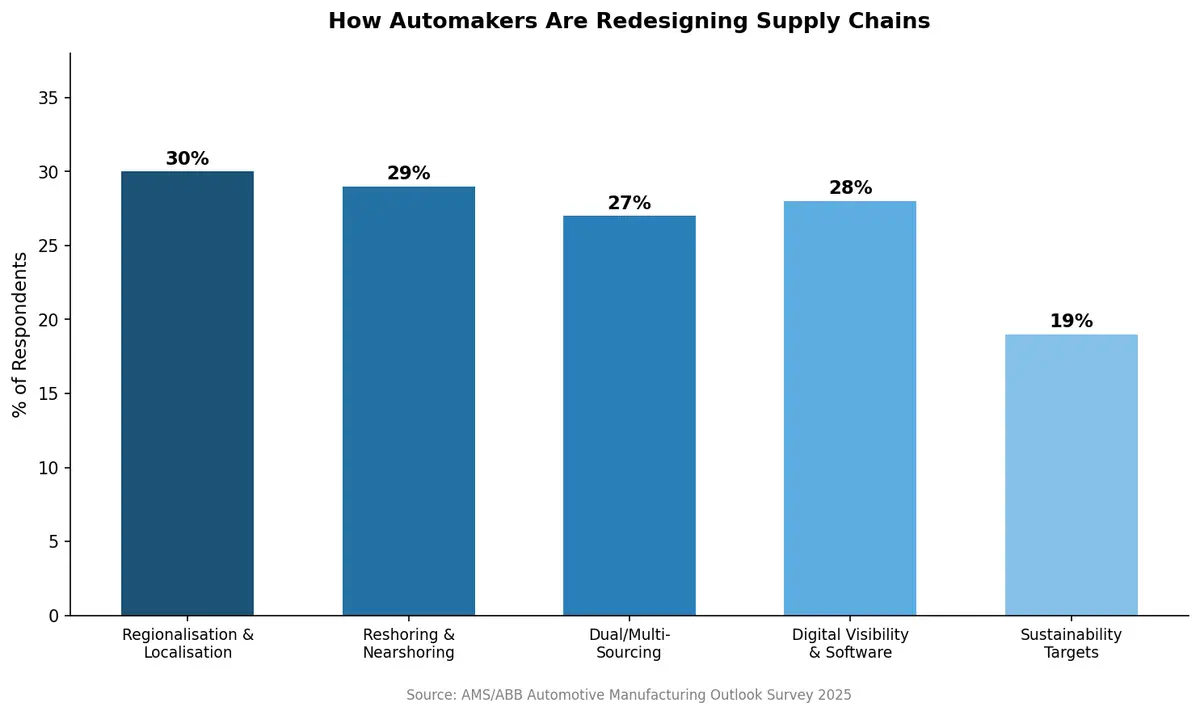
The AMS/ABB survey found that 30% of respondents are pursuing regionalization, localization, and hyper-localization strategies. Another 29% are actively shifting toward reshoring, nearshoring, or friendshoring — a proliferation of terminology that reflects genuine strategic complexity.
This isn't a preference. It's a pressure. USMCA rules of origin require that 75% of a vehicle's content must originate in North America to qualify for duty-free treatment. For automotive steel and aluminum, the threshold is even stricter. As the 2026 USMCA review opens three possible paths — extension, renegotiation, or termination — automakers face a planning nightmare where the rules of the game could change mid-play.
Meanwhile, 27% of survey respondents are shifting from single sourcing to dual or multi-sourcing strategies. When a single semiconductor shortage can idle entire assembly lines for months, the cost of redundancy suddenly looks cheap.
The EV Battery Supply Chain Problem
Electric vehicles don't just change what's under the hood. They change the entire logistics network.
A conventional internal combustion engine vehicle has roughly 30,000 parts sourced from established global networks. An EV battery pack alone requires lithium from Australia or Chile, cobalt from the Democratic Republic of Congo, nickel from Indonesia, and graphite overwhelmingly processed in China. Each material has its own geopolitical risk profile.
Battery electric vehicles are projected to reach 36% of new U.S. vehicle sales by 2026, according to ICCT research. That means more than a third of all new vehicles will require supply chains that barely existed at scale five years ago.
The EU is adding complexity with its forthcoming "Made in Europe" policy, which will require vehicles sold in the bloc to meet local content thresholds — potentially catching European-made vehicles with high Asian battery content. Chinese EV OEMs, despite facing tariffs from multiple regions, continue to expand internationally, creating competitive pressure that forces traditional automakers to accelerate their own supply chain transformations.
The Labor Dimension
Supply chain redesign requires people — and automotive manufacturers can't find them. Rising labor and skills shortages ranked as the second-biggest challenge at 37% in the AMS/ABB survey.
This isn't just a factory floor problem. The industry needs supply chain planners who understand multi-tier visibility, trade compliance specialists who can navigate overlapping tariff regimes, and logistics engineers who can design resilient networks from scratch. When these skills are scarce, even the best-funded transformation programs stall.
Software and digitalization for supply chain visibility ranked as a priority for 28% of respondents — a recognition that managing this complexity manually is no longer viable.
What Automotive Logistics Leaders Must Do Now
The manufacturers that will thrive aren't those with the lowest costs. They're those with the most adaptive supply chains. Key priorities for 2026:
Build multi-tier visibility. You can't manage what you can't see. With supply chains spanning multiple continents and regulatory regimes, real-time visibility into tier-2 and tier-3 suppliers is no longer optional.
Invest in trade compliance technology. Rules of origin calculations, tariff impact modeling, and customs automation need to be embedded in your TMS — not handled in spreadsheets after the fact.
Design for optionality. Dual sourcing, regional manufacturing hubs, and flexible routing aren't inefficiencies. They're insurance policies against the next disruption.
Digitize supplier collaboration. Poor collaboration and lack of standard processes were cited by 22% of survey respondents as a major challenge. Connected platforms that give suppliers, carriers, and assembly plants a shared view of demand and inventory are essential.
How TMS Platforms Power the Redesign
The complexity of modern automotive supply chains — multi-modal shipments across tariff zones, just-in-sequence delivery requirements, hazmat-classified battery materials, and constantly shifting trade rules — demands transportation management systems built for this reality.
CXTMS provides automotive manufacturers with the visibility, compliance automation, and multi-carrier orchestration needed to manage supply chains that are being redesigned in real time. From cross-border USMCA compliance to multi-tier supplier coordination, the platform turns supply chain complexity from a vulnerability into a competitive advantage.
Navigating automotive supply chain complexity? Contact CXTMS for a demo of how our TMS platform handles cross-border compliance, multi-tier visibility, and EV logistics challenges.