Cloud-Native Freight Management Systems: Why Shippers Are Abandoning On-Prem TMS for API-First Platforms in 2026

On-premise transportation management systems served the logistics industry well for two decades. But in 2026, they've become the single biggest bottleneck holding shippers back from the real-time, integration-heavy operations that modern supply chains demand. The global TMS market, valued at $15 billion in 2025 and growing at 10.6% CAGR through 2035, is being reshaped by a fundamental architectural shift: cloud-native, API-first platforms are replacing monolithic on-prem installations at an accelerating pace.
The On-Prem TMS Death Spiral
Legacy on-premise TMS platforms were designed for a world where carrier integrations numbered in the dozens and data moved in nightly batch files. That world no longer exists. Today's shippers need real-time connections to hundreds of carriers, marketplaces, ERPs, warehouse systems, and visibility platforms—all exchanging data continuously.
The pain points are well-documented. On-prem TMS implementations typically take 6–18 months and cost between $500,000 and $5 million, according to Mordor Intelligence's TMS market analysis. Upgrade cycles lock organizations into 12–18 month release schedules, meaning critical features and security patches arrive months after they're needed. Scaling requires hardware procurement, capacity planning, and IT staff—resources most logistics teams can't spare.
Worst of all, every new integration becomes a custom development project. When a shipper using on-prem TMS wants to connect a new carrier API, a freight marketplace, or a real-time visibility feed, they're looking at weeks or months of development work rather than days.
What "Cloud-Native" Actually Means for Freight
Cloud-native isn't just "hosted in the cloud." It's a fundamentally different architecture built on three pillars:
Microservices architecture breaks the TMS into independent, loosely coupled services—rate shopping, route optimization, carrier booking, document generation, and analytics each run as separate services that can be updated, scaled, and debugged independently. When your rating engine needs more compute during RFP season, only that service scales up.
API-first design means every function in the platform is accessible through documented, versioned REST or GraphQL APIs. New carrier integrations, ERP connections, or custom workflows can be built by any developer using standard tooling—no proprietary SDK required.
Event-driven processing replaces batch operations with real-time data streams. Instead of importing tracking updates every 15 minutes, cloud-native platforms process carrier events as they happen, enabling true real-time visibility and proactive exception management.
The API-First Advantage: Integrations in Days, Not Months
The most compelling reason shippers are migrating is integration velocity. Multi-tenant cloud platforms with open APIs can onboard new carrier connections in days rather than the weeks or months required by on-prem systems. According to Logistics Management's coverage of Gartner's supply chain technology trends, connectivity and intelligence are the defining priorities for supply chain technology in 2025 and 2026—and API-first architecture is the foundation that makes both possible.
Consider what this means in practice. A mid-market shipper using a cloud-native TMS can:
- Connect 200+ carriers through pre-built API integrations without custom development
- Add new freight marketplaces for dynamic capacity procurement in hours
- Sync with ERP and WMS systems bidirectionally in real-time, not overnight batches
- Deploy custom workflows using webhooks and event triggers without touching core platform code
- Access new platform features monthly, not annually, with zero-downtime deployments
This integration velocity directly translates to competitive advantage. When spot market conditions shift, cloud-native shippers can onboard alternative carriers and capacity sources faster than on-prem competitors can file a change request.
TCO: The Five-Year Math Favors the Cloud
The total cost of ownership comparison between cloud-native and on-premise TMS has tipped decisively in favor of cloud platforms. Cloud-based TMS solutions deliver 15–25% freight-cost reductions by pooling shipper demand, automating carrier selection through real-time rate shopping, and scaling compute elastically during peak seasons.
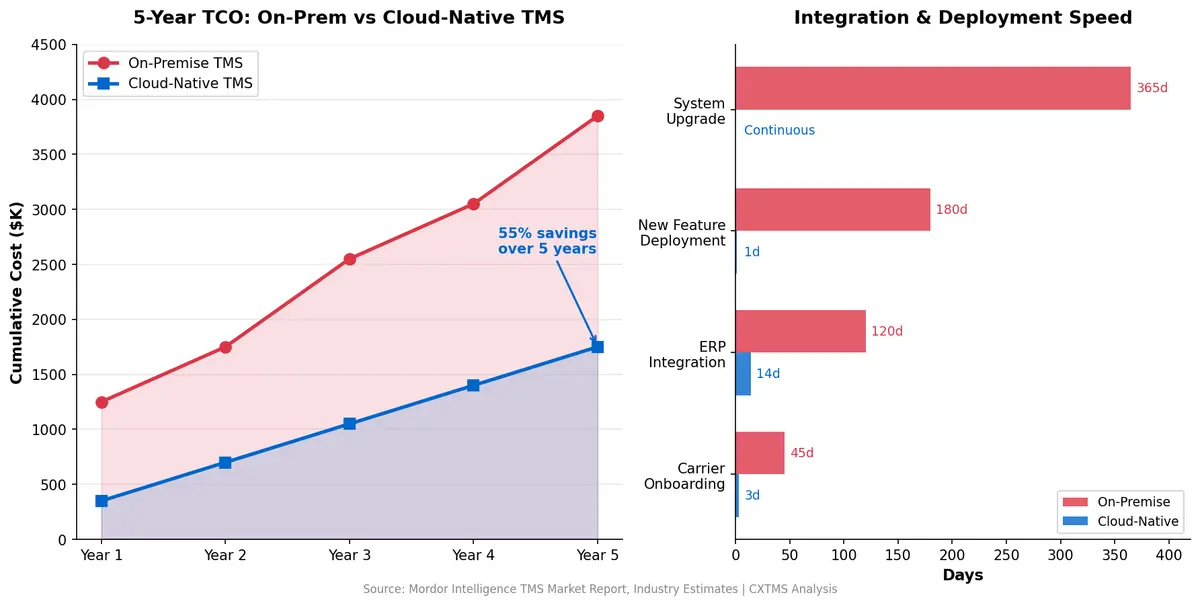
Here's how the five-year TCO typically breaks down:
On-premise TMS (mid-market shipper):
- Initial license and implementation: $500K–$2M
- Annual maintenance and support: $100K–$300K
- Infrastructure (servers, networking, security): $50K–$150K/year
- IT staff for maintenance and upgrades: $150K–$300K/year
- Major version upgrades (every 2–3 years): $200K–$500K each
Cloud-native TMS:
- Implementation and configuration: $50K–$200K
- Annual subscription (usage-based): $100K–$400K
- Infrastructure costs: included in subscription
- IT staff for TMS: minimal (platform-managed)
- Upgrades: continuous, included in subscription
Over five years, mid-market shippers consistently report 30–45% lower TCO with cloud-native platforms, even before accounting for the revenue impact of faster integration deployment and real-time optimization capabilities.
Real-Time Streaming vs. Batch: Why It Matters
The architectural difference between streaming and batch processing isn't just technical—it has direct operational impact. On-prem TMS platforms typically process carrier updates, rate changes, and shipment events in scheduled batch jobs running every 15–60 minutes.
Cloud-native platforms process events in real-time through message queues and streaming architectures. This means:
- Exception alerts fire within seconds of a delay, not after the next batch cycle
- Rate shopping uses live carrier pricing, not yesterday's rate tables
- Capacity availability reflects current market conditions, not stale snapshots
- Customer tracking pages update continuously, improving shipper-of-choice status
For high-volume shippers managing thousands of daily shipments, the difference between 15-minute-old data and real-time data translates directly to fewer missed pickups, lower detention charges, and better carrier relationships.
The Migration Playbook: Moving Without Disruption
The biggest fear holding shippers back from cloud migration is operational disruption. A proven migration approach minimizes risk:
Phase 1 — Parallel operation (4–6 weeks): Run the cloud-native TMS alongside the legacy system for a subset of lanes or modes. Compare outputs to validate rating accuracy and routing logic.
Phase 2 — Graduated cutover (8–12 weeks): Shift traffic mode by mode or region by region. Start with the simplest freight (e.g., domestic FTL) and progress to complex multi-modal and international shipments.
Phase 3 — Legacy decommission (4–8 weeks): Once all traffic runs through the cloud platform, decommission on-prem infrastructure and redirect IT resources to analytics and optimization initiatives.
The entire migration typically completes in 4–6 months—a fraction of the original on-prem implementation timeline—because cloud-native platforms come with pre-built carrier integrations and configurable workflows that eliminate custom development.
The Bottom Line
The shift from on-premise to cloud-native TMS isn't a technology trend—it's a structural transformation in how logistics operations are built and run. With the TMS market growing at 10.6% annually, the platforms capturing that growth are cloud-native, API-first, and designed for the integration-intensive reality of modern freight management. Shippers still running on-prem systems aren't just paying more—they're moving slower in an industry where speed is everything.
Ready to see what a cloud-native, API-first TMS can do for your freight operations? Contact CXTMS for a personalized demo.