Generative AI Transforms Logistics Customer Service: How Autonomous Support Agents Handle 70% of Shipper Inquiries Without Human Intervention

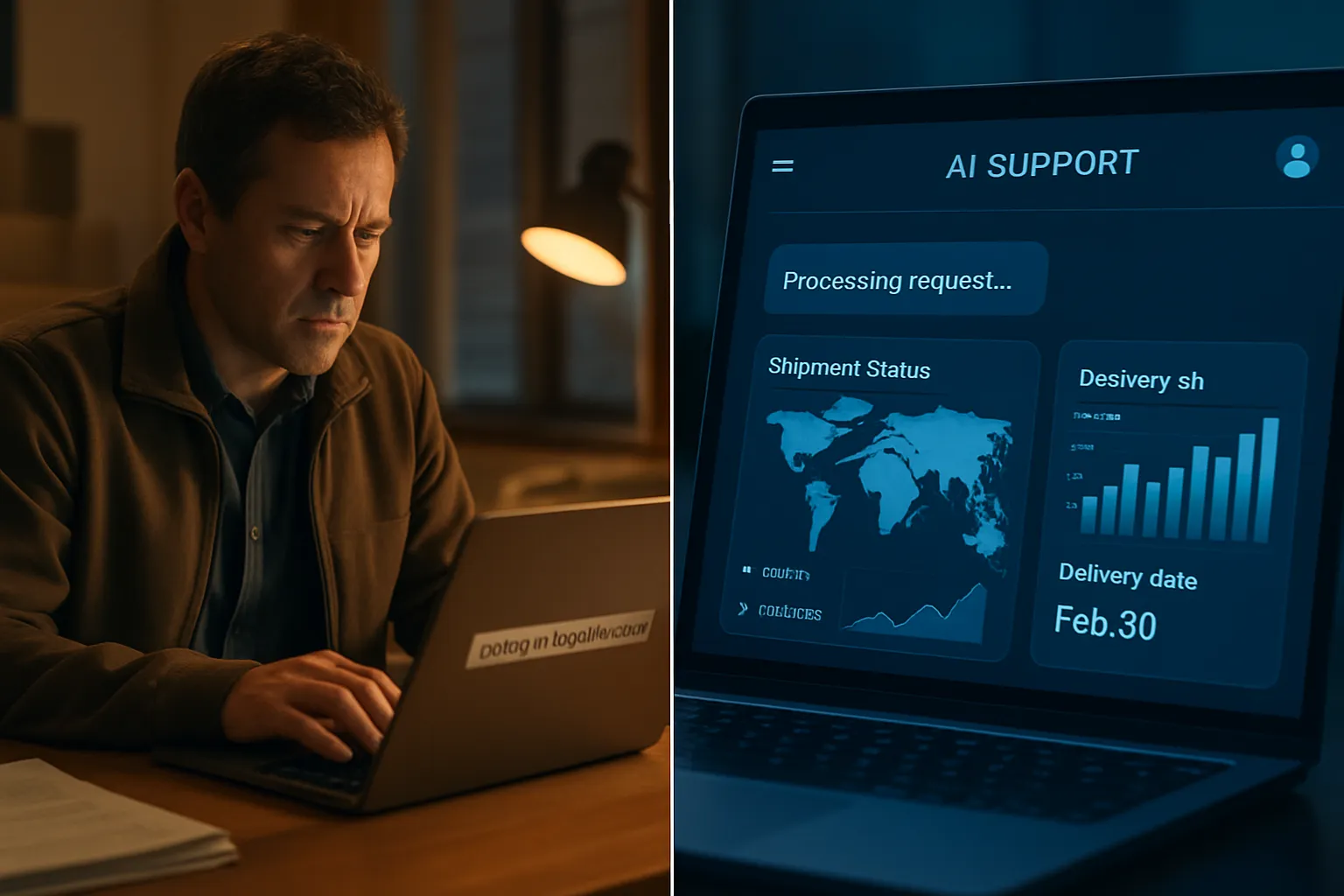
Ask any logistics customer service manager what their team spends most of its time on, and you'll get the same answer: "Where is my shipment?" calls. Tracking updates. Rate quote requests. Appointment rescheduling. Claims status checks. The repetitive, data-retrieval-heavy inquiries that consume 60–80% of agent hours while adding minimal strategic value.
In 2026, generative AI is finally changing that equation — not with the clunky rule-based chatbots that logistics companies have endured for a decade, but with autonomous support agents that understand natural language, pull live data from transportation management systems, and resolve complex multi-step inquiries without ever routing to a human.
The Logistics Customer Service Bottleneck
Freight customer service has a structural problem that most industries don't face. Unlike retail or SaaS support, logistics inquiries almost always require real-time data from multiple systems — a TMS for shipment status, a WMS for inventory, carrier APIs for transit updates, a claims platform for dispute resolution. Traditional chatbots couldn't bridge those systems. Traditional IVR menus couldn't parse the complexity. So customers waited.
The numbers paint a grim picture. Industry surveys consistently show that freight brokerages and 3PLs average 8–15 minute hold times for phone inquiries, with email response times stretching to 24–72 hours. A 2025 supply chain survey found that 40% of logistics companies are already piloting AI customer service chatbots, but most early deployments were limited to FAQ deflection and basic tracking lookups — nothing approaching true autonomous resolution.
The cost is significant. A mid-size 3PL handling 50,000 shipments per month might field 15,000–25,000 customer service interactions monthly. At an average fully loaded cost of $8–12 per interaction for human agents, that's $120,000–$300,000 per month in customer service operations — much of it spent answering the same questions about the same shipments.
Beyond Chatbots: Generative AI Agents That Actually Understand Freight
The difference between a 2023-era logistics chatbot and a 2026 generative AI support agent isn't incremental — it's architectural. Legacy chatbots operated on decision trees: if the customer says "tracking," present a text box for a PRO number. If the PRO number returns a result, display the last scan. If not, route to a human.
Generative AI agents work differently. They understand conversational context, interpret ambiguous requests, and orchestrate multi-system data retrieval in real time. A shipper can say, "I had a shipment pick up from our Dallas facility last Tuesday going to our Chicago DC — can you check if it delivered and send me the POD?" The AI agent parses the request, searches the TMS by origin, destination, and date range, identifies the matching shipment, confirms delivery status, retrieves the proof-of-delivery document, and emails it to the requester — all in under 30 seconds.
This isn't theoretical. As reported by SupplyChainBrain, logistics technology providers are already deploying agentic AI that autonomously handles tasks previously requiring dedicated customer service representatives and department managers. Multiple AI agents collaborate with each other and with large language models to manage complex workflows end to end.
The 70% Deflection Milestone
Gartner predicts that agentic AI will autonomously resolve 80% of common customer service issues without human intervention by 2029, leading to a 30% reduction in operational costs across service organizations. Leading logistics companies aren't waiting for 2029 — early adopters are already reaching 65–75% autonomous resolution rates on freight-specific inquiries.
The inquiries most amenable to AI resolution follow a clear pattern:
- Shipment tracking and status updates (WISMO): 85–95% autonomous resolution. The AI pulls real-time data from carrier APIs and TMS records, interprets transit exceptions, and provides contextual ETAs — not just last-scan locations.
- Rate quote requests: 70–80% autonomous resolution. For standard lanes with established pricing, the AI generates instant quotes by referencing contracted rates, applying current fuel surcharges, and factoring in accessorial estimates.
- Appointment scheduling and rescheduling: 60–75% autonomous resolution. Integration with warehouse management and dock scheduling systems allows the AI to check availability and confirm appointments without human coordination.
- Claims status inquiries: 65–80% autonomous resolution. The AI accesses the claims management system, provides current status, explains next steps, and attaches relevant documentation.
- Invoice and billing questions: 55–70% autonomous resolution. The AI cross-references invoices against contracted rates, identifies discrepancies, and initiates dispute workflows.
Where the math gets compelling is in the compound effect. A 3PL that achieves 70% deflection on 20,000 monthly interactions eliminates 14,000 human-handled contacts. At $10 per interaction, that's $140,000 in monthly savings — or $1.68 million annually — while simultaneously improving response times from hours to seconds.
The Integration Architecture That Makes It Work
Autonomous resolution rates depend entirely on the AI agent's ability to access and act on real-time data. A generative AI agent without system integrations is just a more articulate FAQ page. The integration architecture that enables true autonomous customer service includes:
TMS Integration: The backbone of freight customer service automation. The AI agent needs read access to shipment records, tracking events, rate data, and document repositories. Modern TMS platforms expose REST APIs that support real-time queries, but legacy systems may require middleware or RPA bridges.
Carrier API Connectivity: For live tracking beyond what's cached in the TMS, the AI agent connects directly to carrier tracking APIs — LTL carrier portals, truckload ELD/GPS feeds, parcel tracking systems, and ocean container tracking platforms.
CRM and Communication Platforms: The AI agent operates across channels — phone (via voice AI), email, web chat, SMS, and even WhatsApp or Teams. Each interaction is logged in the CRM with full context, so if a human agent eventually needs to step in, they have complete conversation history.
Document Management: Retrieving and sending BOLs, PODs, rate confirmations, and invoices requires integration with document management systems or the TMS document store.
Handling Edge Cases: The Human Handoff That Preserves Trust
The 30% of inquiries that generative AI can't resolve autonomously are often the ones that matter most — high-value account escalations, complex claims disputes, service failure recovery, and relationship-sensitive situations. The quality of the AI-to-human handoff determines whether customers perceive the AI as helpful or frustrating.
Best-in-class implementations follow three principles:
- Transparent escalation: The AI explicitly tells the customer it's transferring them to a specialist and explains why, rather than silently dropping the conversation.
- Full context transfer: The human agent receives the complete conversation transcript, the AI's attempted resolution steps, and pre-pulled data — so the customer never repeats themselves.
- Continuous learning: Every escalation becomes training data. The AI analyzes why it couldn't resolve the inquiry and adjusts its confidence thresholds and resolution pathways.
Multilingual and Multi-Channel: Supporting Global Shippers
One advantage generative AI holds over human support teams is linguistic flexibility. A logistics company serving shippers across North America, Latin America, and Europe would need multilingual agents across multiple time zones. A generative AI agent handles Spanish, Portuguese, French, and German inquiries with the same fluency as English — and does it at 3 AM on a Saturday.
According to Deloitte's State of AI in the Enterprise report, agentic AI is expected to have its highest impact in customer support, with enterprises already deploying autonomous AI agents across diverse functions including supply chain management. The combination of multi-channel deployment (voice, chat, email, SMS) with multilingual capability means a single AI system can replace what previously required multiple regional support teams.
What This Means for Freight Operations in 2026
The shift toward AI-powered logistics customer service isn't just about cost savings — it's about competitive differentiation. In an industry where service quality has historically been measured by the responsiveness of your customer service team, the companies that deploy effective AI support agents gain a structural advantage: faster response times, 24/7 availability, consistent accuracy, and the ability to scale service capacity without scaling headcount.
For shippers, the implication is clear: when evaluating 3PLs, brokers, and carriers, ask about their AI customer service capabilities. The providers investing in autonomous support aren't just cutting costs — they're delivering a fundamentally better customer experience.
How CXTMS Powers AI-Assisted Customer Interactions
CXTMS is built with the API-first architecture that autonomous AI support agents require. Real-time shipment visibility, rate intelligence, document management, and workflow automation are all accessible through structured APIs — enabling AI agents to pull live data, execute actions, and deliver instant resolution to shipper inquiries.
Whether your team is exploring AI-powered support for the first time or looking to improve deflection rates on an existing deployment, CXTMS provides the connected data foundation that makes autonomous customer service possible.
Ready to see how AI-powered customer intelligence works with CXTMS? Request a demo today and discover how connected freight data enables the next generation of logistics customer service.