The Fuel Surcharge Lag Problem: Why Shippers Overpay During Diesel Spikes and Under-Recover During Drops

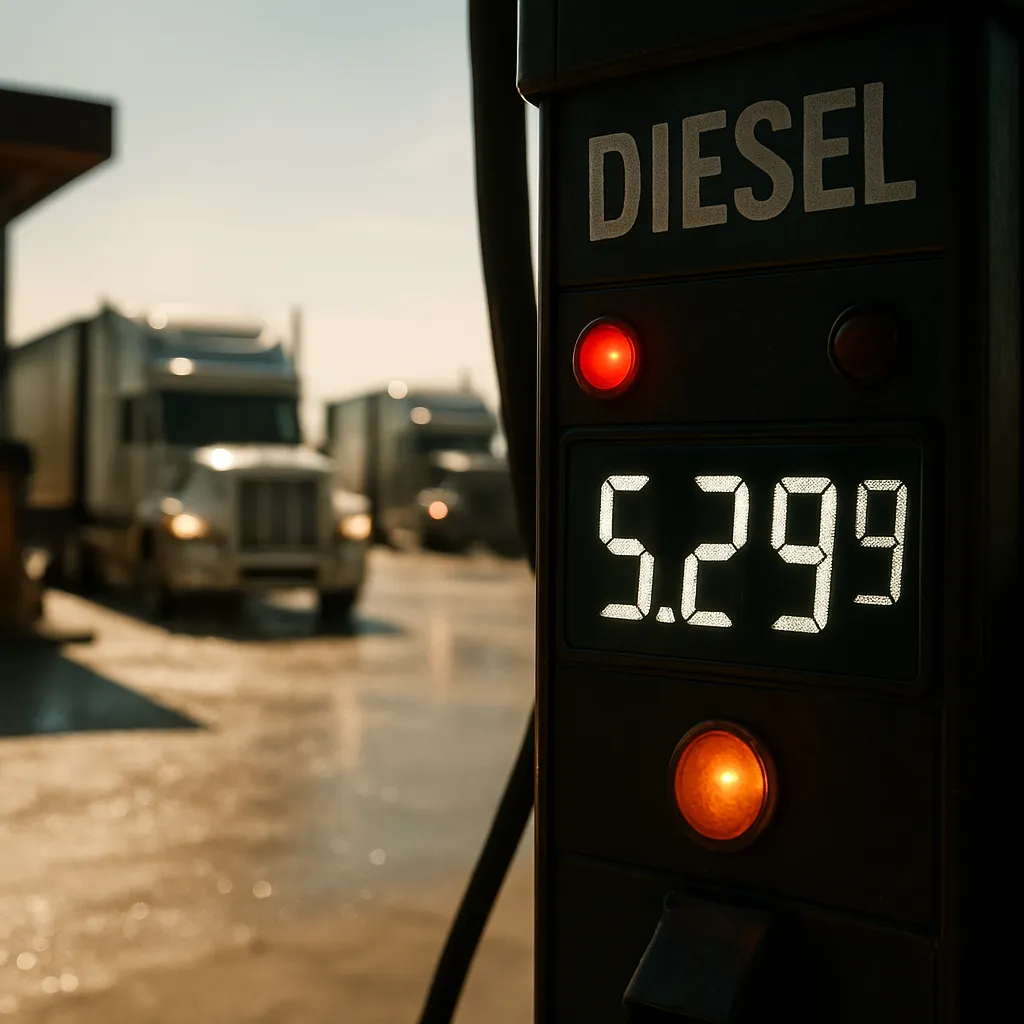
On March 16, 2026, U.S. diesel prices crossed $5 per gallon for the first time since 2022 — a 36% spike in a single month driven by Middle East conflict disrupting flows through the Strait of Hormuz. For shippers watching their freight invoices, the sticker shock wasn't the diesel price itself. It was how long it took their fuel surcharges to catch up — and how slowly those surcharges will fall when prices eventually retreat.
This is the fuel surcharge lag problem, and it quietly costs shippers billions of dollars every year.
How Fuel Surcharges Actually Work
Most shippers understand fuel surcharges as a line item on their freight invoice. Far fewer understand the mechanics behind how that number is calculated — and where the asymmetry hides.
The standard fuel surcharge (FSC) formula in truckload and LTL shipping is tied to the U.S. Department of Energy's (DOE) weekly retail diesel price report, published every Monday by the Energy Information Administration (EIA). Carriers use a base diesel price — typically between $1.10 and $1.25 per gallon — and apply an escalator for every incremental increase above that base.
For truckload shipments, surcharges are commonly expressed as cents per mile. For LTL, they're typically a percentage of the linehaul rate. In both cases, the DOE national average is the benchmark — and the weekly publication cycle is where the lag begins.
Here's the structural problem: diesel prices at the pump change daily, sometimes hourly. But the DOE index that drives surcharge calculations updates once per week. Many carrier contracts then apply a further delay — using the previous week's DOE number to calculate the current week's surcharge. Some LTL carriers update monthly, using data that can be two to four weeks old by the time it hits an invoice.
The Asymmetry: Surcharges Rise Faster Than They Fall
The lag wouldn't matter if it were symmetrical. But decades of freight market data reveal a consistent pattern: surcharges escalate quickly when diesel prices spike, but ratchet down slowly when prices decline.
Why? Several structural factors converge:
Carrier contract design favors upside protection. Most fuel surcharge tables use aggressive escalation brackets on the way up (e.g., a 1-cent-per-mile increase for every 5-cent rise in diesel) but more conservative de-escalation thresholds on the way down. Some contracts include minimum surcharge floors that prevent the FSC from dropping below a set percentage, even when diesel prices fall significantly.
Weekly averaging smooths spikes but prolongs elevated charges. When diesel jumps 30 cents in a week, the DOE average captures most of that increase. But when prices decline gradually over several weeks, the weekly average lags behind the daily reality at the pump, keeping surcharges elevated longer than actual fuel costs justify.
Billing cycles add another layer. Between invoice generation, payment terms, and carrier settlement, the effective surcharge on a given shipment may reflect diesel prices from three to six weeks before the truck actually moved.
Quantifying the Overpayment: The $5 Diesel Case Study
The March 2026 diesel spike provides a real-time case study in surcharge lag economics.
According to ATRI's 2025 Operational Costs of Trucking report, fuel costs averaged $0.48 per mile in 2024, when diesel averaged approximately $3.85 per gallon nationally. That made fuel roughly 21% of the total $2.26 per-mile operating cost for the average carrier.
Now consider the March 2026 environment: diesel surging past $5.00 per gallon — a 30% increase over the 2024 average. For a typical 1,000-mile truckload shipment, the actual incremental fuel cost at the pump is approximately $115 to $140 above the contracted base rate assumption.
But here's what the surcharge formula captures in real time: because most carrier contracts are using the DOE index from the prior week — when diesel was still climbing from $4.50 to $4.80 — the surcharge applied to shipments moving this week understates actual fuel costs by $30 to $50 per load. Across a mid-market shipper moving 500 loads per month, that's $15,000 to $25,000 in under-recovered fuel cost that carriers absorb in the short term, only to over-recover on the back end when prices fall and the surcharge adjusts downward more slowly.
The net effect for shippers? They overpay during the long tail of the decline and underpay briefly at the spike. Annualized across a full cycle of volatility, the asymmetry costs shippers an estimated 3-5% more in fuel-related freight charges than the actual underlying fuel cost would justify.
Why This Matters More in 2026
Fuel has always been a major cost center in trucking. ATRI data consistently shows it representing 21-28% of total cost per mile depending on the diesel price environment. In 2024's relatively moderate fuel market, it dipped to 21%. In 2022's $5+ environment, it peaked near 28%.
With diesel back above $5 in March 2026 — and economists at Nationwide warning that CPI inflation could climb to 4.4% as transportation costs cascade through the economy — the surcharge lag problem isn't an academic exercise. It's a budget-busting reality for any shipper that hasn't modernized their fuel cost management approach.
Major parcel carriers have already responded to the environment. Both FedEx and UPS have increased their fuel surcharge tables and implemented temporary fees for shipments to conflict-affected regions. But for truckload and LTL shippers negotiating directly with carriers, the standard DOE-linked surcharge formula remains the default — and the lag remains embedded.
Strategies to Close the Gap
Smart shippers aren't accepting the standard surcharge formula as immutable. Here are the negotiation levers that are gaining traction in 2026:
Real-time or daily indexing. Some progressive carrier contracts now tie surcharges to daily OPIS or Platt's diesel benchmarks rather than the weekly DOE average. This compresses the lag from 7-14 days to 24-48 hours.
Surcharge caps and corridors. Negotiating maximum surcharge percentages or dollar-per-mile caps protects shippers from runaway fuel costs during spikes. Conversely, establishing minimum corridor widths prevents carriers from maintaining inflated surcharges during prolonged declines.
Fuel cost-sharing models. Rather than a formulaic surcharge, some shipper-carrier partnerships use transparent fuel cost-sharing where actual fuel purchase receipts drive reimbursement. This eliminates the index lag entirely but requires higher trust and data transparency.
Multi-carrier benchmarking. Comparing fuel surcharge structures across your carrier portfolio reveals which contracts have the widest lag gaps. Even small improvements — moving from monthly to weekly resets, or eliminating a one-week delay — can save six figures annually for high-volume shippers.
Hedging and procurement strategy. Large fleet operators and sophisticated 3PLs are using diesel futures and forward contracts to lock in fuel costs, decoupling their actual fuel expense from the DOE index entirely. Shippers can negotiate to benefit from these hedging programs through contractual fuel price guarantees.
How CXTMS Helps Shippers Model Fuel Surcharge Exposure
Managing fuel surcharge complexity across dozens of carrier contracts, each with different base rates, escalation tables, and update frequencies, requires technology purpose-built for the problem.
CXTMS provides freight cost modeling that decomposes every shipment's total cost into linehaul, fuel surcharge, accessorials, and ancillary charges — then benchmarks each component against market rates and actual DOE data. When diesel prices spike, CXTMS's rate comparison engine instantly identifies which carrier contracts offer the most favorable surcharge structures for specific lanes, enabling shippers to route freight toward contracts with tighter lag windows and more favorable escalation brackets.
The platform's scenario modeling capabilities let logistics teams project total freight spend under different diesel price assumptions — critical for budgeting when fuel costs can swing 30% in a single month.
Fuel volatility isn't going away in 2026. The question isn't whether diesel will spike again — it's whether your surcharge structures are designed to protect you when it does. Request a CXTMS demo to see how real-time fuel cost modeling can close the surcharge gap and put millions back on your bottom line.