Depalletizing Has Quietly Become One of Warehouse Automation’s Most Useful 2026 Use Cases

Depalletizing used to be the kind of warehouse task everyone hated and nobody bragged about fixing.
It is repetitive, physical, injury-prone, and usually parked in the “we’ll deal with it later” bucket while leadership chases flashier automation projects.
That logic is getting outdated.
In 2026, depalletizing has become one of the most practical warehouse automation use cases because it sits exactly where modern operators feel the most pain: inbound bottlenecks, labor scarcity, ergonomics, and mixed-SKU complexity. It is not sexy. It is useful. In warehouse operations, useful wins.
A recent Modern Materials Handling look at the space makes the shift obvious. In one deployment, Lakeside Book Company automated a heavy, variable mixed-case depalletizing process and eliminated the need for manual handling of more than 45 million pounds annually. The system also reached more than nine cases per minute, beating initial projections. That is not a lab demo. That is a real inbound throughput problem getting solved with a very sharp knife. Source: Best Practices: Depalletizing moves into the automation era.
The broader market is moving in the same direction. MMH’s 2026 Automation Study reports that companies invested about $21 billion in warehouse automation in 2023, and that figure is expected to exceed $90 billion by 2033, a 329% increase over ten years. Among the 120-plus professionals surveyed, the pressure points are familiar: faster order fulfillment, labor availability, uptime, integration, and ROI. Read that here: 2026 Automation Study: Warehouse automation ticks upward.
That matters because depalletizing checks all the boxes executives say they care about, but it does so in a part of the building where the operational drag is brutally obvious.
Why depalletizing matters more now
For years, automated depalletizing struggled with the warehouse equivalent of bad timing.
The use case was real, but the technology was often too rigid, too expensive, or too brittle when faced with mixed loads, packaging variation, and real-world inbound chaos. Warehouses still needed people to wrestle cartons off pallets because the robots could not reliably see, grip, and adapt.
That has changed.
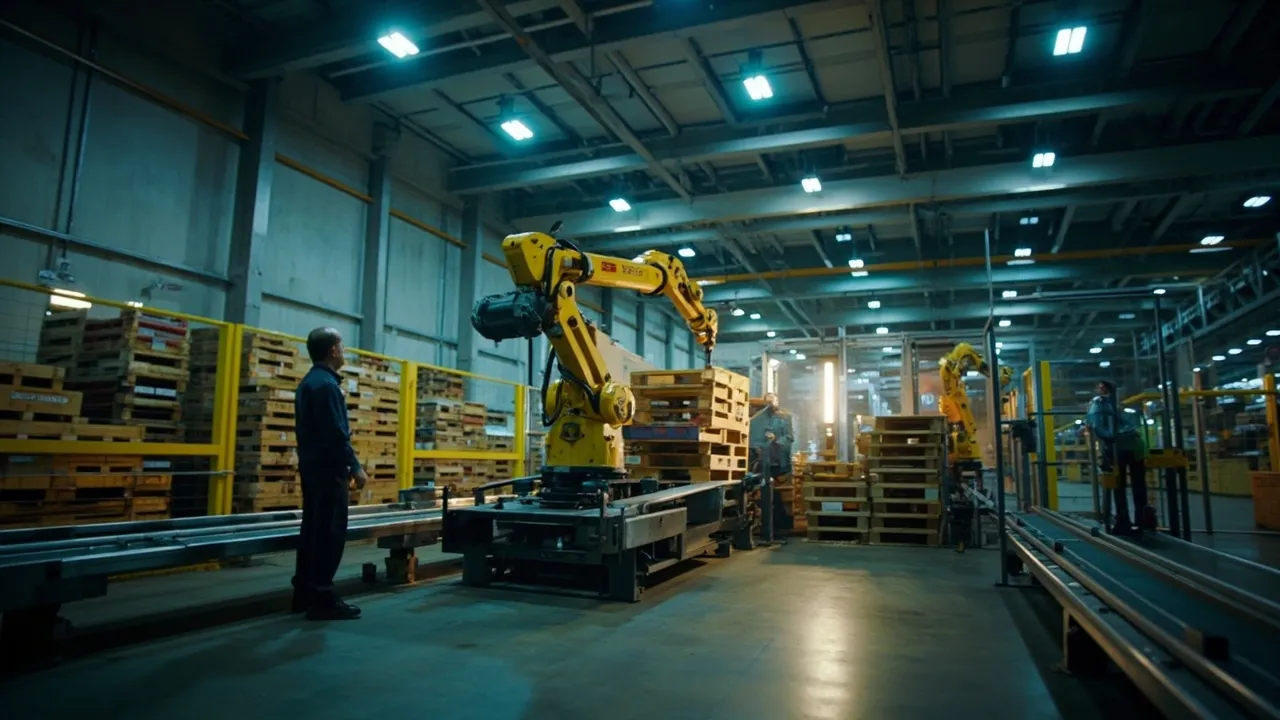
Modern systems combine better 3D vision, AI-assisted object recognition, stronger end-of-arm tools, and smarter motion planning. According to MMH’s reporting, vendors are improving everything from suction and clamp mechanisms to real-time path planning for irregular loads. That matters because inbound pallets are not clean little textbook cubes anymore. They are messy, heterogeneous, and often stacked in ways that seem personally insulting.
At the same time, labor economics have made manual depalletizing look even worse. It is one of the hardest jobs to staff, and when it is staffed, it creates a disproportionate ergonomic burden. MMH cites supplier feedback that standardized depalletizing cells can deliver ROI in as little as 18 months, while also reducing back injuries and other lifting-related strain.
Better technical performance and faster payback are why depalletizing has quietly moved from edge case to priority candidate.
This is really an inbound speed story
The biggest mistake in thinking about depalletizing is treating it as a standalone robotics story.
It is not.
It is an inbound flow story.
Every minute lost breaking down inbound pallets slows putaway, delays replenishment, increases congestion, and creates labor ripple effects that spread far beyond receiving. If pallets pile up at the front end of the building, the rest of the operation starts compensating in ugly ways.
Depalletizing automation matters because it helps warehouses convert physical arrival into usable inventory faster. That is especially important in facilities dealing with store replenishment, grocery, beverage, publishing, automotive, or 3PL flows where inbound velocity and variability are both high.
MMH’s 2026 Automation Study reinforces the point. The research found that 95% of buyers now rate fast service response times as essential, 92% rank durability, reliability, and uptime as very important, and 77% emphasize total cost of ownership, ROI, and maintenance costs. Those are not preferences for gadget buyers. Those are priorities from operators trying to keep freight moving.
Depalletizing fits because the use case is easy to connect to measurable outcomes:
- faster inbound processing
- reduced manual touches
- fewer ergonomic injuries
- more consistent conveyor or sortation feed
- better labor redeployment into higher-value tasks
That is much easier to defend than automation theater.
Mixed-SKU complexity is what made this practical
The old knock against depalletizing automation was simple: it worked fine until reality showed up.
Single-SKU pallets are easy. Mixed retail inbound is not.
What changed is that vision systems and AI-assisted recognition have improved enough to deal with more packaging variation, graphic changes, and irregular layer patterns without requiring the operation to baby the system constantly. MMH notes that AI-based vision gives robots a 3D understanding of pallet structure, making it easier to identify and pick individual cases without disturbing surrounding product.
That matters because mixed-SKU receiving is exactly where warehouses lose the most time and patience.
A robot that can only handle perfect pallets is a nice booth demo. A robot that can work through ugly inbound reality is an operations asset.
The MODEX 2026 innovation cycle also points in the same direction. MHI’s coverage of the event highlighted how automation continues to anchor supply chain modernization and how robotics innovation remains one of the core categories buyers are watching. Source: Innovation on display at Modex 2026.
How operations leaders should prioritize it
Not every manual warehouse task deserves automation first.
Depalletizing should move up the list when four conditions are true.
First, the task is hard to staff and creates visible safety risk.
Second, inbound volume creates downstream disruption. If receiving bottlenecks regularly delay putaway, replenishment, or production staging, depalletizing is a system constraint.
Third, pallet variability is high enough that manual work is inconsistent, but stable enough that a properly configured vision-and-gripper system can still produce repeatable gains.
Fourth, the operation has a clear place to send the output. Automated depalletizing works best when it feeds a broader orchestration layer that includes conveyors, WMS rules, sortation logic, replenishment priorities, and labor planning.
That last point matters most.
The best depalletizing project is not “buy robot, done.” It is “remove one ugly manual choke point so the inbound system can breathe.”
The practical automation era favors ugly problems
Warehouse automation in 2026 is maturing. Buyers are less interested in hype and more interested in whether a technology can survive contact with real freight, real labor shortages, and real budget scrutiny.
Depalletizing now looks strong by that standard.
It solves a task people do not want, in an area where throughput matters, with technology that has gotten materially better at handling variability. When one system can remove 45 million pounds of annual manual handling, exceed nine cases per minute, and potentially pay back in around 18 months, this stops being a niche robotics conversation.
It becomes an operations decision.
That is exactly where it belongs.
If your warehouse team is trying to modernize inbound execution, improve throughput, and connect automation to the systems that actually run the floor, book a CXTMS demo and see how CXTMS helps logistics operators turn isolated tools into coordinated execution.