AI Freight Procurement Agents Are Here: How Autonomous Tendering Is Reshaping Carrier Negotiations in 2026

Freight procurement has long been one of the most labor-intensive, spreadsheet-heavy processes in supply chain management. Twice a year, transportation teams launch massive RFP cycles, manually collecting bids from dozens of carriers, comparing rates in Excel, and negotiating contracts lane by lane. With U.S. logistics costs reaching $2.3 trillion annually and transportation representing the single largest component, even small procurement inefficiencies translate into millions of dollars in lost savings.
That's about to change. In March 2026, a new category of logistics technology has emerged: AI freight procurement agents — autonomous systems that can run RFPs, evaluate carrier bids, benchmark rates against live market data, and even negotiate contract renewals without human intervention. This isn't incremental automation. It's a fundamental shift from periodic, reactive procurement to continuous, AI-driven sourcing.
What AI Freight Procurement Agents Actually Do
Unlike traditional procurement software that digitizes manual workflows, AI freight procurement agents operate autonomously within defined guardrails. These systems can:
- Continuously monitor contracted rates against real-time market benchmarks, identifying lanes where shippers are overpaying
- Autonomously launch digital mini-bids on underperforming lanes without waiting for the next annual RFP cycle
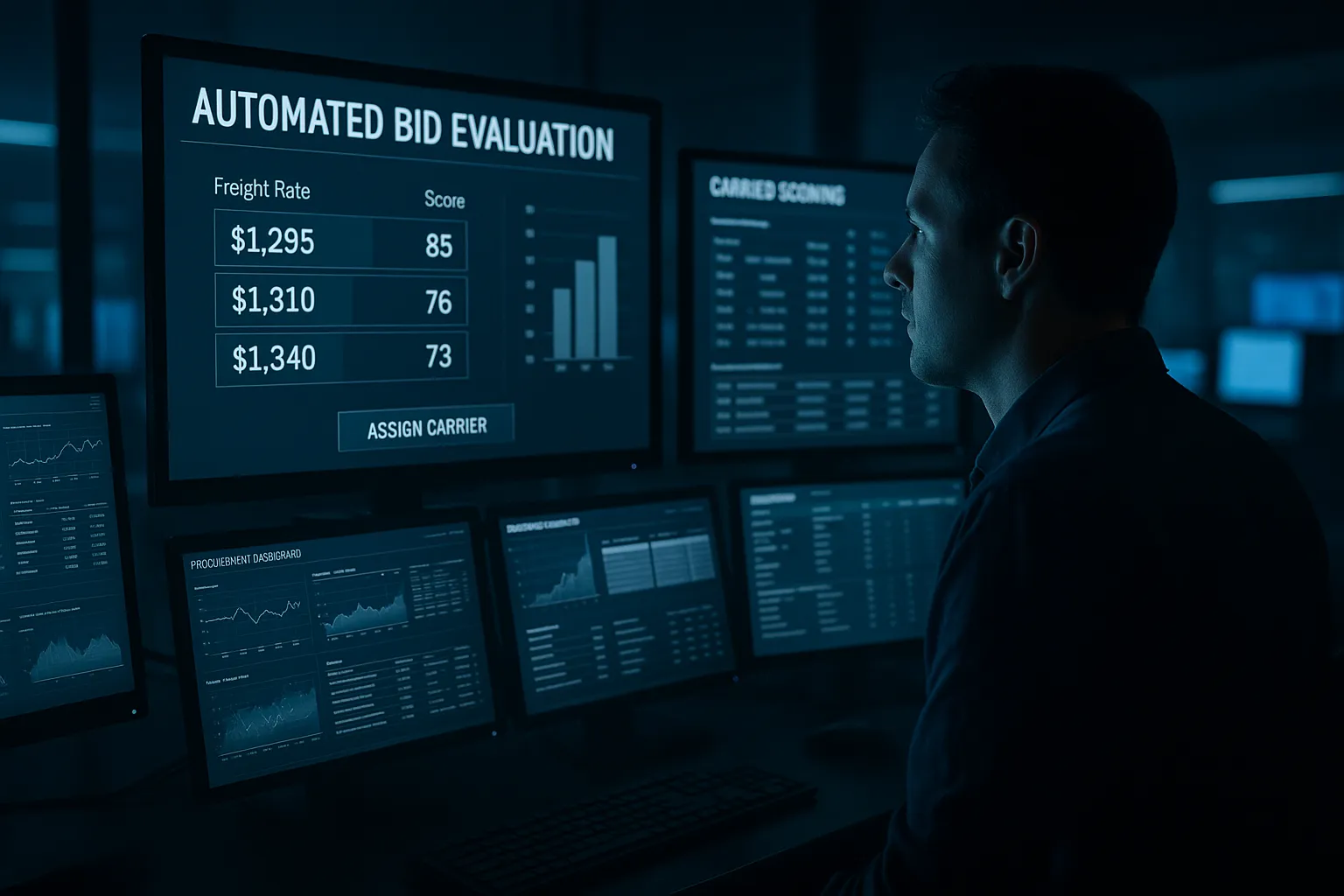
- Evaluate carriers across multiple dimensions — cost, transit time, service reliability, and compliance history — simultaneously
- Execute or recommend awards based on configurable business rules, with full audit trails
- Negotiate renewals within pre-approved rate thresholds, escalating to human review only when parameters are exceeded
The key distinction is agency. These systems don't just present dashboards and wait for a human to act. They identify opportunities, take action, and report results — operating more like a junior procurement analyst than a software tool.
The March 2026 Wave: Why Now?
Several converging forces have made autonomous freight procurement viable in 2026.
First, data density has reached critical mass. Modern logistics platforms now process hundreds of millions of shipment events daily across hundreds of thousands of carriers. This creates the real-time market intelligence that procurement agents need to benchmark rates accurately and identify savings opportunities as they emerge.
Second, agentic AI architectures have matured. According to Inbound Logistics, industry leaders rate AI's expected usefulness in supply chain management at 8 out of 10 for 2026, with agentic AI — systems that can take autonomous action — identified as a key scaling trend. DHL Supply Chain's VP of Analytics, Eric Walters, noted that "agentic AI will automate routine communication to improve efficiency" as many AI projects scale this year.
Third, procurement teams are stretched thin. McKinsey's 2025 report on procurement transformation found that companies now manage 50% more spend per employee than five years ago. The talent gap is real: there simply aren't enough procurement professionals to run continuous optimization across thousands of lanes manually.
Early Results: What the Data Shows
Early deployments of AI freight procurement agents are producing measurable results that validate the autonomous approach:
- 4.1% reduction in freight spend through continuous rate optimization and automated mini-bids
- Up to 75% reduction in sourcing cycle times, compressing what used to take weeks into days or hours
- 70% reduction in manual coordination effort, freeing procurement teams to focus on strategic carrier relationships rather than tactical bid management
These numbers matter because freight procurement is one of the largest controllable cost drivers in the supply chain. For a mid-market shipper spending $50 million annually on freight, a 4.1% reduction translates to over $2 million in annual savings — with most of the work done autonomously.
Gartner has predicted that by 2026, 60% of procurement functions will have fully integrated AI-driven analytics, leading to 20% higher cost savings compared to traditional methods. The freight-specific procurement agent represents the logistics industry's version of this broader trend.
How Autonomous Tendering Differs from Traditional E-Procurement
Traditional freight e-procurement platforms digitized the RFP process but didn't fundamentally change it. Shippers still run bids on a fixed schedule (typically annually or semi-annually), manually review responses, and negotiate through email or phone calls. The process is inherently backward-looking, using historical volumes and last year's rates as the starting point.
Autonomous tendering flips this model:
| Dimension | Traditional E-Procurement | Autonomous Tendering |
|---|---|---|
| Frequency | Annual or semi-annual RFP cycles | Continuous, event-driven optimization |
| Trigger | Calendar-based | Market conditions, rate deviations, service failures |
| Analysis | Human-reviewed spreadsheets | Multi-variable AI scoring in real time |
| Negotiation | Email/phone, weeks-long | Automated within guardrails, hours to days |
| Coverage | Top lanes only (80/20 rule) | All lanes, including long-tail |
| Adaptability | Static until next bid cycle | Dynamic, adjusting to market shifts |
Perhaps most importantly, autonomous tendering addresses the long-tail problem. Traditional procurement teams focus on the top 20% of lanes that represent 80% of spend, leaving hundreds or thousands of smaller lanes unoptimized. AI agents can optimize the entire portfolio simultaneously, capturing savings that manual processes simply can't reach.
Trust, Control, and the Human-in-the-Loop
One of the most thoughtful aspects of current AI procurement agent designs is the emphasis on configurable autonomy. Organizations can define exactly how much authority the agent has:
- Recommendation-only mode: The agent identifies opportunities and suggests actions, but humans approve every decision. This builds trust and allows teams to validate the AI's judgment.
- Bounded autonomy: The agent can execute actions within defined parameters — for example, auto-awarding lanes where savings exceed 3% and the carrier meets all compliance requirements.
- Full autonomy with escalation: The agent handles routine procurement end-to-end, escalating only edge cases, exceptions, or decisions above defined thresholds to human reviewers.
This graduated approach means organizations can start conservatively and expand the agent's authority as confidence grows — a pattern that mirrors how companies have adopted autonomous systems in other domains.
What This Means for Shippers
For transportation and procurement leaders, the emergence of AI freight procurement agents signals several strategic shifts:
-
Procurement becomes continuous, not cyclical. The annual RFP is evolving into an always-on optimization engine. Shippers who adopt continuous procurement will capture rate improvements faster than those locked into annual cycles.
-
Data quality becomes a competitive advantage. AI agents are only as good as the data they operate on. Shippers with clean, comprehensive shipment data and carrier performance histories will extract significantly more value from autonomous procurement.
-
The procurement team's role evolves. Rather than spending 70% of their time on tactical bid management, procurement professionals can focus on strategic carrier relationships, network design, and supply chain resilience.
-
Carrier relationships change shape. Carriers will interact increasingly with AI systems for routine transactions, reserving human-to-human engagement for strategic partnerships and complex negotiations.
How CXTMS Supports Smarter Freight Procurement
At CXTMS, our procurement and rate management modules are built to give shippers the data foundation that AI-driven procurement demands. Our platform provides real-time carrier performance tracking, automated rate benchmarking across modes, and comprehensive lane analytics that power smarter sourcing decisions — whether you're running traditional RFPs or moving toward autonomous tendering.
With integrated carrier compliance verification, multi-modal rate comparison, and historical performance scoring, CXTMS ensures your procurement team has the visibility and intelligence to negotiate from a position of strength.
Ready to transform your freight procurement strategy? Request a CXTMS demo today and see how our platform helps shippers cut costs, reduce cycle times, and build more resilient carrier networks.