Warehouse Maintenance Technicians Are Becoming the Hidden Constraint on Automation ROI

Warehouse automation is usually sold with a clean business case: fewer manual touches, better throughput, tighter space utilization, and a faster payback period. The messy part comes after go-live, when the conveyors, robots, lift trucks, sensors, controls, and software have to keep running through real warehouse conditions.
That is where maintenance technicians become the hidden constraint on automation ROI.
Modern Materials Handling recently put a sharp number behind the issue. In coverage of the warehouse maintenance career track, MMH cited its MRO survey showing that 47% of respondents say finding capable technicians is somewhat of an issue right now, while another 31% call hiring and retention a minor issue that does not yet affect operations. In plain English: most warehouse environments are already feeling some level of technician-capacity pressure.
That pressure matters because automation does not remove operational dependency on people. It changes which people the operation depends on.
Automation is scaling faster than maintenance maturity
The technician constraint is showing up at the same time robotics adoption is moving from experiment to normal operating model. In MMH’s 2026 Intralogistics Robotics Survey, Peerless Research Group, MHI, and The Robotics Group surveyed 166 subscribers across Modern Materials Handling, Logistics Management, and Supply Chain Management Review. The results show that 52% of participants currently use one or more types of robots, up from 48% last year, while 32% plan to deploy robotics within three years.
The same survey found that the share of companies with no robotics plans fell from 9% to 3%. Broader intralogistics automation is also rising: 58% of respondents use or are considering conveyors, sortation, AS/RS, or shuttle systems, up from 46% last year.
That is the part of the story executives like. The part they underfund is what happens after the first system stabilizes. More automation means more maintenance modes: mechanical wear, electrical faults, sensor drift, software exceptions, integration failures, damaged tote paths, blocked conveyors, calibration issues, battery management, and spare-parts planning. A manual process may slow down when labor is short. An automated process can stop hard when the right fault cannot be diagnosed quickly.
Warehouse leaders should not treat maintenance as a back-office support function anymore. In an automated facility, maintenance is part of production capacity.
The modern tech role is not just mechanical
The maintenance job has changed. A strong technician still needs mechanical fundamentals, safety discipline, and hands-on troubleshooting. But the skill stack now reaches further into controls, diagnostics, software awareness, vendor coordination, and communication.
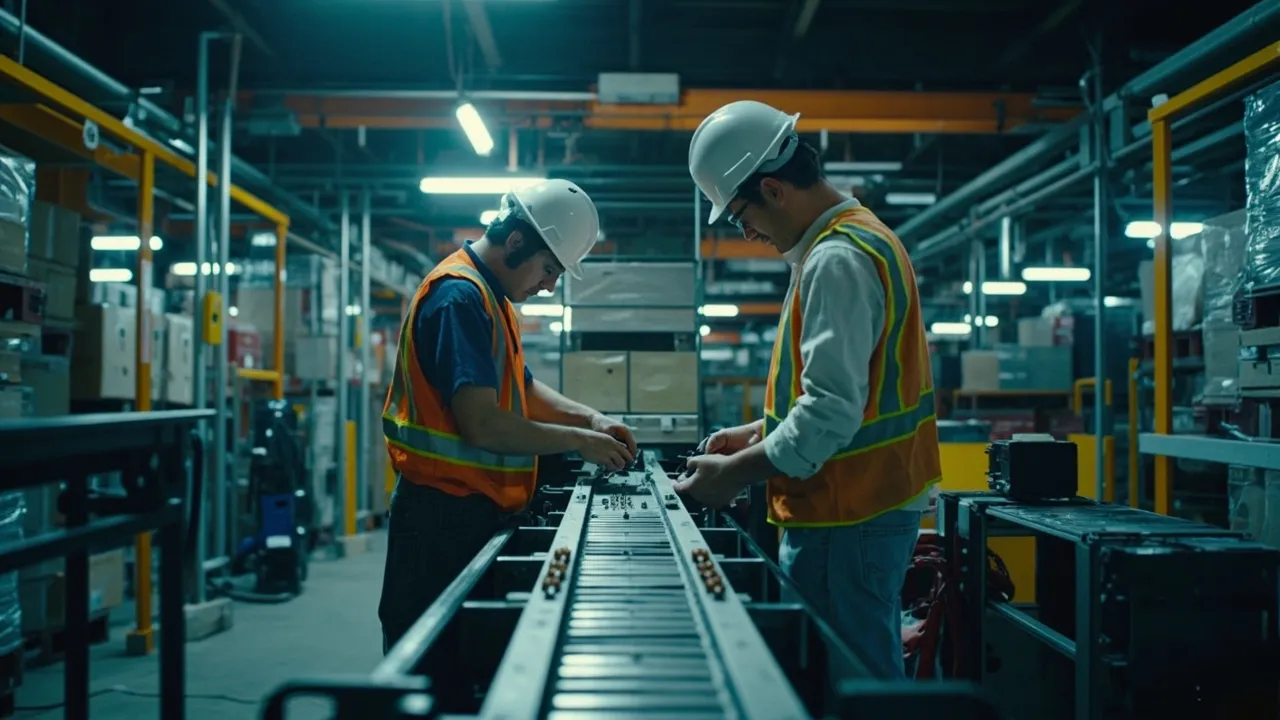
MMH’s maintenance technician profile makes that clear. It describes forklift technicians diagnosing hydraulic problems, automation technicians troubleshooting conveyor systems, and crews keeping robotics and materials handling equipment online. The article also notes that experienced maintenance leaders increasingly spend significant time on people and customer communication, not just repairs.
That is not soft-skill fluff. It is uptime infrastructure.
When a sorter goes down during a wave, the operation needs more than someone who can swap a part. It needs someone who can ask the right questions, separate symptoms from root cause, communicate status to supervisors, coordinate with vendors, preserve evidence for engineering, and document the fix so the same issue does not become tribal knowledge. If the tech cannot explain what is happening, operations cannot make intelligent decisions about labor redeployment, carrier cutoffs, customer promises, or recovery priorities.
Gartner’s 2026 Supply Chain Symposium/Xpo Barcelona highlights also point toward the same future, emphasizing AI in supply chain, autonomous supply chain architecture, and emerging logistics and warehousing technologies. Those technologies will not be self-maintaining magic. The more digital and autonomous the warehouse becomes, the more valuable skeptical, curious, well-trained technicians become.
ROI misses are often maintenance misses in disguise
Automation business cases usually model labor savings, productivity gains, and payback time. They are weaker at modeling technician capacity, preventive maintenance windows, repair backlog, software patch discipline, spare-parts lead times, and fault-response variance between shifts.
That gap shows up later as “automation underperformance.”
A robot fleet that misses pick productivity targets may not have a hardware problem. It may have too many unresolved exceptions. A conveyor investment that fails to deliver wave consistency may be suffering from deferred preventive maintenance. An AS/RS that looks expensive to operate may be losing value because every stoppage requires a small group of overloaded specialists. A facility that buys more robots without documenting failure modes may simply scale its downtime risk.
The robotics survey shows why this matters financially. Respondents ranked ROI as the top evaluation factor at 63%, followed by payback time at 52%, total cost of ownership at 47%, and process performance at 41%. Most projects performed well overall, but the survey still found missed targets tied to ROI, reliability, and integration costs.
Those three misses are connected. Reliability problems increase operating cost. Integration issues create more troubleshooting work. Weak troubleshooting capacity lengthens downtime. Longer downtime erodes ROI.
The checklist before adding more complexity
Before adding another robot use case, conveyor zone, shuttle module, or automated exception workflow, warehouse leaders should ask five practical questions.
First, who owns uptime by system, shift, and failure mode? If the answer is “the vendor” or “maintenance” without names, escalation paths, and response expectations, the operation is not ready.
Second, is preventive maintenance protected on the schedule? If PM work only happens when volume is light, it will lose every time peak demand arrives. The cost of skipped PM rarely appears immediately; it arrives as surprise downtime during the worst possible window.
Third, are faults documented in operational language? A log that says “line down” is nearly useless. A useful record captures location, equipment, time, symptom, root cause, corrective action, part used, recurrence, affected wave, and recovery decision.
Fourth, do supervisors know the fallback workflow? Automation downtime should not trigger panic archaeology. Teams need predefined rules for manual bypass, labor redeployment, carrier-cutoff protection, customer notification, and recovery sequencing.
Fifth, is technician development funded like automation infrastructure? Training, certifications, vendor refresh sessions, documentation time, spare-parts planning, and retention are not extras. They are part of the system cost.
CXTMS turns maintenance reality into operating control
A transportation management system cannot repair a conveyor or recalibrate a robot. But CXTMS can help logistics teams connect warehouse execution reality to transportation decisions before failures become customer-facing misses.
When downtime threatens a wave, pickup, or delivery promise, CXTMS gives teams the control-tower context to adjust tenders, re-sequence shipments, communicate exceptions, and protect service commitments. The strongest automation strategy is not “buy more machines.” It is build an operation where machines, technicians, supervisors, carriers, and customers are working from the same truth.
If your automation ROI depends on tighter exception visibility between warehouse operations and transportation execution, schedule a CXTMS demo and see how better logistics control turns disruption into managed recovery.