Predictive Weather Analytics for Freight: How AI Meteorology Is Replacing Reactive Disruption Management

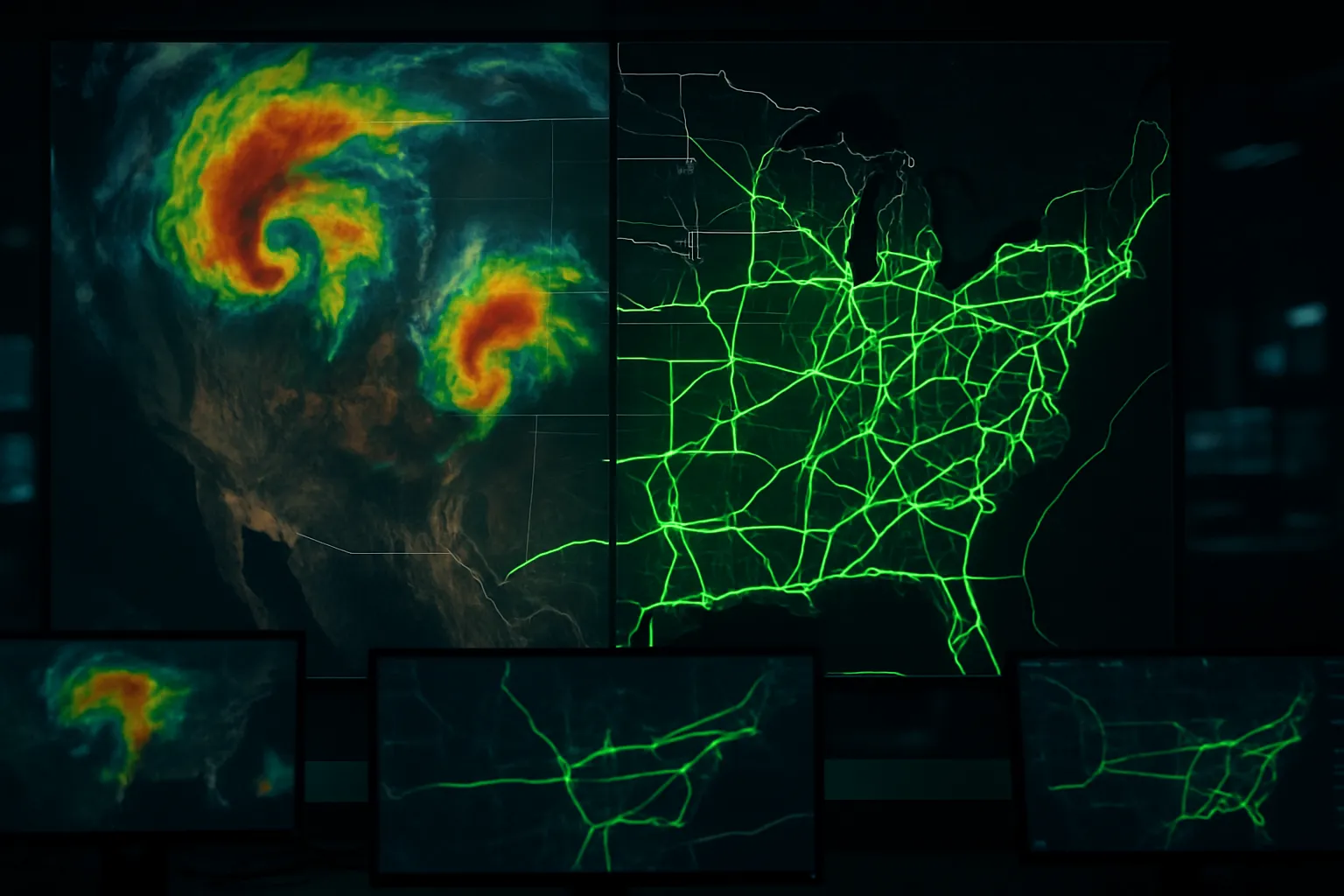
Weather has always been the one variable logistics professionals can't negotiate with. You can renegotiate carrier contracts, reroute around port congestion, and hedge against fuel volatility—but when a Category 4 hurricane parks over your primary distribution corridor, the playbook has historically been the same: scramble, absorb the cost, and hope the next quarter is kinder.
That playbook is becoming obsolete. In 2026, a new generation of AI-powered weather intelligence platforms is giving shippers something they've never had before: the ability to see freight lane disruptions five to seven days before they materialize—and act on that intelligence automatically through integrated TMS systems.
The Staggering Cost of Reactive Weather Response
The financial case for predictive weather analytics starts with understanding what reactive disruption management actually costs. According to FreightWaves, weather-related supply chain disruptions in 2024 cost companies globally upwards of $100 billion—encompassing production delays, transportation failures, inventory losses, and emergency procurement surcharges.
That figure continues to climb. The World Economic Forum projects insured losses from climate-related disasters reaching $145 billion in 2025 alone, a 6% increase from 2024. And those are just the insured losses. The uninsured operational costs—detention charges, emergency spot market rates, spoiled perishables, missed delivery windows—often exceed the headline numbers by a factor of two or three.
The pattern is intensifying. Global economic losses from flooding alone have surged 27% since 2000, averaging $42 billion annually according to the EM-DAT international disaster database. For freight operations, each major weather event triggers a cascade: lane closures spike spot rates 40–60% within hours, detention charges compound daily, and cold chain shipments face spoilage risk the moment temperature control is compromised.
How AI Weather Models Predict Freight Disruptions 5–7 Days Out
Traditional weather forecasting tells you what's happening now and provides generalized regional predictions. AI meteorological models do something fundamentally different: they translate atmospheric data into freight-specific operational intelligence.
These platforms ingest satellite imagery, radar arrays, ground sensor networks, ocean buoy data, and atmospheric modeling outputs—processing terabytes of data through machine learning algorithms trained specifically on transportation impact patterns. The result isn't a generic weather map. It's a lane-by-lane risk assessment that tells you which specific routes will be impassable, when capacity will tighten, and what the cost impact will be if you don't act now.
The accuracy gains are significant. AI weather models have demonstrated 25–35% improvement in severe weather prediction accuracy at the 5–7 day horizon compared to traditional numerical weather prediction alone. For logistics operations, that extended accuracy window is the difference between proactive rerouting at contract rates and panic buying on the spot market at 2x premiums.
Companies like Tomorrow.io, Climavision, and IBM Environmental Intelligence Suite are leading this transformation. Tomorrow.io, for example, operates its own constellation of weather satellites and combines proprietary observation data with AI models to deliver hyperlocal forecasts at the facility level—down to specific warehouse locations and yard operations.
TMS Integration: From Forecast to Automated Action
The real power of predictive weather analytics isn't in the forecast itself—it's in what happens next. Modern weather intelligence platforms integrate directly with transportation management systems to trigger automated responses before disruptions hit.
Here's what that looks like in practice:
- Auto-rerouting: When the system detects a high-probability severe weather event on a primary lane 5 days out, it automatically identifies alternative routes, calculates the cost differential, and presents optimized options to planners—or executes rerouting autonomously based on pre-set rules.
- Pre-positioning inventory: Predictive models can trigger advance shipments to forward stocking locations in anticipation of lane closures, ensuring customer service levels are maintained even during multi-day disruptions.
- Carrier alerts: Integrated systems automatically notify carriers of impending weather events on their routes, enabling proactive schedule adjustments rather than reactive cancellations.
- Dynamic rate management: When a storm is predicted to tighten capacity on specific lanes, weather-aware TMS platforms can lock in carrier commitments at current rates before the surge pricing hits.
According to Inbound Logistics, 2026 is the year AI moves from experimental to operational in supply chain management—with weather-triggered exception management cited as one of the highest-impact use cases now scaling across enterprise shippers.
Cold Chain Protection: Where Weather Prediction Saves Millions
For pharmaceutical, food, and chemical shippers, weather prediction isn't about avoiding inconvenience—it's about preventing catastrophic product loss. A single temperature excursion during transit can destroy an entire shipment of biologics worth hundreds of thousands of dollars, or render a truckload of fresh produce unsaleable.
AI weather models now provide temperature corridor predictions along specific freight routes with hour-by-hour granularity. This allows cold chain operators to:
- Adjust reefer set points proactively based on predicted ambient temperature swings along the route
- Reroute temperature-sensitive loads away from predicted heat domes or extreme cold zones
- Schedule shipments to avoid the worst temperature windows, even if it means a 12-hour departure delay that avoids a 120°F desert crossing at midday
- Trigger backup power protocols at distribution centers when severe weather threatens grid reliability
The ROI is compelling. Industry data suggests that predictive temperature management reduces cold chain loss events by 30–45% compared to reactive monitoring alone. For a pharmaceutical distributor shipping $50 million in temperature-sensitive product annually, that's $2–4 million in prevented losses per year.
Wildfire, Flooding, and Ice: Regional Capacity Planning
Weather intelligence for freight extends well beyond hurricanes and winter storms. The most sophisticated platforms now model:
- Wildfire smoke impact on driver hours-of-service (visibility restrictions and air quality alerts that force stops), plus road closures that can shut down West Coast corridors for days
- Flood stage predictions for river crossings and low-lying warehouse districts, giving 72–96 hours of advance warning to reroute or elevate inventory
- Ice accumulation forecasting at the bridge-and-overpass level, predicting exactly when specific segments of I-70, I-80, and I-90 will become hazardous—and when they'll clear
For regional capacity planning, this granularity is transformative. Instead of blanket "winter weather advisory" alerts that create industry-wide panic and rate spikes, logistics teams can identify precisely which lanes will be affected, for how long, and plan surgical responses rather than wholesale network shutdowns.
Insurance Premium Reduction Through Documented Risk Mitigation
An emerging financial benefit of predictive weather analytics is its impact on cargo and business interruption insurance premiums. Underwriters are beginning to offer 5–15% premium reductions for shippers who can demonstrate systematic use of weather intelligence in their routing and planning processes.
The logic is straightforward: a shipper that proactively reroutes around severe weather events has a demonstrably lower claims frequency than one operating reactively. Documented weather risk mitigation—including automated rerouting logs, pre-positioning records, and carrier alert timestamps—provides underwriters with quantifiable evidence of reduced risk exposure.
For large shippers spending $5–10 million annually on cargo insurance, a 10% premium reduction represents $500,000–$1 million in annual savings—often enough to fund the weather analytics platform itself several times over.
From Reactive to Predictive: The Competitive Advantage
The shippers who have already adopted predictive weather analytics report consistent competitive advantages: 15–20% reduction in weather-related detention charges, 25–30% faster recovery times after major weather events, and measurably higher on-time delivery performance during disruption periods.
The technology gap is widening. As AI weather models improve with each season of training data, the accuracy advantage compounds. Early adopters are building proprietary datasets of weather-impact correlations specific to their freight networks—creating a durable competitive moat that will be increasingly difficult for laggards to close.
How CXTMS Integrates Weather Risk Into Shipment Routing
CXTMS builds weather risk scoring directly into its shipment planning and routing engine. By integrating real-time and predictive weather data feeds, CXTMS automatically flags at-risk shipments, recommends alternative routing, and calculates the true cost-of-delay versus cost-of-reroute for every weather scenario.
For cold chain shippers, CXTMS provides temperature corridor modeling that factors predicted weather conditions into reefer management recommendations. For dry freight operations, the platform's dynamic carrier scoring adjusts carrier reliability ratings based on their historical performance during weather events on specific lanes.
The result is a freight planning process that doesn't just react to weather—it anticipates it, prices it, and routes around it before the first raindrop falls.
Ready to build weather resilience into your freight operations? Request a CXTMS demo to see how predictive weather analytics can transform your disruption management from reactive scramble to proactive strategy.