Intermodal Chassis Pools Go Digital: How IoT Tracking and Dynamic Pricing Transform Container Equipment Management in 2026

If you've ever waited at a port terminal for a chassis that should have been there but wasn't, you know the pain. Chassis shortages are one of the most persistent — and most underestimated — bottlenecks in American intermodal freight. According to C.H. Robinson's 2025 drayage market update, chassis shortages compounding marine terminal congestion can add three to five days to normal transit times on intermodal moves. That's not a minor inconvenience. That's a supply chain failure hiding in plain sight.
But 2026 is shaping up as the year the intermodal chassis industry finally catches up with the digital age. The three largest intermodal equipment providers (IEPs) — DCLI, TRAC Intermodal, and FlexiVan — are all deploying IoT tracking, geofencing, and data-driven management platforms that promise to transform how chassis are located, reserved, maintained, and priced across the North American network.
The Chassis Crisis Nobody Talks About
The global intermodal chassis market was valued at approximately $2 billion in 2024 and is projected to reach $3.5 billion by 2033, growing at a 7.2% CAGR according to Business Research Insights. Yet despite the scale of this market, chassis management has historically operated with shocking opacity. Drayage drivers routinely arrive at rail facilities only to discover that available chassis have already been claimed, are out of service, or simply can't be found.
The Intermodal Association of North America (IANA) has documented how chassis shortages force drayage drivers to constantly check on dwindling availability at origin rail facilities — burning hours of productive driving time on equipment hunts. During peak seasons, the problem intensifies dramatically, creating cascading delays that ripple from port terminals through inland distribution networks.
The root cause isn't necessarily a shortage of physical chassis. It's a shortage of visibility. Without real-time tracking, IEPs and their customers are essentially managing a multi-billion-dollar equipment fleet with spreadsheets and phone calls.
DCLI's 152,000-Chassis GPS Revolution
DCLI, the largest chassis provider in North America with approximately 130,000 marine and 152,000 domestic chassis, is leading what may be the most ambitious equipment digitization project in intermodal history. In December 2024, DCLI announced it would retrofit its entire DCL53 domestic chassis fleet with GPS technology, with completion targeted for late 2026.
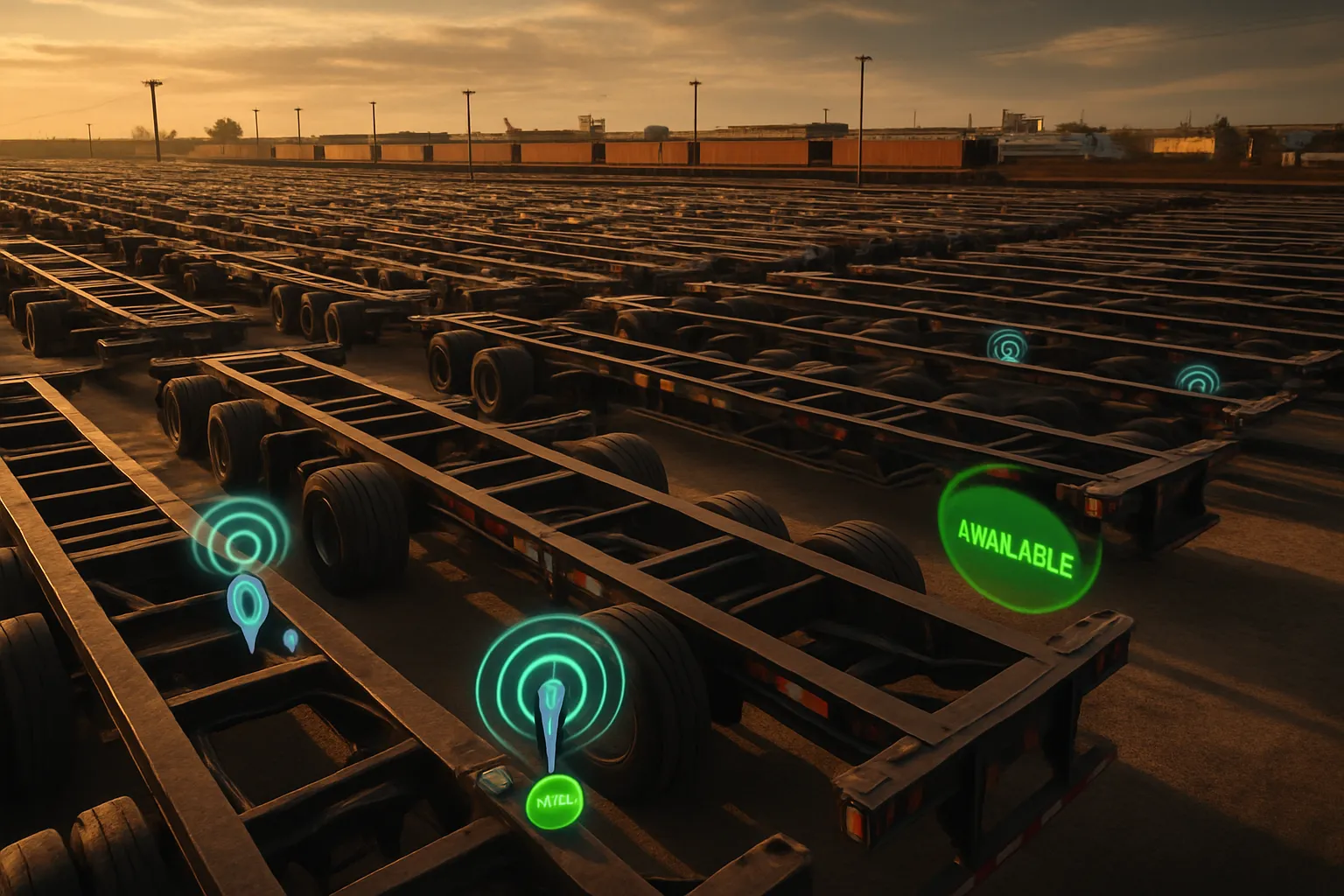
As FreightWaves reported, DCLI partnered with BlackBerry's Radar platform to equip 100,000 chassis with GPS tracking, making previously invisible assets visible in real time. The deployment leverages IoT sensors from Hoopo that deliver up to 10 years of battery life, real-time breadcrumb location tracking, and container mount status detection — meaning the system can automatically determine whether a chassis is loaded or empty.
The operational benefits extend far beyond simple location tracking:
- Asset utilization optimization: Precise location data improves chassis availability across critical markets, helping customers shorten cycle times
- Predictive maintenance: Accurate mileage tracking enables proactive scheduling, and detection of hard braking or rough handling events triggers inspection alerts
- Automated billing: Integrated sensors determine container mount status, streamlining billing processes and reducing reconciliation disputes
- Geofenced alerts: Entry and exit notifications at terminals and customer facilities provide automated visibility without manual check calls
TRAC Intermodal's GeoFleet: Chassis-as-a-Service
TRAC Intermodal, another major IEP, took a different approach with the August 2025 launch of TRAC GeoFleet — a tech-enabled private chassis fleet solution that essentially creates a chassis-as-a-service model. GeoFleet combines guaranteed chassis availability with usage-based billing powered by geofencing capabilities and GPS tracking.
The significance of GeoFleet lies in its pricing innovation. Rather than flat per-diem rates regardless of where or when a chassis is used, TRAC can now implement location-aware, demand-responsive pricing that reflects actual market conditions. High-demand zones during peak periods carry premium rates, while underutilized locations offer incentives — creating natural market signals that help rebalance chassis distribution across the network.
This is the intermodal equivalent of dynamic pricing in ride-sharing: when demand spikes at the Port of Los Angeles during peak season, pricing signals encourage chassis repositioning from lower-demand markets, reducing the shortage before it becomes a crisis.
FlexiVan's Smart Chassis and AIM360 Platform
FlexiVan, the third major IEP, has been building its digital capabilities through its Smart Chassis program and the AIM360 visibility platform. FlexiVan's chassis are equipped with sensors providing near real-time cargo visibility, while AIM360 aggregates millions of data points per month to deliver network analysis that goes far beyond what shippers traditionally expect from a chassis provider.
The platform enables FlexiVan to analyze utilization patterns, predict demand shifts, and optimize chassis positioning across its network. For motor carriers, logistics providers, and beneficial cargo owners, this translates into better equipment availability and fewer of those costly terminal wait times that eat into driver productivity and shipment schedules.
Digital Reservation Systems: Booking Chassis Like Booking Containers
Perhaps the most transformative shift is the emergence of digital chassis reservation systems. Historically, securing a chassis was an opaque, first-come-first-served process that rewarded the earliest arrivals and punished everyone else. Drivers had no way to guarantee equipment availability before dispatching to a terminal.
The new generation of digitally-enabled chassis pools changes this dynamic entirely. With real-time inventory visibility, IEPs can offer advance booking capabilities that let drayage operators reserve specific chassis types at specific locations for specific time windows. This moves chassis management from a reactive scavenger hunt to a planned, predictable logistics process — similar to how container booking platforms transformed ocean freight.
For shippers managing complex drayage operations across multiple ports and rail terminals, the ability to pre-book chassis and receive confirmation before dispatching drivers eliminates one of the most frustrating sources of delay and cost overrun in intermodal transportation.
What This Means for Shippers and Drayage Operators
The digitization of chassis pools creates several immediate opportunities for logistics professionals:
- Reduced dwell time: Real-time chassis availability data eliminates blind trips to terminals where equipment isn't available, potentially saving the three-to-five day delays documented by C.H. Robinson
- Better cost predictability: Dynamic pricing models, while potentially raising peak-period costs, actually reduce total cost of ownership by improving equipment utilization and reducing repositioning waste
- Data-driven planning: Integration of chassis availability into transportation planning systems allows shippers to factor equipment constraints into routing and scheduling decisions proactively
- Maintenance transparency: IoT-enabled condition monitoring reduces the risk of being assigned a chassis with mechanical issues that cause roadside breakdowns and delivery failures
How CXTMS Integrates Chassis Intelligence Into Drayage Planning
At CXTMS, we believe that chassis visibility shouldn't exist in a silo. Our platform integrates equipment availability data alongside vessel schedules, terminal conditions, and drayage carrier capacity to give shippers a complete picture of intermodal execution risk before dispatching a single truck.
When chassis pools publish real-time availability through APIs — as DCLI, TRAC, and FlexiVan are increasingly doing — CXTMS can factor equipment constraints directly into drayage planning, automatically routing containers to terminals with confirmed chassis availability and flagging potential equipment shortages before they cause delays.
The intermodal chassis revolution isn't just about putting GPS on steel frames. It's about finally bringing data-driven decision-making to the last analog link in the containerized supply chain.
Ready to eliminate chassis availability surprises from your drayage operations? Request a CXTMS demo and see how integrated equipment intelligence transforms intermodal planning.