AI Vision at the Pack Station: How Camera-Guided Verification Is Eliminating Shipping Errors and Cutting Mispick Costs by 90%

Every warehouse has a last line of defense before a shipment leaves the dock: the pack station. It's the final quality gate where items are verified, boxed, labeled, and sealed. And for decades, that gate has been guarded by human eyes alone — eyes that fatigue after hours of repetitive scanning, that miss mismatched SKUs when volumes surge, and that cost warehouses an average of $50 to $300 per mispick incident in returns, reshipping, and lost customer loyalty.
Now, AI-powered vision cameras are transforming this critical touchpoint. Mounted directly above packing workstations, these systems verify every item, every quantity, and every packaging step in real time — turning the pack station from a manual bottleneck into an intelligent quality assurance checkpoint.
The Mispick Problem: A $400,000 Annual Drain on Every Warehouse
The economics of shipping errors are brutal. Industry estimates place the average mispick cost between $50 and $300 per incident when accounting for return shipping, replacement fulfillment, restocking labor, and customer service overhead. For a mid-sized distribution center processing 6,000 orders daily with a typical 1% error rate, that translates to 60 mispicks per day — or roughly $400,000 in annual losses from picking and packing errors alone.
But the financial damage extends far beyond direct costs. According to Modern Materials Handling, today's e-commerce fulfillment windows have compressed to the point where a single shipping error can cascade into customer churn, negative reviews, and permanent brand damage. In an era where 84% of consumers say they won't return to a brand after a poor delivery experience, the pack station has become the most consequential square footage in the entire warehouse.
The root cause isn't negligence — it's the fundamental limitations of human visual inspection at speed. A packer processing 150 to 200 orders per hour simply cannot reliably verify item identity, quantity, label accuracy, packaging compliance, and insert inclusion simultaneously across every box.
How AI Vision at Pack Stations Works
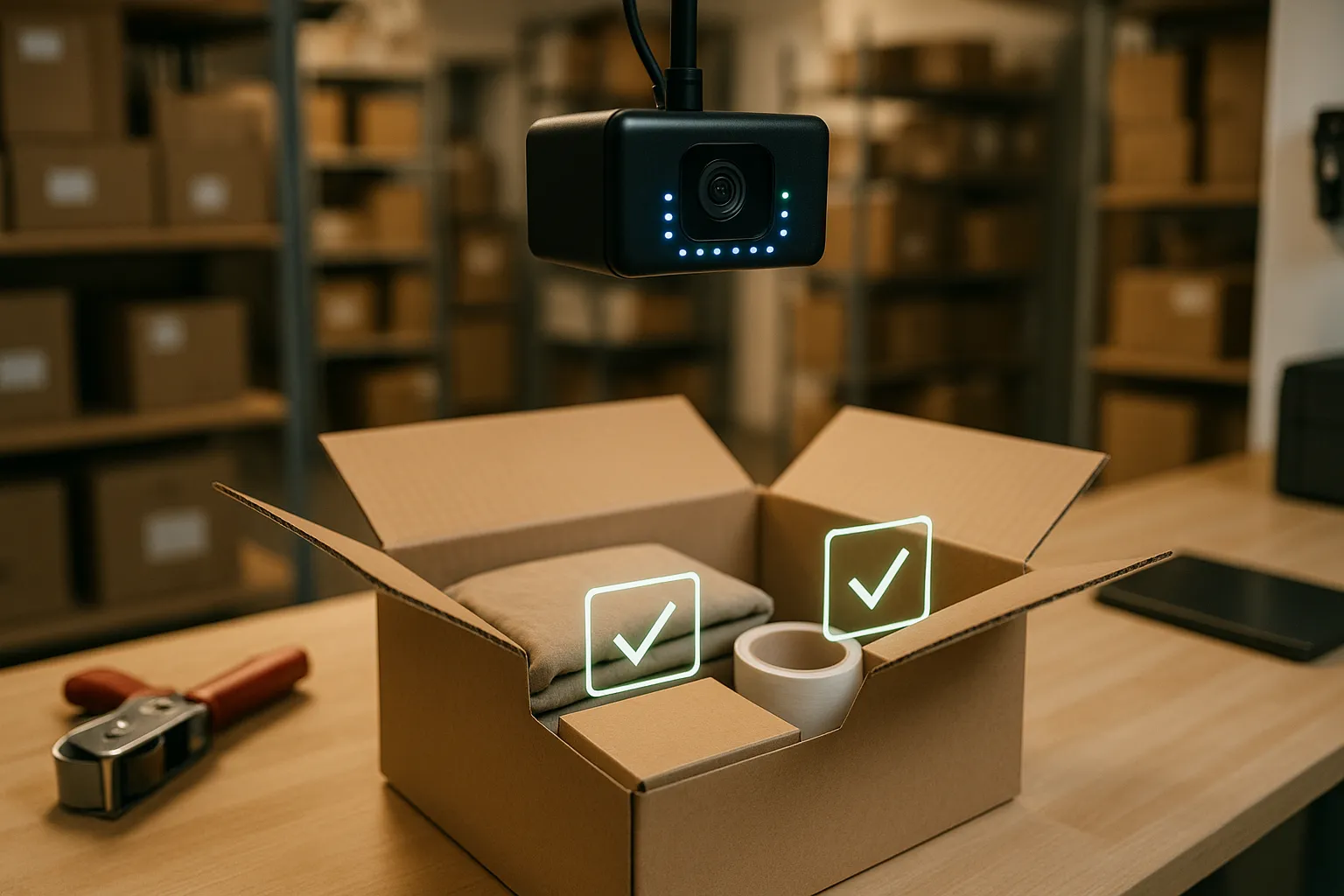
AI vision pack station systems use overhead cameras — typically mounted 24 to 36 inches above the work surface — that continuously capture the packing area. Advanced computer vision models process these images in real time, performing multiple verification tasks simultaneously:
Item identification and count verification. The system recognizes individual SKUs through shape, color, barcode, and visual pattern matching. As items are placed into the box, the AI confirms each one against the order manifest and flags discrepancies instantly — wrong item, missing item, or extra item.
Step-by-step SOP enforcement. For customers with specific packaging requirements — branded tissue paper, promotional inserts, particular box orientation — the camera verifies compliance with each step of the standard operating procedure. If a packer skips the desiccant packet in a moisture-sensitive order, the system alerts immediately.
Label and documentation verification. Before a box is sealed, the vision system confirms the correct shipping label, packing slip, and any required regulatory documentation are present and properly placed.
Real-time packer guidance. Rather than simply catching errors after the fact, these systems provide proactive on-screen guidance. Visual cues direct packers to the correct items, indicate the right box size, and display step-by-step instructions for complex orders.
The result is a system that functions as both a quality inspector and a training tool — reducing errors while simultaneously accelerating pack times for workers of all experience levels.
Yusen Logistics and Rabot: Vision AI at Scale
The most significant real-world validation of pack station AI came in March 2026 when Yusen Logistics (Americas) announced a strategic multi-year partnership with Rabot Inc. to deploy Vision AI cameras across its U.S. distribution centers.
The partnership, which began at Yusen's Hardeeville, South Carolina facility, has already demonstrated transformative results. Rabot's Vision AI cameras are deployed across multiple pack stations, augmenting packers with real-time guidance, quality checks, and step-by-step work instructions at every station. The system addresses three critical challenges: improving order packing accuracy, increasing packing productivity, and ensuring packer compliance with customer-specific SOPs.
Early results have been remarkable. The Yusen-Rabot deployment has achieved 40% faster pack times while delivering 100% order visibility for high-volume brand clients. The system doesn't replace packers — it augments them, providing the kind of real-time quality oversight that was previously impossible without dedicated quality control inspectors at every station.
What makes the Yusen deployment particularly notable is its scalability. Unlike robotic systems that require significant capital investment and facility redesign, vision AI cameras can be installed above existing pack stations in hours. The cameras integrate with existing WMS platforms, pulling order data to know what should be in each box and flagging deviations in real time.
GXO's Vision Technology Expansion Sets the Industry Pace
Yusen isn't alone. GXO Logistics doubled its use of vision technology in 2023 and has continued expanding deployments since then. According to GXO's Chief Automation Officer Adrian Stoch, vision technology optimizes order validation and minimizes errors — and critically, it can be rolled out across various operations in different verticals without significant investment.
GXO's approach highlights a key advantage of vision AI over traditional warehouse automation: speed of deployment. While automated storage and retrieval systems or robotic picking solutions can take 12 to 18 months to install and commission, vision cameras can be operational within weeks. This makes pack station AI one of the fastest paths to measurable ROI in warehouse operations.
The broader computer vision market reflects this momentum. According to Mordor Intelligence, the global computer vision market reached $28.4 billion in 2025 and is growing at a 16% CAGR through 2030, with logistics and warehousing emerging as one of the fastest-growing application segments.
The ROI Calculation: Why Pack Station AI Pays for Itself in Months
The financial case for AI vision at pack stations is straightforward and compelling:
Error cost elimination. If a facility processes 6,000 orders daily with a 1% mispick rate, and each error costs an average of $100 in total remediation costs, the annual error cost is approximately $219,000. A vision system reducing errors by 90% saves roughly $197,000 per year — per facility.
Productivity gains. The Yusen-Rabot deployment demonstrates 40% faster pack times. For a packer processing 150 orders per hour, that's an effective increase to 210 orders per hour — reducing the labor hours needed to process the same volume or enabling higher throughput without additional headcount.
Training acceleration. New packers traditionally require two to four weeks to reach full productivity. AI-guided pack stations with real-time instructions can compress this ramp-up to days, reducing the cost and disruption of seasonal hiring.
Customer retention. While harder to quantify, the downstream value of near-perfect order accuracy on customer lifetime value, Net Promoter Score, and brand reputation is substantial — particularly for e-commerce operations where every shipment is a brand experience.
Installation costs for vision AI pack stations typically range from $3,000 to $8,000 per station, including cameras, computing hardware, and software licensing. For most operations, the payback period falls between three and six months.
What This Means for Shippers and 3PLs
The emergence of pack station AI signals a broader shift in how warehouses approach quality assurance. Rather than relying on statistical sampling — inspecting 5% of orders and hoping the rest are correct — vision AI enables 100% inspection at line speed. Every order is verified. Every deviation is caught.
For shippers evaluating 3PL partners, pack station AI capabilities are becoming a meaningful differentiator. The ability to guarantee near-perfect order accuracy, provide real-time visibility into packing compliance, and offer data-driven insights into operational efficiency is moving from nice-to-have to table stakes.
For 3PLs competing on service quality, vision AI represents an opportunity to offer premium accuracy guarantees backed by verifiable data — turning quality from a cost center into a competitive weapon.
How CXTMS Connects Packing Quality to Shipment Visibility
AI vision at the pack station solves the accuracy problem inside the warehouse — but the shipment journey doesn't end when the box is sealed. CXTMS bridges the gap between warehouse quality assurance and transportation execution by providing end-to-end visibility from pack station to final delivery.
When a vision-verified order enters the CXTMS platform, shippers gain real-time tracking, automated carrier selection, and exception management that extends the quality chain beyond the warehouse walls. The result is a closed loop where packing accuracy, shipping performance, and delivery confirmation are connected in a single view.
Ready to connect your warehouse quality systems with intelligent transportation management? Request a CXTMS demo and see how end-to-end visibility transforms shipment accuracy from the pack station to the customer's door.