AI Procurement Automation: How Agentic Sourcing Is Cutting Supplier Onboarding From Weeks to Hours


Supplier onboarding has long been procurement's most stubborn bottleneck. The average enterprise takes six to twelve weeks to qualify, verify, and activate a new supplier — a timeline that made sense when procurement was a back-office function processing purchase orders. In 2026, with supply chains under constant disruption and procurement managing 50% more spend per employee than five years ago, that pace is no longer acceptable.
Agentic AI is rewriting the rules. Unlike traditional automation that follows rigid workflows, agentic procurement systems can independently evaluate suppliers, verify credentials, negotiate terms, and execute onboarding — compressing what once took weeks into hours.
The Procurement Bottleneck Nobody Talks About
While logistics and warehousing have received billions in automation investment, procurement has remained surprisingly manual. According to McKinsey's research on procurement transformation, only 60% of large firms and just 30% of small ones have fully implemented procure-to-pay platforms. Even fewer — roughly a third — use e-sourcing tools, despite evidence they can cut maintenance and repair costs by up to 20%.
The result is a function caught between strategic ambition and operational reality. Two-thirds of the 300-plus procurement leaders McKinsey surveyed now report directly to the CEO or CFO, reflecting procurement's growing influence. Yet their teams are still buried in manual document verification, email chains with suppliers, and spreadsheet-based qualification processes.
A Hackett Group report found that nearly half of procurement teams piloted generative AI in 2024, but only 4% managed to scale it widely. The gap between pilot and production is where most procurement AI initiatives stall.
From Rules-Based Automation to Agentic Sourcing
Traditional procurement automation follows predefined rules: if a purchase request exceeds a threshold, route it for approval; if a supplier's insurance expires, send a reminder. These workflows are useful but brittle — they break when encountering exceptions, which in procurement happen constantly.
Agentic sourcing takes a fundamentally different approach. Multi-agent systems deploy specialized AI agents for distinct procurement tasks:
- Supplier discovery agents scan databases, industry directories, and news sources to identify potential vendors matching specific criteria
- Qualification agents autonomously request and verify credentials, insurance certificates, compliance documents, and financial statements
- Negotiation agents analyze market pricing data and historical spend to recommend optimal terms and counter-offers
- Onboarding agents communicate directly with suppliers via email, ingest documents, validate information, and progress the onboarding workflow without human intervention
Platforms like Ivalua have built supplier onboarding agents that autonomously handle the entire back-and-forth of document collection and verification. Camunda's orchestration platform demonstrates how agentic workflows can reduce a 12-week onboarding process to days by parallelizing verification steps that were previously sequential.
Real-World Impact: The Numbers Behind the Shift
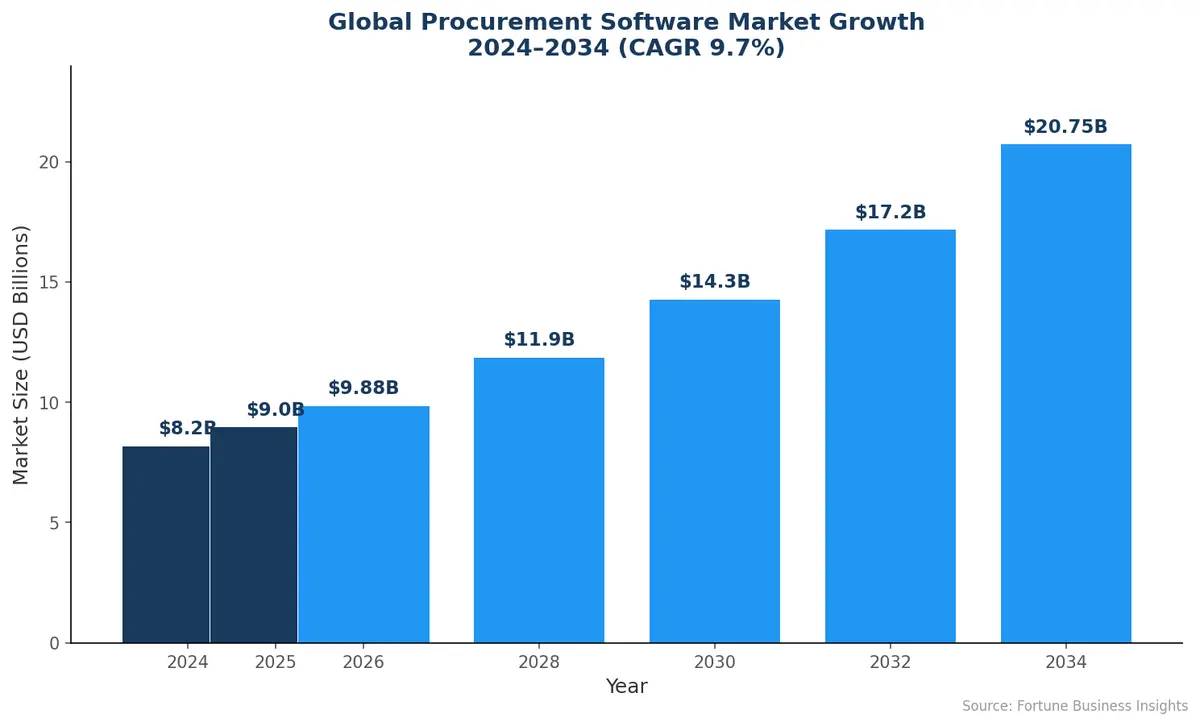
The procurement software market is projected to reach $9.88 billion in 2026 and grow to $20.75 billion by 2034, according to Fortune Business Insights — a 9.7% compound annual growth rate driven largely by AI capabilities. North America commands 43% of this market.
McKinsey's analysis is even more striking: the next wave of agentic automation could make procurement operations 25% to 40% more efficient. In one pharmaceutical example cited in their research, an AI-powered contract audit recovered $10 million in missed value in under a month.
Major retailers are already moving aggressively. Nordstrom recently revealed it is using AI "quite heavily" within procurement spend analytics, with the technology helping build sourcing category strategies that were previously assembled manually over weeks. A power-equipment manufacturer cut procurement costs by 11% after aligning its AI-enabled sourcing group with product development cycles.
The SAP and Enterprise Platform Response
Enterprise vendors are racing to embed agentic capabilities into their procurement suites. SAP's positioning as an IDC Leader in multi-enterprise supply chain commerce reflects a broader push toward AI-driven procurement orchestration that spans organizational boundaries.
The shift is architectural, not incremental. Legacy procurement platforms were built around approval workflows and catalog management. The new generation is built around decision intelligence — systems that don't just route requests but actively analyze spend patterns, predict supplier risks, and recommend sourcing strategies.
Companies with advanced procurement operating models enjoy five percentage points higher EBITDA margins than their peers, according to McKinsey's Global Procurement Excellence benchmark. As agentic AI makes these advanced models accessible to mid-market companies — not just Fortune 500 enterprises — the competitive implications are significant.
What This Means for Logistics and TMS
Procurement automation doesn't exist in isolation. When supplier onboarding accelerates from weeks to hours, the downstream effects ripple through the entire supply chain:
- Carrier onboarding follows the same pattern — AI agents can verify insurance, safety ratings, and compliance documents for new carriers in hours rather than weeks
- Rate procurement benefits from agents that continuously scan market rates, benchmark against historical data, and recommend optimal carrier selections
- Contract management becomes proactive rather than reactive, with AI monitoring performance against SLAs and flagging deviations before they become disputes
The connection between procurement AI and transportation management is direct. Every new carrier relationship, every renegotiated rate, every compliance verification feeds into the TMS that orchestrates daily logistics operations.
Building Your Agentic Procurement Strategy
For logistics leaders evaluating AI procurement automation, the path forward has three phases:
- Digitize the foundation — Implement procure-to-pay platforms if you haven't already. Agentic AI needs structured data and digital workflows to operate on.
- Deploy targeted agents — Start with high-volume, rule-heavy processes like supplier qualification and document verification. These offer the clearest ROI and lowest risk.
- Orchestrate across functions — Connect procurement agents to your TMS, WMS, and financial systems so that sourcing decisions automatically flow into operational execution.
McKinsey's warning is clear: procurement can no longer rely on manual processes or outsourcing. As agentic AI advances, routine work is being insourced and managed by intelligent systems, freeing procurement professionals to focus on strategy, risk management, and supplier partnerships.
The organizations that move first won't just onboard suppliers faster — they'll build more resilient, responsive supply chains that can adapt to disruption in real time.
Ready to connect procurement automation with your logistics operations? Contact CXTMS for a demo of our carrier onboarding and rate management platform.