Africa's Logistics Corridor Revolution: How AfCFTA Infrastructure Is Creating the Next Global Supply Chain Frontier

Supply chain leaders spend enormous energy analyzing nearshoring to Mexico, friend-shoring to Vietnam, and reshoring back to the United States. But there's a continent-scale logistics transformation happening that most Western shippers are barely tracking—and it may represent the single largest untapped supply chain opportunity of the decade.
Africa's logistics infrastructure is undergoing a generational overhaul. The catalyst: the African Continental Free Trade Area (AfCFTA), which unites 54 member states into the world's largest free trade zone by number of participating countries. According to Mordor Intelligence's 2026 market analysis, the Middle East and Africa freight and logistics market is valued at $321.36 billion in 2026, growing at a 5.34% CAGR toward $416.75 billion by 2031.
Those aren't speculative numbers. They reflect billions of dollars in corridor projects, port expansions, and cross-border trade modernization already underway.
AfCFTA: The World's Largest Free Trade Area Takes Shape
The AfCFTA isn't just another trade agreement. It's an attempt to stitch together a continent of 1.4 billion people—with a combined GDP exceeding $3.4 trillion—into a single market for goods and services.
The potential impact is staggering. According to analysis from CNBC Africa, AfCFTA implementation is expected to boost intra-African trade by 50% in the medium term. But as logistics analysts consistently note, that growth is unachievable without modern freight infrastructure to move goods across borders that have historically been defined by delay, inefficiency, and regulatory fragmentation.
That's exactly where the investment is flowing. The Infrastructure Africa 2026 summit framed corridor investment not as a national prestige project but as a "continental economic necessity"—emphasizing lower transit times, improved border efficiency, and increased freight reliability as prerequisites for trade growth.
Morocco as Gateway: Tangier Med Surpasses 11 Million TEUs
If you want to understand how African logistics infrastructure has already achieved world-class scale, look at Morocco.
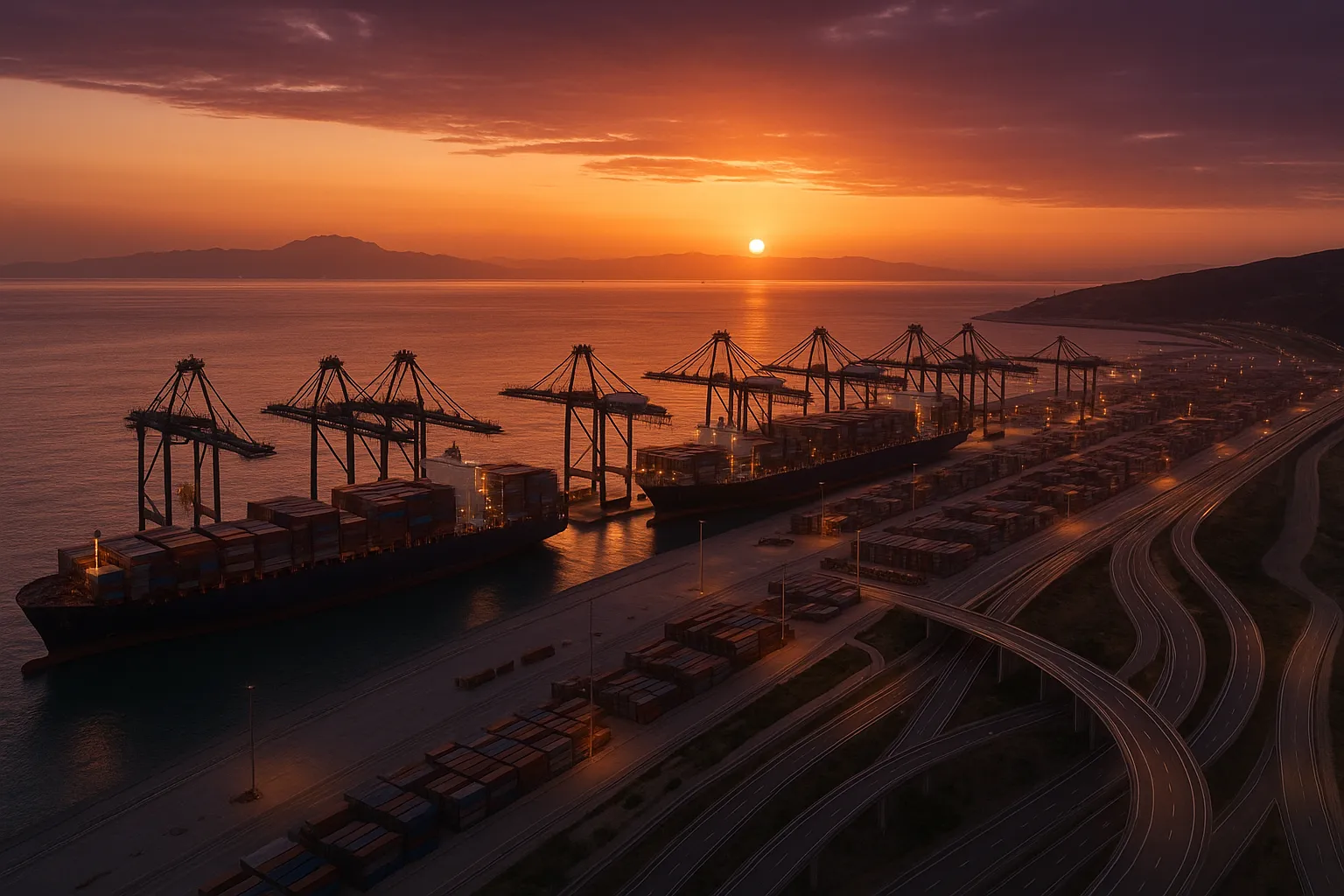
The Port of Tangier Med processed 11.1 million TEU containers in 2025, an 8.4% increase over 2024, handling more than 161 million tonnes of total cargo. That makes it one of the busiest container ports on Earth—not just in Africa.
Tangier Med's strategic advantage is geography. Sitting at the Strait of Gibraltar, it offers 24-hour access to Spain and direct connectivity to over 180 ports across 70 countries. APM Terminals recently completed a 2 million TEU capacity expansion at MedPort Tangier, specifically to handle Maersk and Hapag-Lloyd's reconfigured shipping networks.
For shippers, Morocco's position creates a unique dual-gateway opportunity: it serves as both a European distribution access point and an entry into the North and West African market. Companies routing through Tangier Med can reach Southern European markets in under a day while simultaneously accessing the growing consumer economies of the Maghreb and Sahel regions.
East Africa's Northern Corridor: Mombasa to Kampala and Beyond
On the continent's eastern flank, the Northern Corridor—stretching 1,700 kilometers from Kenya's Port of Mombasa through Uganda, Rwanda, Burundi, and into eastern DRC—is undergoing its most significant modernization in decades.
Mombasa handles over 25 million tons of cargo annually, serving as the maritime gateway for landlocked East African economies. The Standard Gauge Railway (SGR) linking Mombasa to Nairobi and Naivasha has been designed for an annual cargo capacity of 22 million tonnes, representing what Railway News calls "a generational shift from an outdated meter-gauge system to modern railway technology."
The corridor's impact goes beyond freight volumes. Reduced transit times from Mombasa to Kampala directly affect the cost structure of every manufacturer, retailer, and distributor operating in the East African Community. When it takes fewer days to move a container from port to warehouse, inventory carrying costs drop, stockout risk decreases, and capital efficiency improves across the entire supply chain.
Plans are now in motion to extend the SGR from Naivasha-Kisumu to Malaba on the Ugandan border, which would create a continuous modern rail link from the Indian Ocean coast to the heart of East Africa.
The Cross-Border Freight Opportunity
Africa's cross-border road freight transport market—the backbone of intra-continental trade—is projected to grow from $10.2 billion in 2026 to $12.38 billion by 2031, according to Mordor Intelligence. That growth depends on solving a set of challenges fundamentally different from those in North American or European logistics.
Border crossing delays remain the single biggest friction point. A truck crossing from Kenya to Tanzania can lose days to paperwork, inspections, and regulatory discrepancies between neighboring countries. Electronic cargo tracking, automated customs clearance, and integrated transport platforms are being deployed to reduce these delays, but implementation varies widely across corridors and countries.
The AfCFTA's trade facilitation protocols aim to standardize customs procedures, harmonize regulations, and create mutual recognition frameworks—essentially giving cross-border freight the kind of regulatory predictability that the European Union's single market provides for intra-EU trade.
Special Economic Zones Reshaping Distribution Networks
Across the continent, special economic zones in Nigeria, Kenya, Egypt, Morocco, and South Africa are attracting diversified investment into light manufacturing, automotive components, food processing, and energy infrastructure. Their strategic placement near ports and airports is designed to strengthen supply chains and reduce last-mile logistics costs.
For global shippers, these zones create opportunities to establish regional distribution hubs that serve multiple African markets from a single location—similar to how Dubai serves as a logistics gateway for the broader Middle East region. The difference is scale: Africa's 1.4 billion consumers represent a market that's projected to grow faster than any other continent over the next two decades.
Infrastructure Delivery: The Gap Between Policy and Pavement
Ambition and execution don't always align. Africa's logistics infrastructure agenda faces real challenges: funding gaps between policy commitments and actual construction, political instability in key corridor countries, and the sheer physical scale of connecting a continent three times the size of Europe.
But the trajectory is clear. Digital logistics platforms are being adopted faster than physical infrastructure is being built, meaning electronic tracking and customs automation are leapfrogging the traditional paper-based systems that have historically defined African trade corridors. This digital-first approach may ultimately accelerate physical infrastructure investment by demonstrating the economic returns of reduced transit times and improved freight reliability.
How Shippers Using CXTMS Can Tap Into African Trade Lanes
As Africa's logistics corridors mature, shippers need transportation management systems that can handle the complexity of multi-modal, multi-country, multi-currency freight movements across emerging trade lanes.
CXTMS is built for exactly this kind of complexity. Our platform provides:
- Multi-corridor rate management across ocean, rail, and road segments spanning multiple African trade lanes
- Real-time container visibility through ports like Tangier Med, Mombasa, and Durban—where dwell time management directly impacts total landed cost
- Cross-border documentation automation that adapts to the evolving regulatory frameworks of AfCFTA member states
- Carrier performance analytics that help shippers identify reliable partners in corridors where service quality varies significantly
Africa's logistics revolution isn't a future event—it's happening now. The shippers who build African trade lane capability today will have a structural advantage as the continent's consumer and industrial markets scale over the next decade.
Ready to explore African trade lanes with confidence? Request a CXTMS demo and discover how our platform helps you manage complex international freight across emerging corridors.