The $580B Highway Bill Is Really a Freight Reliability Bill

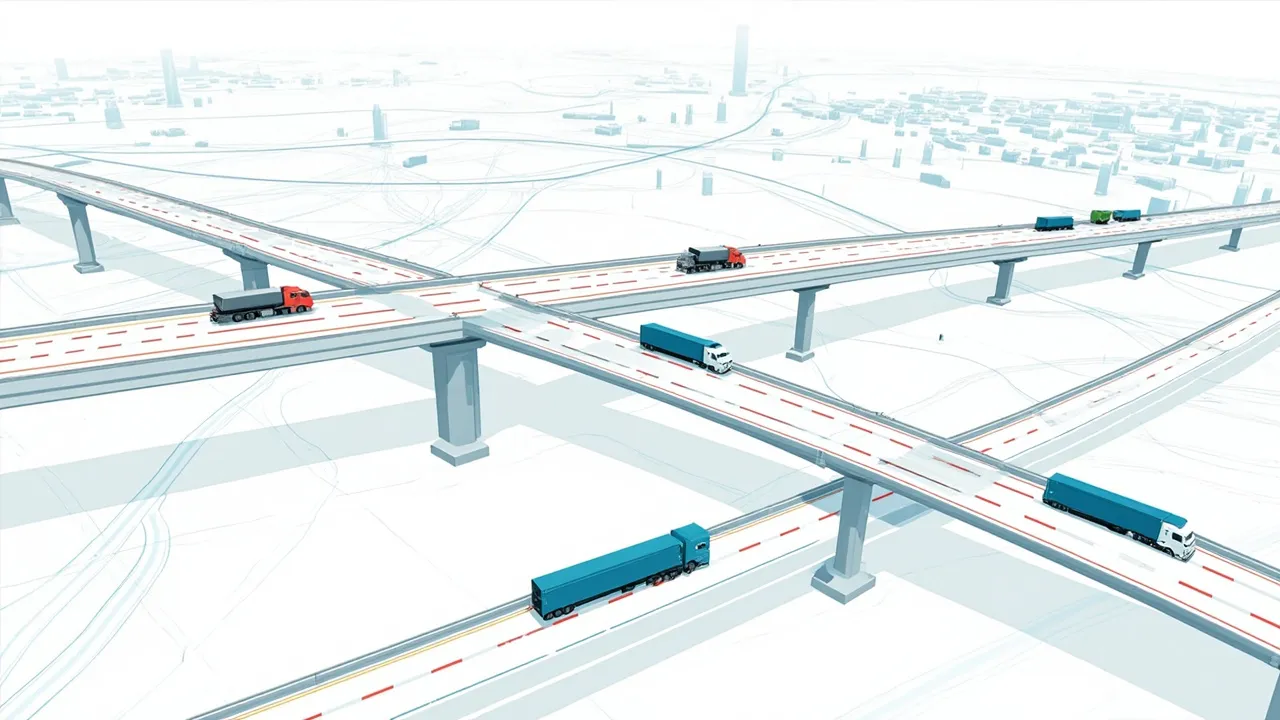
Congress is moving — slowly — on a five-year surface transportation reauthorization worth roughly $580 billion. The BUILD America 250 Act cleared the House Transportation and Infrastructure Committee in late May on a 62–2 vote, authorizing funding for highways, transit, rail, and truck-specific programs through fiscal year 2031.
The details matter for logistics. And the details are mostly about keeping what already exists from falling apart.
What the Bill Actually Funds
The breakdown by agency over five years:
- Federal Highway Administration: $376 billion
- Federal Transit Administration: $87.6 billion
- Federal Railroad Administration: $64.7 billion (including $31.1 billion for Amtrak)
- Federal Motor Carrier Safety Administration: $5 billion
- National Highway Traffic Safety Administration: $5.7 billion
The Highway Trust Fund gets a revised bridge formula program at $9.2 billion per year, plus a separate $2 billion per year Bridge Completion Program from General Fund. There's also a $150 million fund for truck parking — a persistent gap in the national network that forces drivers into unsafe or non-compliant rest stops.
On the policy side, the bill creates a voluntary pilot program allowing states to increase interstate weight limits up to 91,000 pounds on six-axle, bridge-formula-compliant vehicles. It establishes a federal framework for autonomous commercial motor vehicles and codifies a cargo-theft task force.
The Senate is the unknown variable. Sheldon Whitehouse (D-R.I.) and Shelley Moore Capito (R-W. Va.), leaders of the Environment and Public Works Committee, haven't agreed on a top-line figure. A short-term extension at current funding levels before the September 30 expiration looks increasingly likely.
Why Shippers Should Care Before the Headlines
The DoT's 2026 National Freight Strategic Plan puts the stakes in plain numbers: the nation's multimodal cargo network moves more than 54 million tons of goods daily, valued at more than $68 billion. That's the circulatory system of the economy. When a bridge closes for maintenance on I-95 or a rural interchange gets restricted to lighter loads, the rerouting cost doesn't show up in macro freight indices — it shows up in late deliveries, fuel surcharges, and customers asking why their order is three days late.
The connection between federal infrastructure investment and operational freight reliability is direct but slow. A $9 billion annual bridge program doesn't mean a bridge gets fixed next month. It means the engineering studies get funded, the environmental reviews proceed, and the procurement timeline starts — years before a crane shows up.
What Shippers Should Track
1. Corridor-level bottleneck mapping. FHWA bridge deficiency data and state DOT maintenance schedules are public, but most routing guides are built from historical lane performance, not forward-looking infrastructure calendars. Shippers who overlay planned closure data onto lane volumes can identify risk corridors 12–18 months out.
2. Drayage access at port-adjacent corridors. When weight restrictions change on specific highway segments, oversize or heavy-container moves may need route detours that add a day or change modal requirements. This is especially relevant at intermodal ramps where chassis weights interact with posted limits.
3. Truck parking availability as a scheduling input. The bill's $150 million truck parking fund is small relative to need, but any new certified parking reduces the risk of hours-of-service violations that cascade into missed appointments and detention claims.
4. EV fee implications for private fleet operators. The proposed $130 annual registration fee for electric vehicles (rising to $150 by 2031) won't change routing economics today. But as fleet electrification progresses, these fees will be an input to total cost of ownership models for drayage and regional distribution equipment.
Translating Policy Into Routing-Guide Risk
The practical framework isn't complicated:
- Identify high-volume lanes that traverse bridges rated poor or fair in the FHWA National Bridge Inventory.
- Cross-reference with state DOT 3-year work plans — most states publish these — for planned maintenance closures on those segments.
- Build primary and alternate routing options that don't rely on the same corridor for critical delivery windows.
- Track the Senate process. If a short-term extension passes, the policy uncertainty window extends. If a full bill passes with the bridge and truck parking provisions intact, the operational risk profile shifts — maintenance deferrals reverse over 2–3 years, not 5.
The same logic applies to procurement. Carrier bids built only on historical rate tables miss future construction exposure, bridge detours, and truck parking constraints. Adding infrastructure-risk notes to lane awards gives transportation teams a reason to split volume before disruption arrives, instead of discovering too late that every preferred carrier depends on the same fragile corridor.
The freight system is a physical network with a policy overlay. The policy is moving toward $580 billion in authorization. Whether it moves fast enough to prevent deterioration that compounds routing risk is the real question — and one that shippers need to answer in their own network plans, not wait for the headlines.
Source: Logistics Management
Ready to build resilience into your transportation execution? Schedule a CXTMS demo to see how CXTMS handles lane-level routing exceptions, carrier capacity visibility, and the milestone tracking that keeps freight moving when infrastructure disrupts the plan.