NVIDIA GTC 2026: How Omniverse-Powered Digital Twins Are Training Warehouse Robots in Virtual Environments

At NVIDIA GTC 2026 in San José this week, CEO Jensen Huang declared that "physical AI has arrived — every industrial company will become a robotics company." For logistics and warehousing professionals, that statement isn't hyperbole. It's a description of what's already happening on warehouse floors, powered by a platform most shippers have never heard of: NVIDIA Omniverse.
The announcements at GTC 2026 mark a pivotal shift in how warehouse robots are developed, tested, and deployed. Instead of months of on-site calibration, trial-and-error programming, and expensive downtime, companies are now training entire robotic fleets in physics-accurate virtual warehouses — and deploying them into live operations with dramatically shorter commissioning timelines.
Here's what happened at GTC 2026 that logistics leaders need to understand, and why it matters for your automation strategy.
The Core Breakthrough: Physics-Accurate Virtual Warehouses
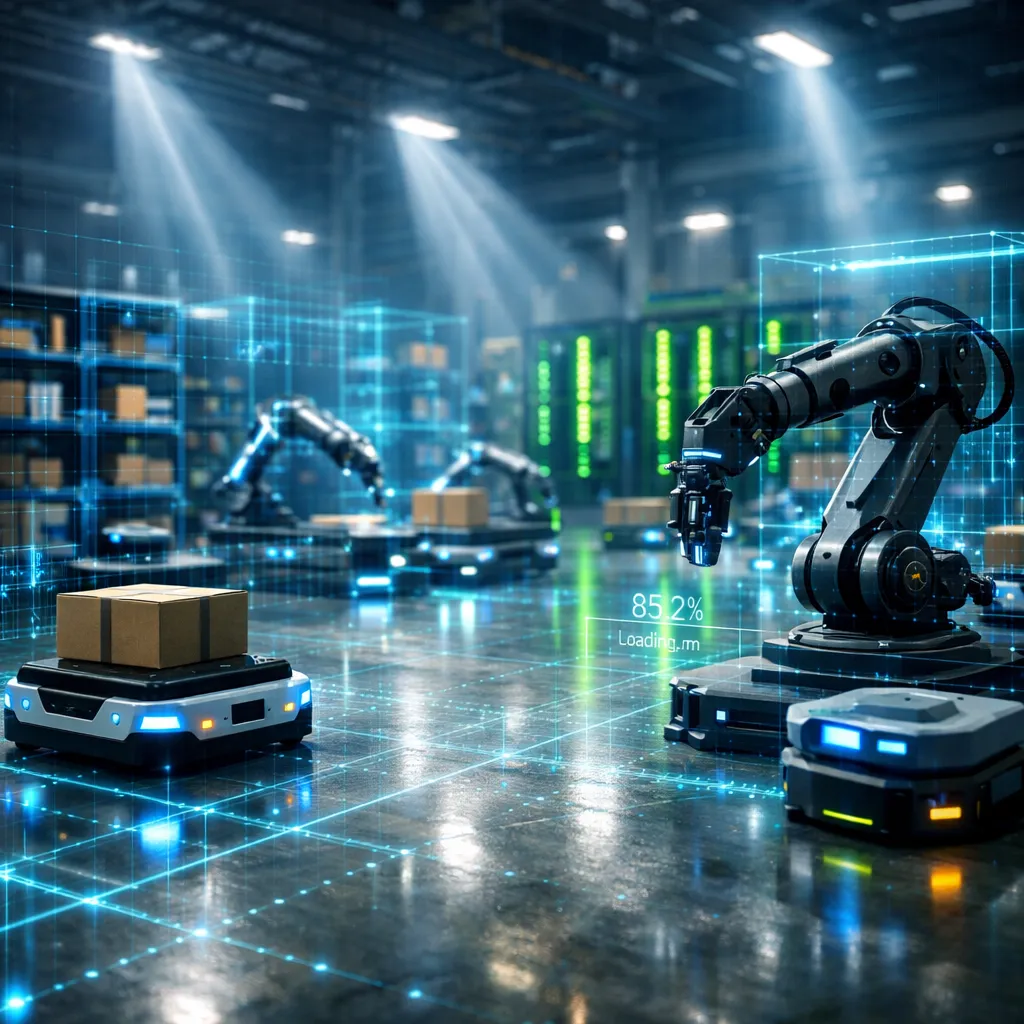
NVIDIA Omniverse is the company's platform for building and operating physics-based digital twins — virtual replicas that don't just look like a warehouse, but behave like one. Every conveyor belt, pallet rack, forklift path, and floor surface is simulated with real-world physics: gravity, friction, collision dynamics, and lighting conditions.
This matters because warehouse robots don't just need to know where things are. They need to understand how objects move, how loads shift on pallets, how lighting changes affect camera sensors, and how to navigate around unpredictable human workers. Training these behaviors in the real world is slow, expensive, and risky. Training them in Omniverse is fast, scalable, and safe.
The digital twin market reached $13.6 billion in 2024 and is growing at over 41% CAGR, with warehouse and logistics applications emerging as one of the fastest-expanding segments. GTC 2026 showed why that growth trajectory is accelerating.
KION and GXO: Autonomous Forklifts Trained in Virtual Warehouses
The most concrete logistics announcement at GTC came from KION Group — the parent company of Linde Material Handling and STILL — partnering with Accenture and NVIDIA to bring physical AI into live warehouse operations for GXO, the world's largest pure-play contract logistics provider.
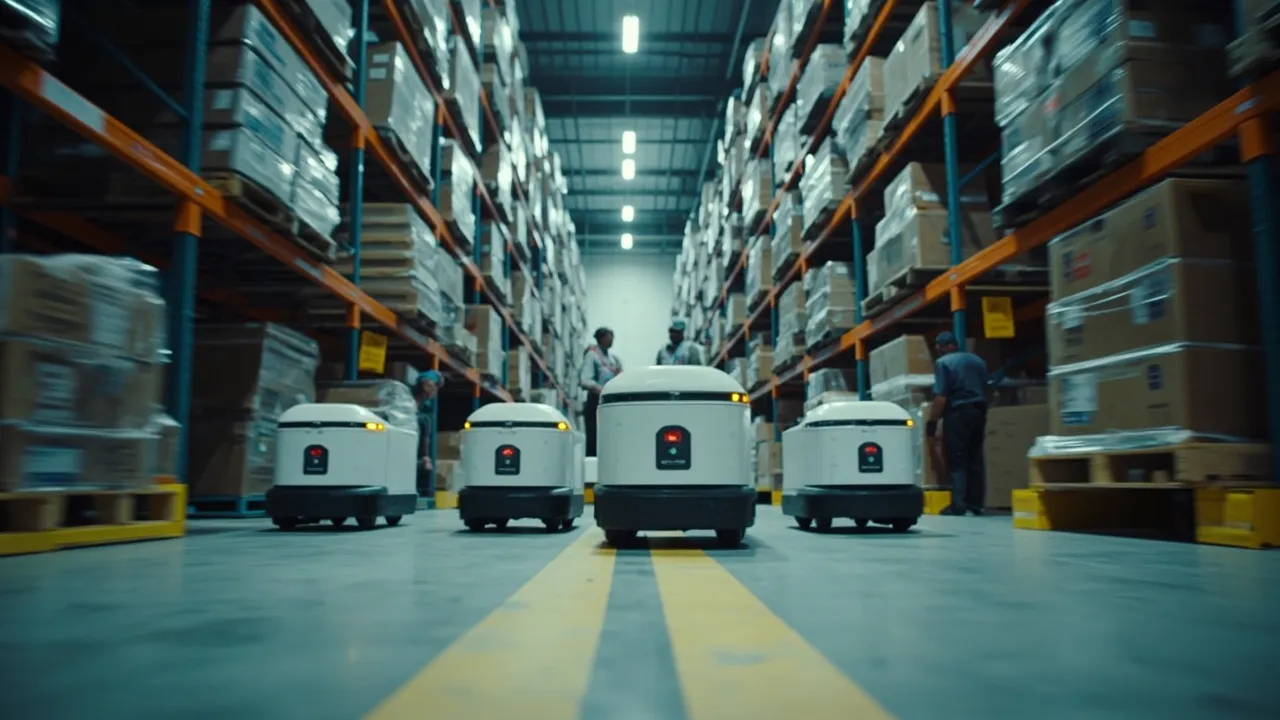
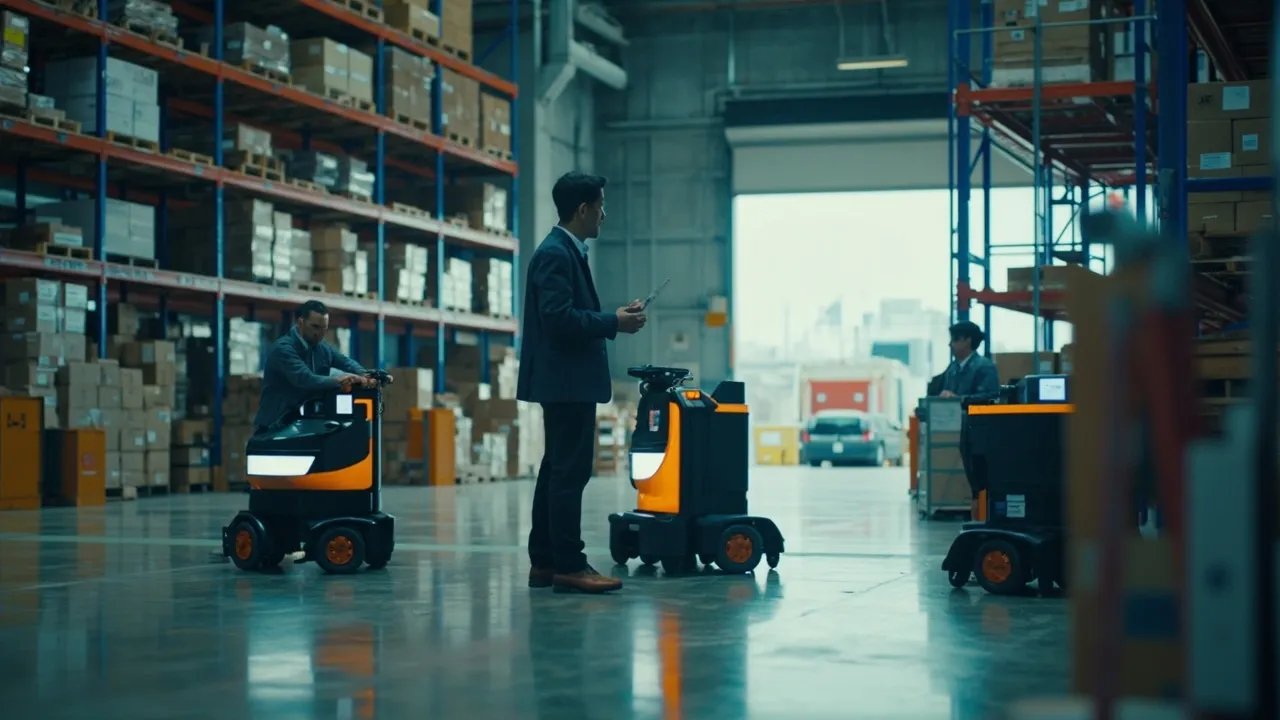
Using NVIDIA Omniverse and the MEGA simulation engine, along with a physical AI-powered digital twin architecture pioneered by Accenture, KION engineers can create large-scale, physics-accurate digital twins of customer warehouses. Inside these virtual environments, they train and test fleets of NVIDIA Jetson-based autonomous forklifts before a single machine enters the physical facility.
The process works like virtual commissioning on steroids: rather than programming each forklift behavior individually, AI models learn through thousands of simulated scenarios — navigating narrow aisles, avoiding human workers, handling variable pallet configurations, and responding to edge cases that would take months to encounter in real operations. The warehouse management software integrates directly with the Omniverse digital twin, creating and assigning missions for robot brains like moving loads between staging areas and dock doors.
For GXO, which operates over 970 facilities globally, the ability to virtually commission autonomous equipment before physical installation could compress deployment timelines from months to weeks — a massive competitive advantage in a contract logistics market where speed to automation determines contract wins.
The Robot Brain Revolution: From Task-Specific to Generalist AI
GTC 2026 also revealed a fundamental shift in how warehouse robots think. Traditional automation requires painstaking programming for each specific task: this robot picks these items, this forklift moves pallets on this exact route, this AMR follows this specific path. Change the warehouse layout or product mix, and you're back to reprogramming.
NVIDIA's new approach treats robots as general-purpose systems with adaptable "brains." The company announced several breakthroughs making this possible:
- Cosmos 3: The first world foundation model that unifies synthetic world generation, vision reasoning, and action simulation — essentially giving robots the ability to understand and predict how the physical world works before they interact with it.
- Isaac Lab 3.0: A framework for large-scale robot learning built on the new Newton physics engine, enabling faster training of dexterous manipulation and complex warehouse tasks on NVIDIA DGX-class infrastructure.
- GR00T N1.7: Now available in early access with commercial licensing, bringing generalized robot skills including advanced manipulation to production-ready deployments.
Leading robot brain developers like FieldAI and Skild AI are using these tools to build generalized robot intelligence — systems that can master new warehouse tasks with minimal retraining. The warehouse robotics market, valued at approximately $8.75 billion in 2026 and projected to reach $27.5 billion by 2032, is being reshaped by this transition from hard-coded behavior to adaptive AI.
Dassault Systèmes and Industry World Models
Beyond robotics training, GTC 2026 showcased a deeper integration between NVIDIA and Dassault Systèmes on "industry world models" — physics-based AI systems that go beyond traditional digital twins.
At GTC, Dassault demonstrated how its virtual twin technology, built on the 3DEXPERIENCE platform integrated with NVIDIA Omniverse, can simulate autonomous, software-defined shop floors. These aren't static 3D models — they're continuously evolving system representations that maintain authority across design, simulation, manufacturing, and operation.
For supply chain leaders, the implication is significant: the same virtual twin used to design a warehouse can simulate its robotic workflows, predict throughput under varying demand scenarios, and optimize layouts — all before construction begins. Jensen Huang and Dassault CEO Pascal Daloz have been vocal that "everything will be represented in a virtual twin," positioning physics-based simulation as the foundation for all future industrial planning.
The ROI Case: Why Virtual Training Changes Warehouse Economics
The business case for simulation-trained robotics comes down to three cost drivers that every logistics leader will recognize:
Commissioning time reduction. Traditional robotic system deployment requires weeks of on-site integration, testing, and adjustment. Virtual commissioning in Omniverse allows teams to identify and resolve 80-90% of integration issues before physical installation, compressing deployment timelines by 40-60% based on early adopter reports from industrial settings.
Risk elimination. Testing autonomous forklifts in a live warehouse with human workers carries inherent safety risks. Virtual environments allow thousands of edge-case scenarios — near-miss situations, unexpected obstacles, sensor failures — to be tested without any physical risk.
Scalability across facilities. Once a robotic fleet is trained in a virtual twin of one warehouse, those learned behaviors can be adapted to new facilities far faster than starting from scratch. For large 3PL operators managing hundreds of sites, this creates compounding returns on simulation investment.
The warehouse simulation market is growing at 14.5% CAGR, driven precisely by these economics. Companies investing in simulation-first deployment strategies are seeing measurable advantages in speed-to-operation and total cost of ownership.
What This Means for Shippers Evaluating Warehouse Automation
GTC 2026's announcements create a new evaluation framework for shippers considering warehouse automation investments. Here's what to ask your automation vendors and 3PL partners:
Is simulation-first deployment part of the implementation plan? Vendors still relying on purely physical commissioning are working with a cost and risk model that's already outdated. Ask whether they use digital twin platforms for pre-deployment testing.
Can the robotic system adapt to layout changes without full reprogramming? The shift from task-specific to generalist AI means warehouse robots should be able to handle product mix changes, layout adjustments, and seasonal demand shifts with minimal intervention.
What's the data infrastructure requirement? Omniverse-powered digital twins require accurate facility data — 3D scans, equipment specifications, workflow patterns. Understanding the data collection burden upfront prevents project delays.
How does the automation investment connect to your broader transportation and logistics strategy? Warehouse automation doesn't exist in isolation. The speed at which robots process orders, stage shipments, and load trailers directly impacts transportation scheduling, carrier utilization, and last-mile delivery windows.
Connecting Warehouse Intelligence to Transportation Strategy with CXTMS
The convergence of warehouse robotics and digital twin simulation creates massive amounts of operational data — throughput rates, staging times, loading patterns, order processing velocities — that have direct implications for transportation planning and execution.
CXTMS bridges this gap by providing shippers with visibility that connects warehouse operational performance to transportation outcomes. When your automated warehouse can process orders 40% faster after a simulation-optimized robotic deployment, your transportation planning needs to adapt in real time: earlier carrier notifications, adjusted pickup windows, and optimized load consolidation.
As warehouse automation becomes simulation-driven and AI-adaptive, the shippers who gain the most advantage won't just be the ones deploying robots — they'll be the ones connecting that warehouse intelligence to their broader freight strategy.
Ready to see how CXTMS connects warehouse performance data to smarter transportation decisions? Request a demo and discover how unified logistics visibility transforms your automation investments into freight savings.