Huawei's Five Smart Transportation Solutions at MWC 2026: What Digital Intelligence Means for Global Logistics Infrastructure

When most people think of MWC Barcelona, they picture smartphone launches and 5G demos. But tucked inside the world's largest mobile technology conference on March 9, 2026, Huawei hosted a forum that should matter far more to supply chain professionals than any new handset: "Accelerate Transportation Digital Intelligence."
The event wasn't a vague vision statement. Huawei announced five concrete solutions spanning road, rail, customs, port operations, and connected fleets — backed by deployments across more than 100 ports, 210 airports, 300 urban rail lines, and 200 logistics enterprises globally. For an industry still wrestling with fragmented visibility and siloed data, this represents a fundamentally different approach: building intelligence into the physical infrastructure itself.
Why a Telecom Giant Is Reshaping Logistics Infrastructure
The global intelligent transportation systems market is valued at approximately $46.8 billion in 2025 and projected to reach $102 billion by 2035, growing at an 8.1% CAGR according to Market.us. The smart ports segment alone is expected to surge from $2.3 billion in 2024 to over $16 billion by 2033, reflecting a 24.2% CAGR as ports race to digitize operations.
Huawei's play is distinct from software-only logistics platforms. As David Shi, Vice President of Huawei's ICT Marketing and Solution Sales, framed it at the forum: the company aims to "build a solid digital and intelligent foundation, connecting passenger, freight, business, revenue, and information flows." The key word is foundation — Huawei is positioning telecom-grade connectivity (5G, edge computing, IoT sensors) as the bedrock layer that logistics software sits on top of.
This matters because the biggest bottleneck in supply chain digitization isn't software — it's infrastructure. You can deploy the most sophisticated TMS or visibility platform in the world, but if the port terminal, rail network, or customs checkpoint lacks the connectivity and sensor infrastructure to generate real-time data, you're still flying blind.
The Five Solutions: Breaking Down Huawei's Logistics Stack
1. Transportation Operations Coordination Center (TOCC) for Road
Huawei's TOCC solution goes beyond traditional intelligent transportation systems. Built to support integrated transportation monitoring, holiday travel surge management, and multimodal logistics coordination, it establishes what Huawei calls "a new model for integrated urban transportation management and control."
For freight operators, this means cities deploying TOCC can dynamically manage truck routing, congestion pricing, and intermodal transfer coordination — reducing the estimated 20–30% of urban freight time lost to congestion and inefficient last-mile routing.
2. Next-Gen Bearer Network for Rail Operations
Railways remain the backbone of inland freight movement, yet many rail networks still rely on legacy communication systems designed decades ago. Huawei's next-generation bearer network for railway operation and dispatching delivers high bandwidth, low latency, and robust reliability for operational communication services.
The practical impact: safer, more efficient rail dispatching that supports the kind of real-time freight tracking shippers increasingly demand. At the forum, Zaiming Ren of CRSC International highlighted how FRMCS (Future Railway Mobile Communication System) technology enhances train control efficiency and boosts transport capacity while lowering lifecycle costs.
3. Big Data Risk Control for Customs
Perhaps the most underappreciated solution in the lineup targets customs clearance — a persistent chokepoint in global trade. Huawei's big data risk control solution, developed with ecosystem partners, integrates multi-source heterogeneous data to enable risk response within seconds rather than hours.
Traditional customs risk control suffers from "limited dimensions, incomplete coverage, and heavy reliance on manual processes," according to Huawei. The new solution addresses this by aggregating trade data, shipping manifests, historical compliance records, and real-time intelligence into a unified risk-scoring engine. For shippers moving goods through emerging markets where customs delays can add days to transit times, this is a significant development.
4. AI-Powered Port Operations: The All-Element Scheduling Agent
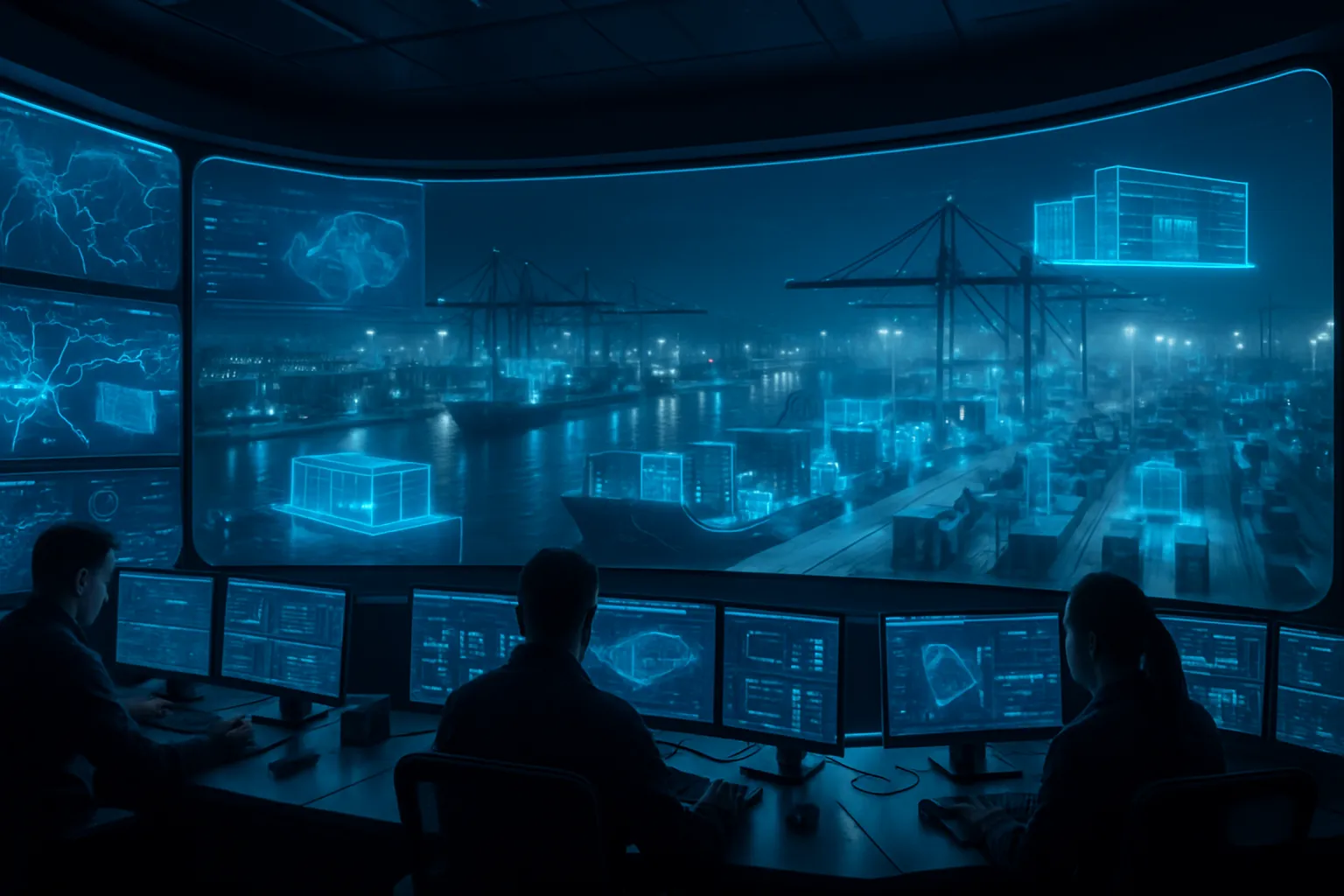
The port solution may be the most technically impressive of the five. Huawei has developed what it calls the industry's first all-element scheduling agent powered by chain-of-thought (CoT) technology — essentially an AI that coordinates the entire port operation process, from berth planning to container distribution and transportation.
The results are striking: operation planning time drops from hours to minutes. The intelligent horizontal transportation 2.0 system supports large-scale scheduling of over 300 vehicles, reduces manual takeover rates to under 0.1%, and achieves parking alignment precision within ±5 centimeters of target position.
Yang Rong, General Engineer of Tianjin Port Group, noted that the port has "digitally managed all port elements and deployed an intelligent horizontal transportation system" — offering a blueprint for what FreightWaves has described as the emerging global push toward digital freight infrastructure that synchronizes data across modes and jurisdictions.
5. Connected Fleet and Railway Connectivity
Rounding out the portfolio, Huawei and Surge announced the world's first commercial deployment of a 1.4 GHz 5G fixed wireless access (FWA) network for railways in Indonesia. This isn't just a connectivity milestone — it represents a paradigm shift in how railway corridors can serve as digital infrastructure backbones, delivering next-generation communications while achieving nationwide coverage along rail lines.
Telecom-Grade vs. Software-Only: Why the Distinction Matters
Most logistics technology companies operate at the application layer — building platforms that process and visualize data. Huawei operates at the infrastructure layer, deploying the physical connectivity, sensors, and edge computing that generate the data in the first place.
This distinction matters enormously for emerging markets. According to the U.S. DOT's recent Request for Information on Transportation Digital Infrastructure, even advanced economies are grappling with "siloed" logistics data and the challenge of federating data sharing across jurisdictions. In developing markets across Southeast Asia, the Middle East, and Africa — where Huawei has its strongest infrastructure presence — the gap between available connectivity and the requirements of modern logistics platforms is even wider.
Huawei's approach effectively bundles the infrastructure and the intelligence: 5G connectivity, IoT sensor networks, edge computing, and AI-driven scheduling all deployed as an integrated stack. For port authorities, rail operators, and customs agencies in these markets, this offers a faster path to digitization than assembling best-of-breed software solutions that require infrastructure that doesn't yet exist.
The Competitive and Geopolitical Dimension
Huawei's expanding logistics infrastructure footprint raises important strategic questions for Western supply chain technology providers. With deployments spanning over 180,000 kilometers of railways and 200,000+ kilometers of road networks globally, Huawei is building a digital infrastructure ecosystem that could become the default connectivity layer for freight movement in many emerging markets.
For shippers and logistics operators, this creates both opportunity and complexity. The opportunity: dramatically improved visibility and efficiency in markets that were previously data deserts. The complexity: ensuring interoperability between different digital infrastructure ecosystems as goods move across borders and through ports operated on different technology stacks.
What This Means for Your Supply Chain
Huawei's MWC announcements signal that the era of "software-only" logistics digitization is giving way to integrated infrastructure intelligence. Here's what supply chain leaders should be watching:
- Port technology investments: If your supply chain touches ports adopting AI-powered scheduling agents, expect step-function improvements in berth utilization and container throughput — but plan for integration requirements.
- Customs digitization: Big data risk control at customs checkpoints could dramatically reduce clearance times in emerging markets. Factor this into your trade lane planning.
- Rail modernization: Next-gen communication networks for railways mean real-time intermodal tracking becomes viable on corridors where it was previously impossible.
- Infrastructure lock-in risks: As telecom-grade infrastructure becomes the foundation of logistics intelligence, evaluate how technology stack choices at ports and terminals affect your data access and visibility capabilities.
How CXTMS Bridges Infrastructure and Visibility
Regardless of which infrastructure ecosystem your supply chain operates within, the need for unified, shipper-centric visibility doesn't change. CXTMS is built to integrate with any underlying infrastructure — whether it's Huawei's intelligent port systems, Western IoT networks, or legacy EDI feeds — and deliver a single pane of glass across your entire freight network.
As smart infrastructure deployments accelerate globally, the shippers who thrive will be those with visibility platforms flexible enough to ingest data from any source and intelligent enough to turn it into actionable decisions.
Ready to future-proof your freight visibility? Request a CXTMS demo and see how our platform connects the dots across every mode, market, and infrastructure ecosystem your supply chain touches.