Global Container Port Terminals Post Record 2025 Earnings: What Rising Throughput and $740M CapEx Plans Mean for Shipper Costs

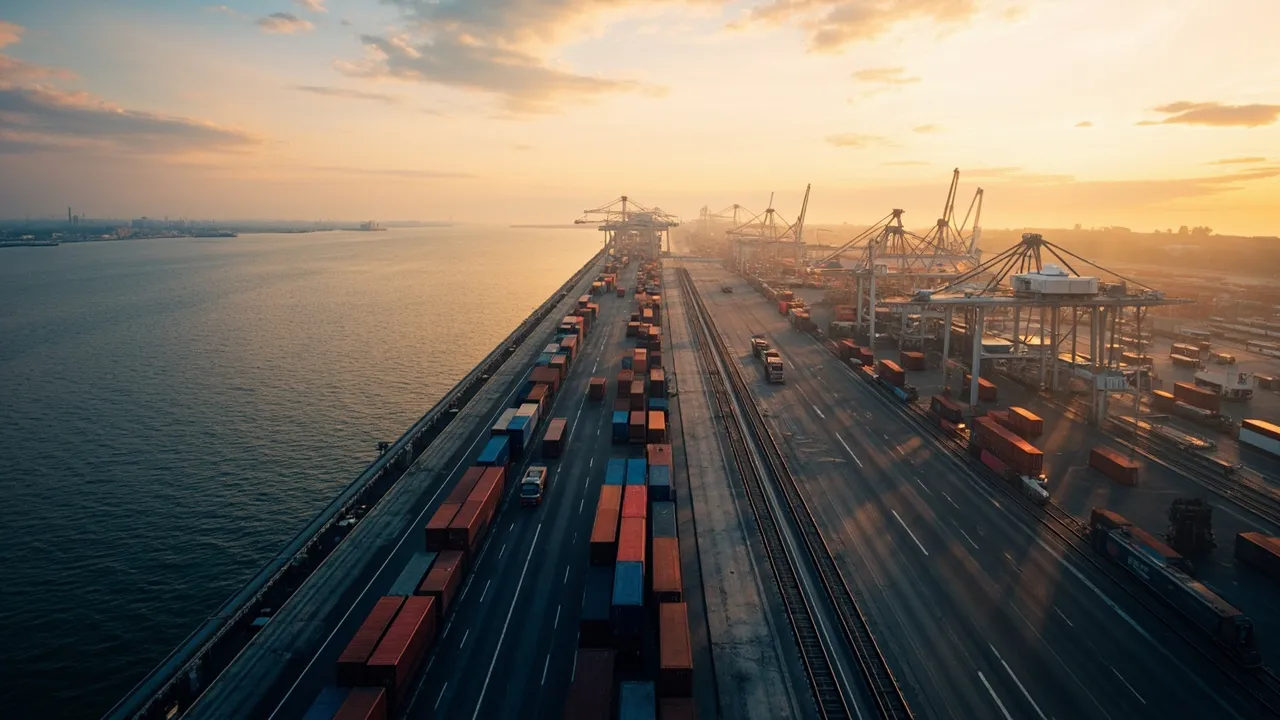
The global port terminal industry just closed its most profitable year on record — and shippers should be paying close attention. From Manila to Rotterdam, from Dubai to Latin America, every major terminal operator posted earnings that shattered previous benchmarks in 2025. The question logistics teams need to answer: when terminal operators are this profitable, where is that money coming from, and what does it signal for your freight costs in 2026?
A Record-Breaking Earnings Season
The numbers across the board are staggering. ICTSI (International Container Terminal Services) crossed the billion-dollar net income threshold for the first time, reporting $1.05 billion in net income — up 23% year over year — on revenues of $3.23 billion and consolidated volumes of 14.5 million TEU. The Philippines-based operator's EBITDA margin reached 66%, among the highest in the global terminal sector.
PSA International handled a record 105 million TEU — a 5% increase that solidifies its position as the world's largest terminal operator — with revenue rising 7% to SGD 8.3 billion and operating profit surging 19% to SGD 1.4 billion.
DP World reported first-half 2025 revenue of $11.24 billion, up 20.4%, with EBITDA of $3.03 billion and a 69% increase in net profit to $960 million. Its Port Saint John terminal in Canada achieved a remarkable 29.4% year-over-year container volume increase, handling 239,364 TEU — volumes that have grown 175% in just four years.
APM Terminals, Maersk's port division, delivered what its parent company described as "record results," posting an EBIT margin of 39.4% in Q3 2025 with revenues growing 22% year on year and several terminals approaching what Maersk described as "optimal utilization limit."
Even Yilport, the Turkish operator now ranked tenth globally, grew container volumes 12% to 8.4 million TEU, with standout performances in Latin America — Paita in Peru grew 57%, Puerto Bolívar in Ecuador 38%.
Rotterdam's Structural Shift: A Window Into the Future
The Port of Rotterdam's 2025 results reveal something particularly significant for long-term logistics planning. Container throughput grew 3.1% to 14.2 million TEU even as total cargo tonnage declined 1.7% to 428.4 million tonnes. Revenue rose 6.6% to €940.4 million, though net profit fell to €266 million after higher depreciation charges.
This divergence — containers up, fossil fuels down — reflects the structural transformation underway at Europe's largest port. Dry bulk fell 6.5% and liquid bulk dropped 1.5%, driven by Europe's accelerating energy transition. For shippers, the implication is clear: port infrastructure investment is increasingly concentrated on containerized cargo handling, and the terminals that handle your boxes are becoming the primary revenue engines.
Shanghai consolidated its position as the world's busiest container port at 55.06 million TEU, a 6.9% increase, with its Yangshan Phase III automated terminal surpassing 10 million TEU for the first time.
$740 Million in CapEx: Where Terminal Operators Are Investing
When operators are this profitable, they reinvest aggressively — and shippers ultimately fund those investments through terminal handling charges (THC). ICTSI has announced an estimated $740 million in capital expenditure for 2026, earmarked for completing the Phase 3B expansion at Contecon Manzanillo (CMSA) in Mexico, ongoing expansions at Manila International Container Terminal, and capacity additions across its global portfolio.
This is not isolated spending. Across the industry, terminal operators are in an unprecedented investment cycle. According to research from Astute Analytica, the global port construction market is projected to reach $346.53 billion by 2035, driven by mega-project expansions and capacity upgrades. North American container volumes surged 8.3% in the latest reporting period, further fueling the investment case.
The CapEx priorities reveal where the industry sees growth:
- Automation and electrification — automated rail-mounted gantry (ARMG) systems, electric rubber-tired gantry cranes, and AI-driven yard management
- Capacity expansion in emerging markets — Latin America, Southeast Asia, and Africa are receiving disproportionate investment relative to mature European and North American terminals
- Intermodal connectivity — terminals that can move a container from ship to rail in under two hours command premium pricing
What Record Terminal Profits Signal for Shipper Costs
Here's the uncomfortable reality for logistics teams. Terminal handling charges are the second-largest component of ocean freight costs after the base ocean rate, and they have historically trended in one direction: up. When terminal operators report 66% EBITDA margins and 23% net income growth, the pricing environment is not working in the shipper's favor.
Several dynamics are converging to keep THC elevated through 2026:
Near-capacity utilization. APM Terminals described several facilities as approaching "optimal utilization limit." When terminals run hot, they lose flexibility to negotiate volume discounts. Shippers requesting priority handling, extended gate hours, or guaranteed vessel windows pay a premium.
Red Sea diversions persist. With a large-scale return of container ships to Red Sea routing unlikely in 2026, vessels continue routing via the Cape of Good Hope — adding transit time, consuming capacity, and increasing port calls at intermediate terminals that charge accordingly.
Consolidation concentrates pricing power. The top five global terminal operators now control an outsized share of global throughput. When PSA handles 105 million TEU and DP World's revenue approaches $22 billion annualized, the competitive landscape offers shippers fewer alternatives at major gateway ports.
Infrastructure surcharges are coming. As operators pass through $740 million+ CapEx programs, expect new infrastructure surcharges, terminal efficiency fees, and green transition levies to appear on invoices. The automation investments that promise long-term efficiency gains are funded by near-term cost pass-throughs.
How Shippers Can Respond
The worst strategy is passivity. Shippers who treat THC as a fixed, non-negotiable line item are leaving money on the table. Here's what proactive logistics teams are doing:
Diversify port selection. The record earnings reveal significant regional variation. Emerging market terminals in Latin America and Southeast Asia often offer competitive rates with expanding capacity. Yilport's 57% growth at Paita demonstrates that alternative gateways are scaling rapidly.
Benchmark THC across terminals. Most shippers lack visibility into THC variation across competing terminals within the same region. A $50-per-container difference across two gateway ports handling the same trade lane compounds into six-figure annual savings at volume.
Negotiate multi-year volume commitments. Terminal operators investing $740 million need volume certainty. Shippers willing to commit multi-year volumes can lock in THC rates before the next round of infrastructure surcharges takes effect.
Leverage real-time visibility for port optimization. Understanding dwell times, congestion patterns, and vessel schedule reliability at the terminal level — not just the port level — enables dynamic routing decisions that avoid the most expensive handling windows.
How CXTMS Helps You Navigate Rising Port Costs
CXTMS gives logistics teams the multimodal visibility and cost analytics needed to turn port terminal data into a competitive advantage. Our platform provides real-time terminal performance benchmarking, dwell time analytics, and THC comparison across competing port facilities — so you can route shipments through the most cost-effective terminals rather than defaulting to habit.
With CXTMS, you can model the total landed cost impact of port selection decisions, including THC, drayage, intermodal connections, and transit time trade-offs. When terminal operators are posting record margins, the shippers who win are the ones with the data to negotiate from strength.
Request a CXTMS demo → and see how multimodal port analytics can reduce your terminal handling costs by optimizing port selection and carrier routing across your network.