EDI 856 Goes Mission-Critical: How ASN Data Accuracy Is Becoming a Supply Chain Differentiator


The humble EDI 856 Advance Ship Notice has been a supply chain staple for decades. But in 2026, what was once a routine electronic packing slip has become a mission-critical data asset — and the accuracy of your ASN data is rapidly becoming a competitive differentiator that separates thriving suppliers from those hemorrhaging margin to chargebacks and lost accounts.
From Paperwork to Strategic Asset
The EDI 856 transaction tells a receiving warehouse exactly what to expect: items, quantities, packaging hierarchy, carrier details, and estimated delivery times. For years, many suppliers treated ASN generation as an afterthought — a compliance checkbox rather than a strategic capability.
That era is over. Three converging forces are elevating ASN accuracy from "nice to have" to "business survival":
- Retailer compliance mandates with real financial teeth
- FDA regulatory requirements demanding granular traceability data
- Automated receiving systems that depend on flawless electronic data
Together, these forces mean that a single inaccurate ASN can cascade into chargebacks, regulatory violations, and broken receiving workflows.
Retailer Chargebacks: The Cost of Inaccuracy
Major retailers have dramatically tightened their supplier compliance programs, and ASN accuracy sits at the center of these mandates. Walmart's On-Time In-Full (OTIF) program now demands 98% compliance from suppliers, with penalties of up to 3% of invoice value for non-compliance. ASN errors — missing shipment data, incorrect quantities, or late transmission — directly undermine OTIF scores.
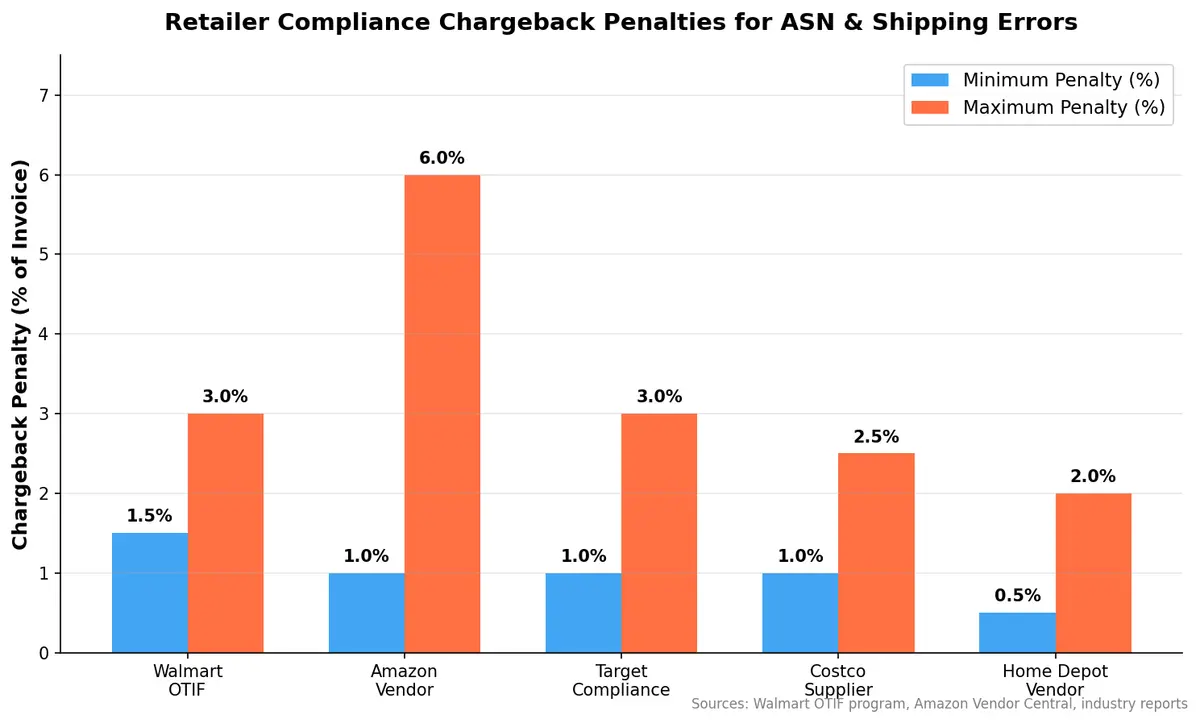
The financial impact extends far beyond Walmart. Amazon imposes compliance chargebacks ranging from 1% to 6% of product cost depending on the violation type and compliance rate. Target, Costco, and Home Depot all enforce similar penalty structures. For a mid-size supplier shipping $50 million annually, even a 2% chargeback rate translates to $1 million in pure margin erosion.
What makes these chargebacks particularly painful is their compounding nature. A supplier with poor ASN accuracy doesn't just pay penalties — they lose priority in retailer allocation decisions, get excluded from promotional programs, and eventually face delisting. In a commoditized market, execution reliability becomes the tie-breaker.
FSMA 204: Regulation Meets EDI Reality
The FDA's Food Safety Modernization Act Section 204 is adding another layer of urgency to ASN data quality. While the compliance deadline has been extended to July 2028, as Supply Chain Management Review reported, retailers and grocers are not waiting — they want this traceability data now.
FSMA 204 requires companies handling foods on the Food Traceability List (FTL) to capture Key Data Elements (KDEs) at Critical Tracking Events (CTEs) throughout the supply chain. This includes lot codes, manufacturing dates, expiration dates, and origin information. The primary vehicle for transmitting this data from supplier to retailer? The EDI 856 ASN.
This regulatory requirement fundamentally changes what an ASN must contain. It's no longer sufficient to send item counts and carrier information. Food and beverage suppliers must now embed granular lot-level traceability data into every shipment notification. Companies that have been tracking this data in spreadsheets face a stark reality: manual processes are too error-prone and too slow for the volume and precision that FSMA 204 demands.
The competitive implications are clear. Suppliers who integrate FSMA traceability data into their ERP and EDI systems gain a compliance advantage. Those who don't become what industry experts call "disruptive vendors" — partners that increase risk rather than reduce it.
Automated Receiving Depends on ASN Precision
The third force elevating ASN importance is the rapid adoption of automated receiving systems in distribution centers. Modern warehouses increasingly use ASN data to pre-plan labor, stage receiving areas, and automate put-away decisions before a truck even arrives at the dock.
When ASN data is accurate, a distribution center can:
- Pre-print receiving labels matched to expected containers
- Allocate dock doors based on shipment size and priority
- Schedule cross-dock transfers without manual inspection
- Trigger automated inventory updates the moment goods are scanned
When ASN data is wrong, the entire automated workflow breaks down. Staff must manually inspect shipments, reconcile discrepancies, and re-enter data — wiping out the efficiency gains that automation was supposed to deliver. For retailers investing billions in warehouse automation (Walmart alone is at peak automation capex in 2026), unreliable ASN data from suppliers is increasingly unacceptable.
Achieving 99%+ ASN Accuracy
The path to high ASN accuracy starts with system integration. The most common source of ASN errors is disconnected processes — order management, warehouse execution, and EDI generation operating in separate systems with manual handoffs between them.
Key strategies for improving ASN accuracy include:
- Integrate EDI generation with WMS: ASN data should be generated directly from warehouse scan events, not re-keyed from pick tickets
- Validate before transmission: Automated pre-send checks that compare ASN content against original purchase orders catch mismatches before they reach the retailer
- Implement serial-level tracking: GS1-128 barcode scanning at pack and ship ensures that what's in the box matches what's in the ASN
- Automate lot and date capture: For FSMA-regulated products, integrate production system data directly into EDI workflows to eliminate manual date entry
- Monitor and measure: Track ASN accuracy as a KPI with the same rigor as on-time delivery or fill rate
The role of a modern TMS in this process is critical. A transportation management system that integrates with both warehouse operations and EDI platforms can validate shipment data at every stage — from order creation through carrier pickup to final ASN transmission. This closed-loop approach catches errors at the source rather than after a chargeback arrives.
The Data Quality Dividend
Companies that invest in ASN accuracy see returns far beyond chargeback reduction. High-quality shipment data enables better demand planning, faster receiving cycles, and stronger trading partner relationships. It's the foundation that makes advanced capabilities like automated receiving, cross-docking, and real-time inventory visibility possible.
In the words of Supply Chain Management Review's Norman Katz, customers have a right to "the right data" — and he argues this should be recognized as the ninth fundamental right in supply chain execution. For suppliers and logistics operators, meeting that standard isn't just good practice. It's becoming the price of admission.
The Bottom Line
EDI 856 accuracy is no longer a back-office concern. It's a front-line competitive capability that affects retailer relationships, regulatory compliance, and operational efficiency. As retailer mandates tighten, FSMA 204 requirements take hold, and automated warehouses demand flawless data, the suppliers who treat ASN accuracy as a strategic priority will win — and those who don't will pay the price, one chargeback at a time.
Struggling with ASN accuracy and retailer compliance? Contact CXTMS for a demo of how our integrated TMS platform ensures EDI 856 precision across your entire supply chain.