How Static Warehouse Layouts Are Failing High-SKU Manufacturers: The Case for Dynamic Slotting and Adaptive Fulfillment in 2026

If your warehouse layout looks the same today as it did six months ago, you're almost certainly leaving money on the floor—literally. For high-SKU manufacturers juggling thousands of product variations across seasonal demand cycles, static slotting strategies are becoming one of the most expensive hidden inefficiencies in the supply chain.
The global warehouse automation market reached $29.98 billion in 2026 and is projected to hit $59.52 billion by 2030 at an 18.7% CAGR. Yet despite this massive investment wave, 80% of warehouses worldwide still operate without any form of automation. For manufacturers managing complex SKU portfolios, the gap between static layouts and intelligent, demand-responsive operations is where the real margin erosion happens.
The Static Layout Problem: Death by a Thousand Wasted Steps
Traditional warehouse slotting assigns products to fixed locations based on historical averages—typically reviewed quarterly or even annually. In a low-SKU, stable-demand environment, this approach works well enough. But for manufacturers handling 5,000 to 50,000+ active SKUs with variable demand patterns, static slotting creates compounding inefficiencies.
Industry data consistently shows that A-items—the top 20% of SKUs by pick frequency—drive approximately 80% of all fulfillment activity. When those high-velocity items aren't continuously repositioned near packing stations and primary pick paths, operators walk unnecessary distance on every single order. Across a facility processing thousands of picks per shift, those wasted steps translate to 15–25% of total pick path time lost to suboptimal product placement.
The problem compounds during demand shifts. A manufacturer producing both consumer and industrial goods might see dramatic SKU velocity changes tied to seasonal contracts, product launches, or raw material availability. A static layout designed around last quarter's demand patterns becomes actively counterproductive when this quarter's reality looks different.
Dynamic Slotting: AI-Driven Real-Time Product Placement
Dynamic slotting replaces periodic manual reviews with continuous, AI-driven optimization that repositions products based on real-time demand signals. Instead of waiting for a quarterly slotting review, the system analyzes current order patterns, inbound receipts, and forecasted demand to recommend—or in fully automated environments, execute—slot reassignments daily or even intra-day.
Modern warehouse management systems are evolving rapidly to support this capability. As Inbound Logistics reports, next-generation WMS platforms are shifting from transaction recorders to AI-enabled orchestration hubs that integrate robotics, labor management, and real-time analytics into a single control layer. This evolution makes dynamic slotting not just theoretically possible but practically achievable for mid-market manufacturers.
The core mechanics of dynamic slotting include:
- Velocity-based repositioning: High-frequency SKUs migrate automatically toward golden zones closest to pack stations
- Affinity grouping: Products frequently ordered together cluster into adjacent slots to reduce multi-stop picks
- Seasonal pre-positioning: Demand forecasting triggers proactive slot changes before seasonal surges hit
- Exception handling: Oversized, hazmat, or temperature-sensitive items maintain compliance-driven fixed positions while everything else flows dynamically
Adaptive Fulfillment Zones: Reconfiguring for Peak vs. Off-Peak
Dynamic slotting addresses individual product placement. Adaptive fulfillment takes the concept further by reconfiguring entire warehouse zones based on operational mode. During peak periods, a manufacturer might expand the primary pick face by 40%, temporarily converting bulk storage areas into active pick zones. During off-peak, those zones revert to deeper storage configurations that maximize cubic utilization.
This approach requires a WMS capable of managing fluid zone definitions and directing labor and automation systems to operate across shifting boundaries. The technology is available today. Companies are planning to allocate roughly 25% of capital spending to automation investments over the next five years, with logistics and fulfillment accounting for the largest share, according to McKinsey research cited by The Network Installers.
For high-SKU manufacturers specifically, adaptive zones solve a critical tension: the need for broad product accessibility during fulfillment windows versus the need for dense storage efficiency during replenishment and staging windows.
North America vs. Asia-Pacific: The Automation Race Heats Up
The competitive pressure to modernize is global but playing out differently across regions. North America currently leads the warehouse automation market with 35.6% of global revenue, driven by labor costs that account for 50–70% of total warehousing budgets and wages that climbed 7–9% year-over-year in 2024.
Meanwhile, the Asia-Pacific warehouse automation market is expected to grow from $14.18 billion in 2025 to $38.57 billion by 2031 at a 17.31% CAGR. Southeast Asia, India, and Australia are filling the investment gap as consumer digital adoption accelerates and manufacturing capacity expands. Japanese importers are sourcing cost-competitive Chinese robotics to address regulatory labor constraints, illustrating how cross-border technology flows are reshaping the competitive landscape.
For North American manufacturers, the implication is clear: competitors in Asia-Pacific are building automation-first facilities from the ground up. Retrofitting existing facilities with dynamic slotting and adaptive fulfillment isn't just an efficiency play—it's a competitive survival strategy.
Implementation Roadmap for Mid-Market Manufacturers
Transitioning from static to dynamic slotting doesn't require a greenfield facility or a seven-figure automation investment. A practical roadmap looks like this:
Phase 1 (Months 1–3): Data Foundation. Instrument your current operations to capture granular pick-path data, SKU velocity metrics, and order-line affinity patterns. Most WMS platforms already collect this data—the gap is usually in analysis, not capture.
Phase 2 (Months 3–6): Algorithmic Slotting. Deploy AI-driven slotting recommendations that human supervisors review and approve before execution. This builds trust in the system while delivering immediate efficiency gains of 10–15% in pick path reduction.
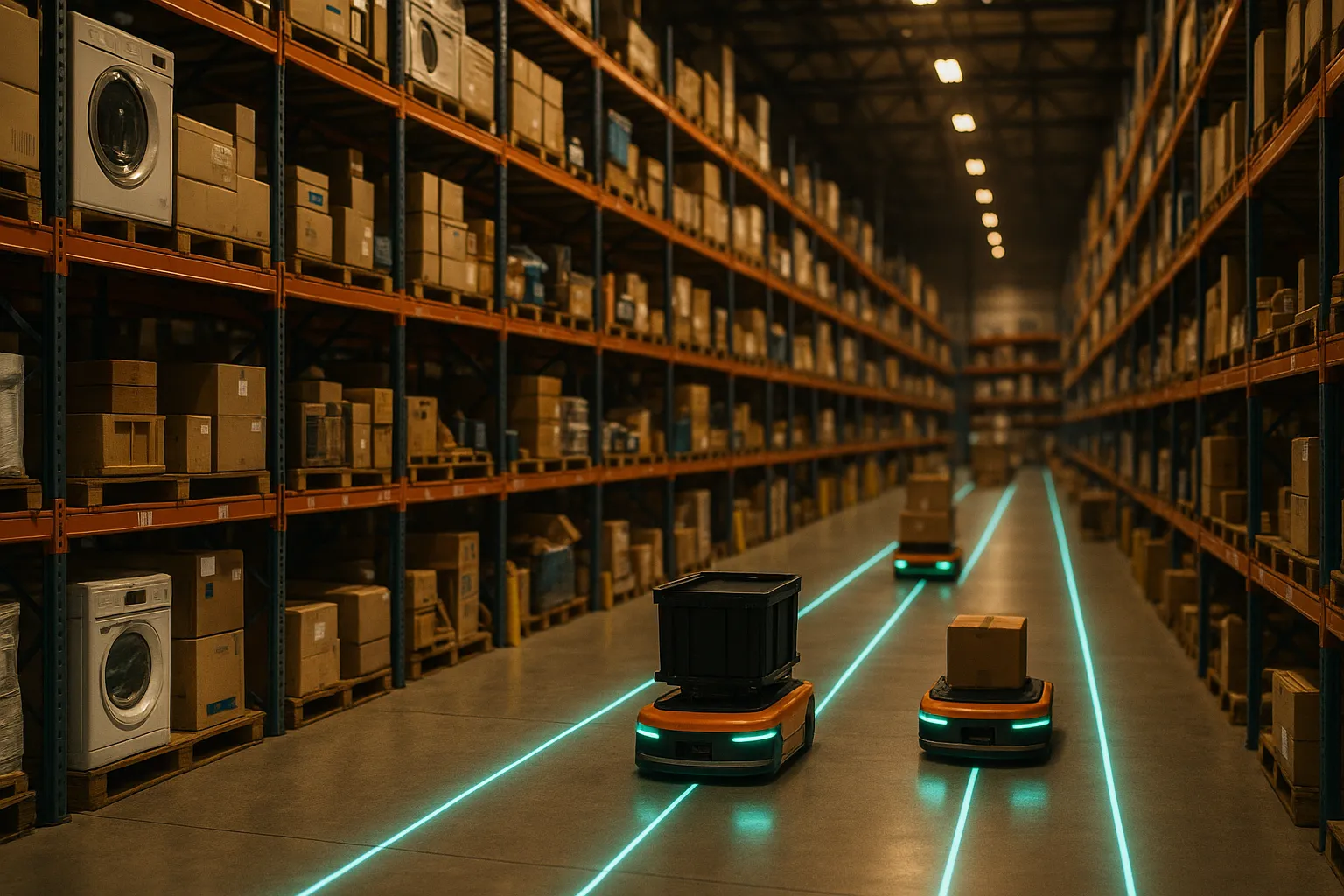
Phase 3 (Months 6–12): Autonomous Execution. Transition to automated slot reassignment with human exception handling. Integrate with AMR fleets or conveyor systems for physical product relocation during off-shift windows.
Phase 4 (Months 12–18): Adaptive Zones. Implement dynamic zone boundaries that respond to demand forecasts, enabling the facility to reconfigure its operational footprint on a weekly or even daily basis.
The ROI math is compelling. Automation can reduce labor costs by 30–40% over five years, and AMR deployments that redeploy even four operators can deliver a 42% five-year OPEX reduction with an eight-month payback period.
How CXTMS Connects Outbound Freight to Dynamic Fulfillment
Dynamic slotting and adaptive fulfillment optimize what happens inside the warehouse. But the real supply chain impact multiplies when fulfillment operations sync with outbound freight planning. CXTMS connects these two worlds by providing real-time carrier rate optimization, load consolidation intelligence, and delivery window management that align with your facility's fulfillment cadence.
When your warehouse dynamically reorganizes around today's order profile, CXTMS ensures your outbound freight strategy adapts in lockstep—matching carrier selection and shipment timing to the actual flow of goods leaving your dock, not yesterday's static plan.
Ready to connect your warehouse operations to smarter freight execution? Request a CXTMS demo and see how unified fulfillment-to-freight visibility transforms your outbound logistics.