CPKC’s Record Q2 Needs a Cross-Border Train-Level Service Ledger

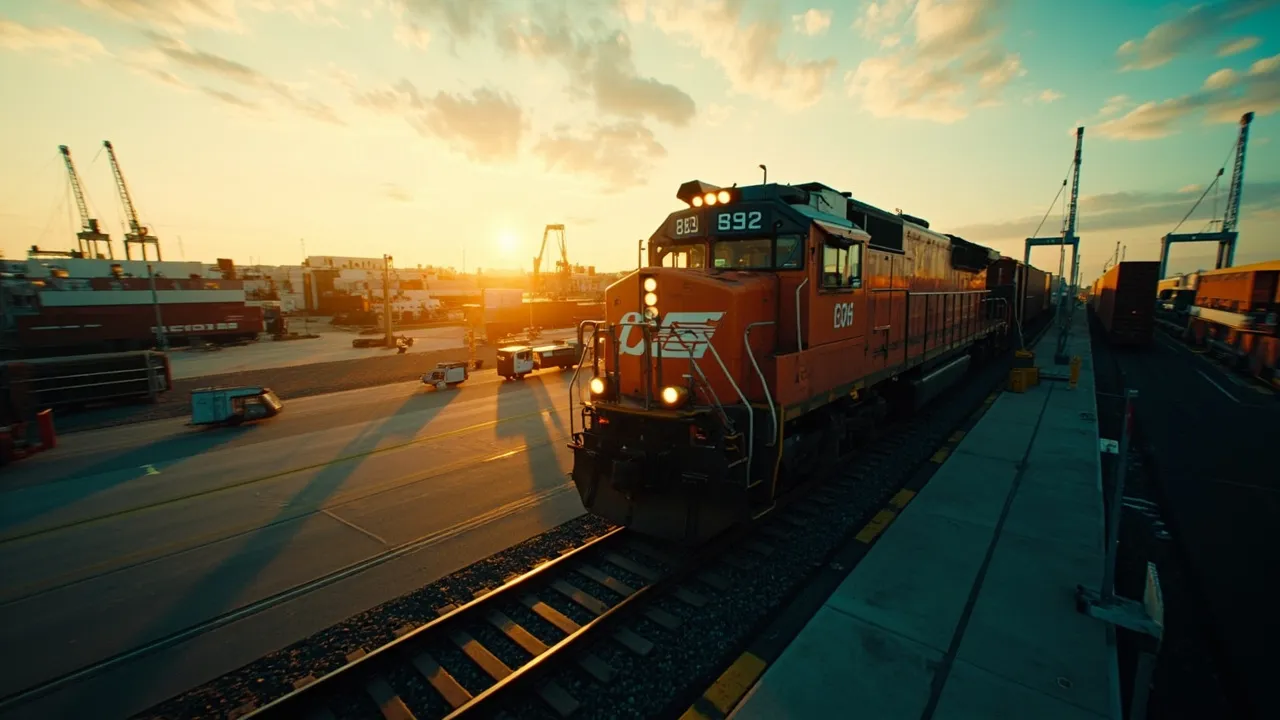
Canadian Pacific Kansas City’s record second-quarter revenue is a strong signal for North American rail. It is not, by itself, a service-level agreement for a shipper moving containers across three countries.
CPKC reported second-quarter revenue of C$4.2 billion, up 13% year over year. Its domestic intermodal volume increased 3%, while volume on the cross-border SMX service rose 30% from the first quarter, when dedicated stack trains began operating. Those figures, reported by FreightWaves, show commercial momentum around a network designed to connect Mexico, the United States, and Canada.
The broader market is moving in the same direction. According to Logistics Management, North American intermodal volume reached 1,639,677 units in June, an 11.6% annual increase and a sharp acceleration from May’s 4.4% gain.
For shippers, however, stronger rail volume can create two opposing outcomes. It can support better train frequency and network density, but it can also expose weak handoffs at terminals, customs desks, and drayage ramps. Financial and volume growth therefore need a companion operating record: a cross-border train-level service ledger.
Revenue growth is not shipment visibility
A quarterly income statement answers whether the railroad is growing profitably. It does not answer when a particular container cleared customs, whether it made the planned train, how long it sat after terminal availability, or whether final dray capacity was ready.
Those distinctions matter more on a cross-border intermodal move than on a domestic lane. A Mexico-to-U.S. or Mexico-to-Canada shipment may pass through an origin ramp, rail linehaul, customs processes, one or more terminal events, an interchange or connection, and final drayage. A delay at any one point can consume the economic advantage of rail even when the linehaul train performs exactly as scheduled.
Average transit time hides that variability. Two shipments can both average five days: one might arrive consistently within a narrow four-to-six-day window, while another alternates between three and seven days. The averages look identical, but the second pattern forces the shipper to carry more buffer inventory and raises the risk of missed appointments.
Build the ledger around operational milestones
A useful ledger should create one record for each container and planned train, then time-stamp the milestones that determine whether the move succeeded. At minimum, it should capture:
- Booking confirmation and the service product purchased
- Origin-gate cutoff and actual gate-in time
- Customs-document completion and holds at each border
- Planned train, actual train, departure time, and any rollover reason
- Interchange or connection arrival and departure
- Destination terminal availability and free-time expiration
- Dray carrier assignment, pickup appointment, actual out-gate, and final delivery
Every event needs a common shipment identifier. Train symbols, container numbers, booking references, customs entries, and dray orders often live in separate systems. The ledger should cross-reference them rather than forcing operations teams to reconcile five screens after a customer asks where the freight is.
It should also preserve the planned timestamp alongside the actual timestamp. An event feed that only says a container became available at 14:20 provides visibility, but it does not show whether availability was six hours early or 30 hours late. Planned-versus-actual variance turns tracking data into a performance measure.
Measure the handoffs, not just the linehaul
The most valuable metric is not one network-wide transit average. It is the distribution of delay by stage.
A shipper can calculate cutoff compliance, origin dwell, border-release time, connection success, destination dwell, and dray pickup latency separately. It can then assign an exception code: documentation incomplete, customs hold, train rollover, terminal congestion, unavailable chassis, missed pickup appointment, or customer constraint.
This prevents a common argument in cross-border transportation: every provider can claim that its own segment performed while the end-to-end shipment still arrived late. A shared ledger identifies which milestone broke the plan and how much time it added.
The same record should measure reliability with percentiles, not only averages. Median transit describes the typical move. The 90th percentile shows the buffer required to protect most orders. On-time performance within a promised window, connection success rate, customs-release variance, terminal dwell, and exception recurrence by lane give procurement teams a more honest picture of service.
Compare rail and truck on the outcome that matters
Cross-border rail should not be compared with truck using quoted linehaul time alone. The decision should include total door-to-door elapsed time, variability, inventory carrying cost, drayage at both ends, customs administration, detention or storage exposure, and the cost of service recovery.
For a stable, high-volume lane, rail may deliver a meaningful cost and capacity advantage even if its median transit is longer. For an urgent or highly variable flow, truck may justify a premium. The train-level ledger supplies the evidence to segment those decisions instead of applying one mode rule to every shipment.
The 30% sequential growth reported for SMX makes this discipline timely. As a service scales, shippers should establish a baseline by origin-destination pair, train, day of week, commodity, and border process. Monthly reviews can then distinguish a one-time disruption from a recurring design problem, such as an unrealistic cutoff or a dray appointment that routinely falls after free time begins.
Turn rail visibility into accountable execution
CPKC’s record quarter and the wider intermodal volume increase validate cross-border rail’s strategic importance. But growth makes granular service governance more important, not less. Shippers need to know whether each planned train and each cross-border handoff performed—not merely whether the network produced a strong quarter.
CXTMS helps freight forwarders connect booking, milestone, customs, terminal, and drayage data in one operational workflow. Request a CXTMS demo to build exception management and lane-level performance reporting around your cross-border freight.