Warehouse AI Robotics Hit $11.86B: Prove Throughput Before Scaling the Fleet

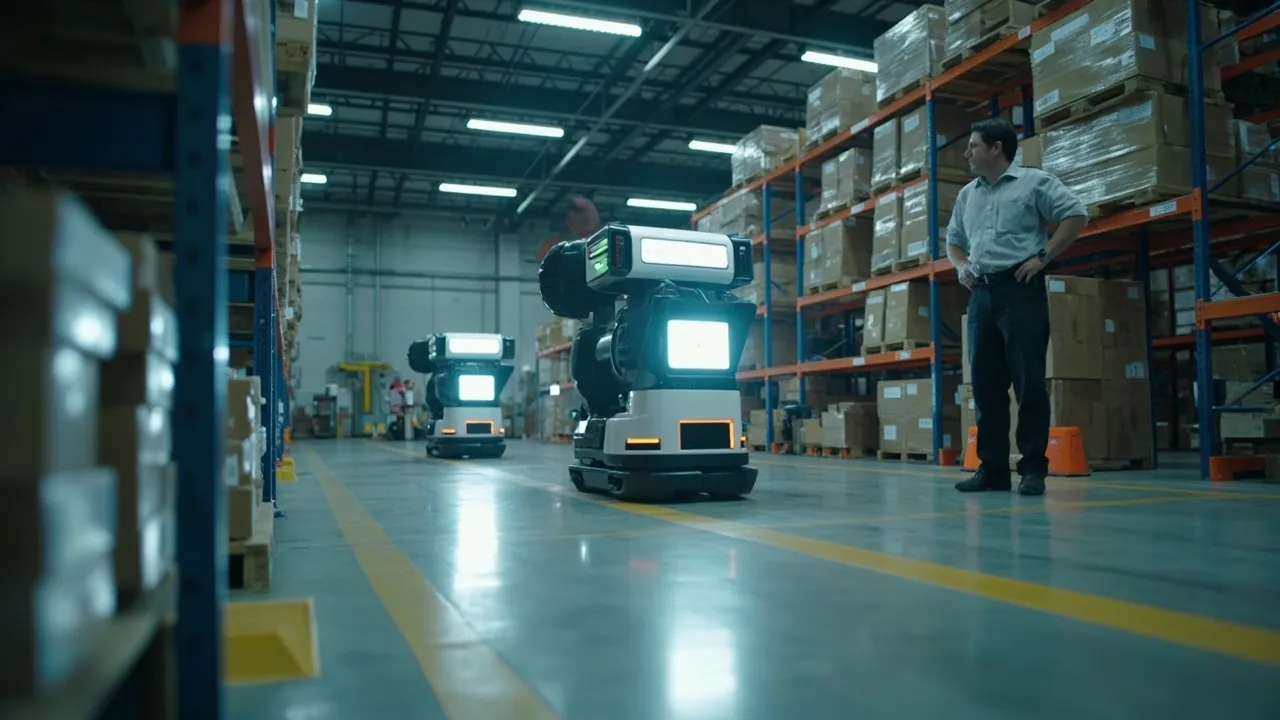
The warehouse market for AI-driven robotics is projected to reach $11.86 billion in 2026. That headline signals serious investment momentum, but it does not prove that another robot will improve any particular distribution center. A robot can stay busy all shift while orders still miss the carrier cutoff because replenishment, packing, exception handling, or system integration cannot keep pace.
The right question is therefore not, "How many robots should we buy?" It is, "What measurable operating result must a pilot produce before we scale?" A controlled throughput gate keeps market enthusiasm from becoming an expensive fleet that simply moves bottlenecks around the building.
Market growth is a signal, not a business case
The scale of investment is real. Modern Materials Handling's 2026 Automation Study notes that organizations invested about $21 billion in warehouse automation in 2023 and projects spending above $90 billion by 2033, a 329% increase over ten years. The study surveyed more than 120 people directly involved in material-handling purchase decisions.
Budgets are also moving upward. Respondents planned to spend an average of $1.6 million in 2026, compared with $1.5 million in 2025. Thirty-one percent expected spending to increase, while 43% expected it to remain level. Those figures validate automation as a strategic category. They do not validate a robot type, workflow, or site-specific return.
Every facility has a different constraint. An autonomous mobile robot may reduce picker travel but create congestion at workstations. A robotic arm may accelerate each pick but wait for poorly sequenced totes. An AI vision system may identify products accurately while master-data errors prevent the warehouse management system from closing tasks. The investment case must follow the complete order, not the machine.
Measure the flow, not robot activity
Utilization, missions completed, distance traveled, and picks per robot are useful diagnostic measures. They are not sufficient business outcomes. A pilot scorecard should start with end-to-end performance:
- Order lines completed per labor hour: Include associates who replenish, supervise, clear faults, and handle exceptions—not only workers at the automated station.
- Order cycle time: Measure from release to pack completion, then segment results by order profile and priority.
- First-pass accuracy: Count mispicks, short picks, damaged product, labeling errors, and orders reopened for correction.
- Cutoff attainment: Track the share of eligible orders ready before carrier dispatch, especially during the final two hours of a wave.
- Recovery backlog: Measure work accumulated during a failure and the time required to return to normal service.
- Cost per completed order: Include leases or depreciation, software, integration support, maintenance, charging infrastructure, and retained labor.
This broader view matters because the software layer is already complex. The same MMH study found warehouse management systems in use at 57% of surveyed operations, warehouse control systems at 49%, and warehouse execution systems at 38%. A robot must exchange reliable tasks, inventory states, and confirmations with that stack. Integration is part of throughput, not an implementation footnote.
Build a pilot that can fail honestly
A credible pilot begins with a manual baseline collected over several representative weeks. Record volume, SKU mix, lines per order, travel, replenishment demand, exceptions, absenteeism, and cutoff performance. Do not compare a robotic pilot running clean, preselected orders with a manual process handling everything else.
Then test the system under four conditions:
- Normal volume: Establish stable performance and eliminate basic configuration problems.
- Peak volume: Reproduce the busiest sustained hour and a realistic order-arrival surge, not merely the average day.
- Difficult mix: Include heavy, fragile, irregular, slow-moving, and frequently substituted items.
- Disruption: Simulate a blocked aisle, depleted battery, network interruption, unavailable workstation, and WMS task mismatch.
Create an exception taxonomy during the trial. Each intervention should have a reason code, duration, owner, and disposition. Separate product exceptions from robot faults, integration failures, process-design gaps, and operator learning. Otherwise, teams tend to label every interruption "pilot noise" and discover after rollout that the noise is the operation.
Labor redeployment also belongs in the test. If robots save travel but associates remain assigned to standby, the modeled labor benefit never reaches the profit-and-loss statement. Define which hours move to replenishment, quality control, packing, or another shift, and verify that the receiving process actually needs them.
Set explicit gates before adding robots
Agree on scale criteria before vendor demonstrations and pilot enthusiasm influence the decision. A practical gate might require the robotic cell to improve lines per labor hour by a defined percentage, maintain the target accuracy and cutoff rate, and recover from a planned disruption within a fixed window for four consecutive peak-like shifts.
Four additional gates prevent fragile deployments:
- Integration stability: Task failures, duplicate messages, and inventory mismatches remain below an agreed threshold, with no unresolved severity-one defects.
- Human intervention: Manual assists per 1,000 missions fall below the level assumed in the financial model.
- Maintenance coverage: The site has trained first-response staff, spare parts, escalation contacts, and a tested recovery procedure for every operating shift.
- Unit economics: Cost per completed order improves after including software, support, maintenance, supervision, and the actual redeployment of labor.
Scalability deserves special scrutiny. In the MMH survey, 59% called scalability very important, up from 42% in the prior study; 68% called integration and compatibility very important, up from 56%. That shift reflects a useful reality: a technically successful robot is only valuable when the broader operation can absorb more of it without creating new queues or dependencies.
Scale the constraint, not the fleet
If the pilot passes, expand in measured increments and repeat the scorecard after each increment. The fifth robot may produce a different result from the first because workstation capacity, aisle traffic, charging, wireless coverage, and replenishment all have nonlinear limits. Stop adding units when marginal throughput flattens, even if robot utilization remains high.
If the pilot misses its gate, that is useful evidence—not failure to innovate. Fix the binding constraint, redesign the workflow, or reject the use case before a small mismatch becomes a network-wide operating cost.
CXTMS helps logistics teams connect warehouse execution with transportation planning, carrier cutoffs, shipment visibility, and exception management. Request a CXTMS demo to see how operational data can turn automation performance into better shipment decisions.