Autonomous Trailer Loading Needs a Dock Exception Budget Before Deployment

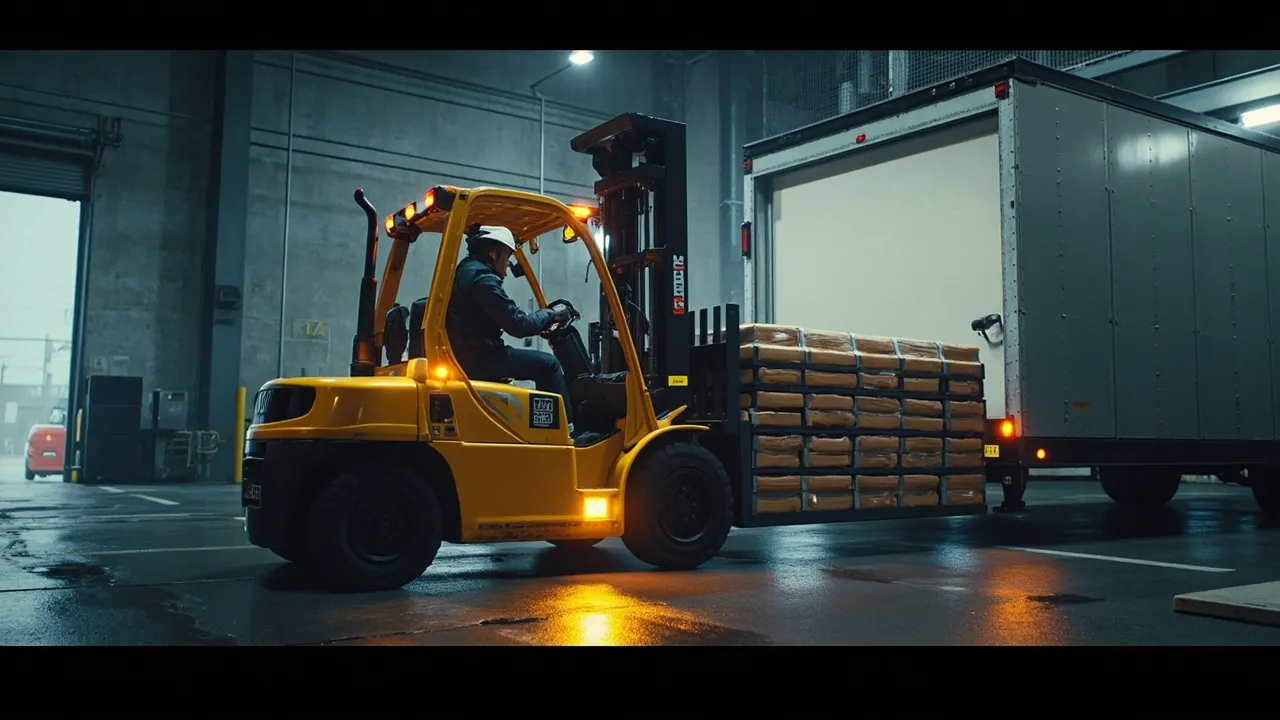
Autonomous forklifts are moving beyond predictable warehouse lanes and into one of the facility's least controlled environments: the trailer. That is an important step. It is also where a clean throughput demonstration can collide with damaged freight, uneven floors, shifting trailers, mixed pallet geometry, and people entering the work zone.
A recent Food Logistics report on Gideon's TREY describes the system as capable of loading and unloading trailers from the first pallet to the last. The claim signals how far perception and navigation have advanced. For buyers, however, the central question is not whether a robot can complete a compliant trailer. It is how the operation performs when the trailer, pallet, dock, or workflow is not compliant.
That is why every business case should include a dock exception budget: the amount of time, labor, and cutoff risk the operation can absorb when autonomy pauses and a person must intervene.
The average move hides the operational risk
A conventional automation pilot often emphasizes pallets per hour, utilization, or distance traveled. Those measures remain useful, but trailer loading is a sequence. One unresolved exception can block every pallet behind it, occupy a door, delay a driver, and threaten the outbound cutoff.
Consider a system that moves 24 pallets per hour in normal conditions. On paper, a 26-pallet trailer takes about 65 minutes. If one damaged pallet causes a six-minute stop, a restraint fault adds eight minutes, and the supervisor needs four minutes to clear and restart the work zone, the cycle becomes 83 minutes. Nominal throughput did not change, yet effective throughput fell from 24 to about 18.8 pallets per hour. The exceptions consumed 18 minutes, or nearly 22% of the completed cycle.
This is not an argument against automation. It is an argument for evaluating the complete operating system rather than the machine's best uninterrupted run.
Build the exception catalog before the pilot
The dock team should record exceptions by category for several weeks before deployment. The list should include at least:
- Damaged pallets, protruding boards, leaning loads, torn wrap, or freight outside its expected dimensions.
- Trailer floor holes, soft spots, debris, moisture, steep dock-leveler angles, and unexpected interior obstructions.
- Mixed pallet heights, weights, footprints, or loading sequences that force a change in fork position or placement logic.
- Missing or failed wheel chocks, vehicle restraints, dock locks, communication lights, or trailer-presence signals.
- Human entry into the autonomous zone, including quality checks, load securement, spill response, and driver activity.
- Lost labels, unreadable identifiers, WMS mismatches, network interruptions, low battery states, or unavailable recovery equipment.
The safety layer matters because the dock is not simply another warehouse aisle. MHI's material-handling guidance notes that manual wheel chocks depend on correct human placement and can be forgotten, lost, or ineffective in bad weather, while automatic devices reduce that reliance. Similarly, Inbound Logistics explains that modern dock communication lights can display restraint status in a forklift operator's direct line of sight. An autonomous vehicle needs the digital equivalent: a verified restraint state incorporated into its permission to enter the trailer.
The broader risk is substantial. Inbound Logistics cites nearly 97,000 serious forklift-related injuries annually in the United States, including about 100 fatalities. Automation may reduce exposure, but only if exception handling prevents an autonomous zone from becoming an ambiguous shared zone.
Measure intervention, not just uptime
An exception budget needs four clocks.
Detection time runs from the first abnormal condition to a safe stop and alert. Response time runs until the assigned responder arrives. Recovery time covers diagnosis, physical correction, validation, and restart. Schedule impact measures the resulting dwell, door occupancy, labor diversion, and proximity to the carrier cutoff.
Track these by exception type, door, shift, trailer type, customer, and load profile. Averages alone are dangerous; the 95th-percentile recovery time shows what happens on a difficult day. Other useful measures include interventions per 100 pallets, autonomous completion rate per trailer, repeat-stop rate after restart, minutes of human entry into the controlled zone, and trailers that miss their planned departure.
For example, a facility may set an initial budget of no more than three interventions per 100 pallets, five median minutes per intervention, 15 minutes at the 95th percentile, and zero unplanned shared-zone entries. These are illustrative thresholds, not universal benchmarks. The facility should derive its limits from door capacity, labor coverage, safety analysis, and customer commitments.
Give every fallback a named owner
“Call someone” is not a recovery plan. Each exception class needs a named role, a safe method, and an escalation timer. Dock associates might replace a damaged pallet. Maintenance might own leveler and restraint faults. Controls engineers might handle perception or integration failures. A shift manager should decide when to abandon autonomous recovery, move the trailer, reassign the door, or switch to a manual forklift.
The handoff must be designed as carefully as autonomous operation. Define who places the robot in a verified safe state, who controls access, how the trailer is revalidated, and who authorizes restart. Provide a manual escape path that does not require personnel to improvise around a disabled machine. Train the people who cover breaks and night shifts, not only the pilot team.
Scale by exception profile, not door count
The first expansion should go to doors and loads that resemble the successful pilot. A stable pool of trailers, uniform pallets, dependable restraints, and consistent ASN data offers a better next step than the facility's most chaotic doors. Add complexity deliberately and compare exception rates after each change.
A credible deployment gate should require sustained performance across normal production weeks, including peak volume and imperfect inbound conditions. If the system meets throughput targets only because technicians stand nearby, that labor belongs in the cost model. If recovery regularly threatens cutoffs, the next investment may be pallet quality, dock equipment, data discipline, or standard work—not another autonomous forklift.
Autonomous trailer loading can remove repetitive travel, reduce human exposure inside trailers, and create more consistent dock flow. The strongest business case is not a frictionless demonstration. It is a measured operation that knows how much friction it can tolerate, who resolves it, and when to fall back safely.
To connect dock exceptions, shipment milestones, carrier cutoffs, and operational performance in one workflow, request a CXTMS demo.